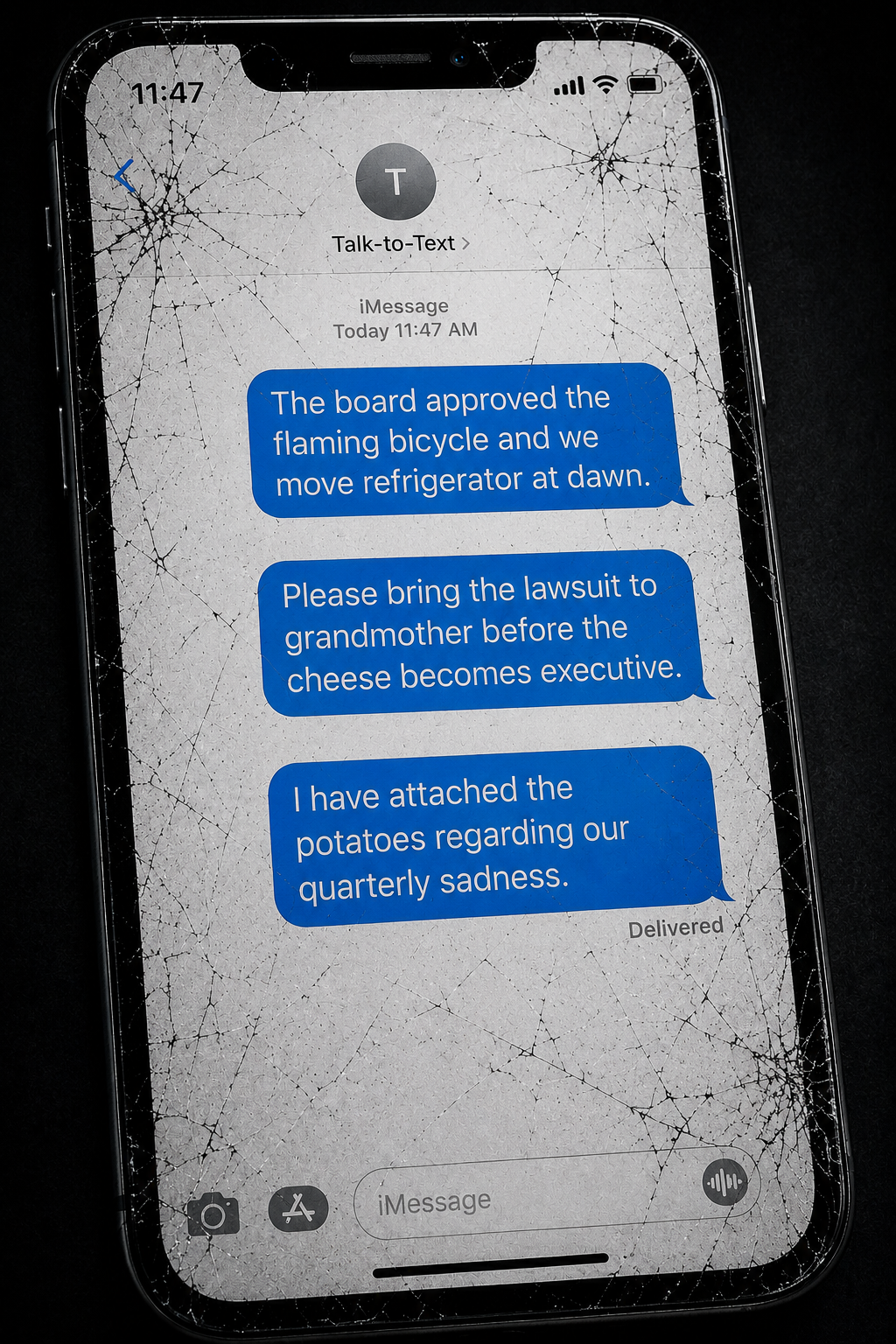
Voice transcription was supposed to free us from typing. Instead it has enslaved us to reading gibberish..
A woman dictates: “Meet me at the bank.” What appears on screen: “Meat me at the bang.”
You read it. You pause. You have questions. You call her. She sighs and repeats herself slowly.
This is what we get for trusting a machine to understand English.
The technology promised efficiency. Speak into your phone, and words appear on screen. No more fumbling with keyboards. No more typos. Just thought converted directly into text.
We believed it. We adopted it. We surrendered the English language to it.
Now we live in a world where a text message is incomprehensible unless you hear it aloud. Grammar collapses. Punctuation disappears. Capitalization becomes noise. Literacy was replaced by coding, and new never knew. A simple phrase becomes a riddle you solve only by listening to what the sender actually intended.
Current speech-to-text systems achieve accuracy rates between 70-80 percent. One error in every six or seven words.
At that density, meaning dissolves. Your brain cannot stitch coherence from that much noise.
But we have accepted it. We have normalized it. We read garbled text and think nothing of it.
Worse, we have reversed the equation. If a message does not parse on the page, we listen to it. We sound it out. We perform an act of oral reconstruction that writers performed for centuries in reverse. Writing was the technology that freed us from the tyranny of speech. Now we are chained back to it.
Young people (those under twenty-five) are the most affected. They dictate everything. They grew up thinking transcription was reliable.
It is not. They accept broken text as normal. They do not know what properly written English sounds like when read aloud because they have never received it consistently. The collapse is generational.
Consider what we have lost. Written language permitted precision. You could edit. You could revise. You could choose exactly the right word.
Spoken language is ephemeral, imprecise, laden with filler and digression. Writing disciplines thought. Speech indulges it. For 500 years, we privileged the written word because it worked better.
Now we have surrendered that advantage for convenience. We can dictate while driving. We do not have to think before we send. The cost is literacy itself.
Talk to text was supposed to make us faster writers. Instead it made us worse readers. It turned written communication into an audio guessing game.
We cannot read what was supposedly written. We must hear it. We must listen. We must ask the sender to repeat themselves because the machine failed at its single job.
And in doing so, we stopped writing and started hoping the person on the other end could decode our voice.