The cross was never wood.
It was wanting.
Believing tomorrow
could argue with now.
It can’t.
So I walk
past the fences,
past the yards
that still know my name,
past the mitten
if I have to.
Until now
is only a word,
and you
are only
who I loved.


America has become obsessed with deciding which box everybody belongs in.
Male or female. Gay or straight. Autistic or neurotypical. Traumatized or fine. Sick or healthy. Left or right. Normal or abnormal.
Then nature walks into the room and fucks up the filing system.
Almost everything interesting about a human being comes in degrees.
We have spent years arguing about gender and sexuality as though the argument were unique to gender and sexuality. It isn’t. The larger lesson may be staring us in the face.
The world runs on spectrums.
Start with the body.
We casually call testosterone the male hormone and estrogen the female hormone. Biology never agreed to those terms. Male bodies produce estrogen. Female bodies produce testosterone. The average concentrations differ considerably, particularly with testosterone, but both hormones participate in the biology of both sexes.
Nature likes variation more than our vocabulary does.
Height exists on a spectrum. Blood pressure exists on a spectrum. Intelligence does. Strength does. Skin pigmentation does. Hormone concentrations do.
Sexual orientation certainly does.
A person can experience attraction exclusively toward one sex. Another can experience attraction predominantly toward one sex with occasional attraction toward another. Between those points are millions of individual configurations that become difficult to describe once we insist that everybody pick one of two words.
Then we discovered something similar about the mind.
Autism provides perhaps the clearest example because we put the word spectrum right in its name.
Researchers have found that autistic traits extend throughout the general population. People without autism diagnoses can possess measurable traits associated with autism: sensory sensitivity, social difficulty, repetitive behavior, cognitive rigidity or unusual patterns of communication.
That does not mean everyone has autism.
That distinction matters.
A spectrum describes the distribution of characteristics. A diagnosis establishes that a particular constellation of those characteristics has crossed criteria significant enough to warrant a clinical name.
We have begun confusing those two ideas.
Spend enough time online and ordinary human characteristics acquire diagnostic labels. Someone who likes an orderly desk has OCD. Someone distracted at work has ADHD. Someone uncomfortable at a party is autistic. Someone who remembers an ugly experience has PTSD.
Sometimes those suspicions lead people toward answers they have needed for years. Medicine has historically missed people, particularly when diagnostic models were built around narrow populations. Self-recognition can be the first step toward professional evaluation.
But recognition and diagnosis remain different things.
Perhaps America needs an undiagnosis phase.
Not one in which people with genuine conditions surrender their diagnoses. Those diagnoses can explain lives, open doors to treatment and give people language for experiences they struggled for years to understand.
The rest of us could surrender our hunger for them.
We could acknowledge something simultaneously more ordinary and more profound:
We are all on spectrums.
You can possess autistic traits without having autism. You can experience anxiety without having an anxiety disorder. You can suffer after something frightening without having PTSD. You can like order without having obsessive-compulsive disorder.
The trait can be real while the diagnosis remains somewhere farther along the continuum.
This is where Evidentialism becomes useful.
Evidentialism has little interest in the boxes we prefer. It asks where the evidence puts us.
Imagine a line numbered from zero to 100.
Human beings desperately want to draw a vertical mark somewhere along it and announce that everything to the left is one thing and everything to the right is another.
Sometimes we must. Medicine needs diagnostic thresholds. Law needs definitions. Athletic competition needs categories. Governments need rules.
Nature gets no such administrative headache.
Nature keeps drawing the line.
That may offer a useful way out of some of America’s nastiest cultural fights.
The transgender debate becomes less mysterious when we recognize that human biology and human psychology contain multiple variables rather than a single cosmic switch. Sexuality becomes less threatening when attraction is understood as something humans experience in different degrees. Neurodiversity becomes easier to comprehend when we recognize that many neurological traits vary across populations.
And disagreement itself could use a spectrum.
We have constructed a country in which every opinion supposedly identifies its owner. Agree with one proposition and you are liberal. Agree with another and you are conservative. Question either tribe and somebody starts checking your papers.
Real people remain stubbornly inconvenient.
They agree 70 percent here and 20 percent there. They change. They contradict themselves. They occupy points for which our political vocabulary has no name.
That’s because categories are human inventions.
Spectrums are measurements.
The distinction is central to Evidentialism. A label tells us what we have decided to call something. Evidence tells us what is actually there.
There are times when a label is essential. There are times when it saves a life.
There are also times when the label becomes more important than the evidence underneath it.
Maybe the next American revolution requires fewer new identities and a better understanding of the creatures carrying them.
Every one of us is an improbable coordinate on thousands of overlapping spectrums: biological, psychological, behavioral and social.
There is no such thing as the normal human. There are only ratios.
Find yours.
Ask the average American if they’re good at math and they’ll tell you they suck at it.
What they really mean is they suck at math class. They mean long division felt like punishment. They mean algebra was abstract and trigonometry made no sense. They mistake the exercise for the concept, the classroom for the mathematics itself.
But it costs us something real: a fundamental misunderstanding of what we actually do every moment of our lives.
We are all mathematicians.
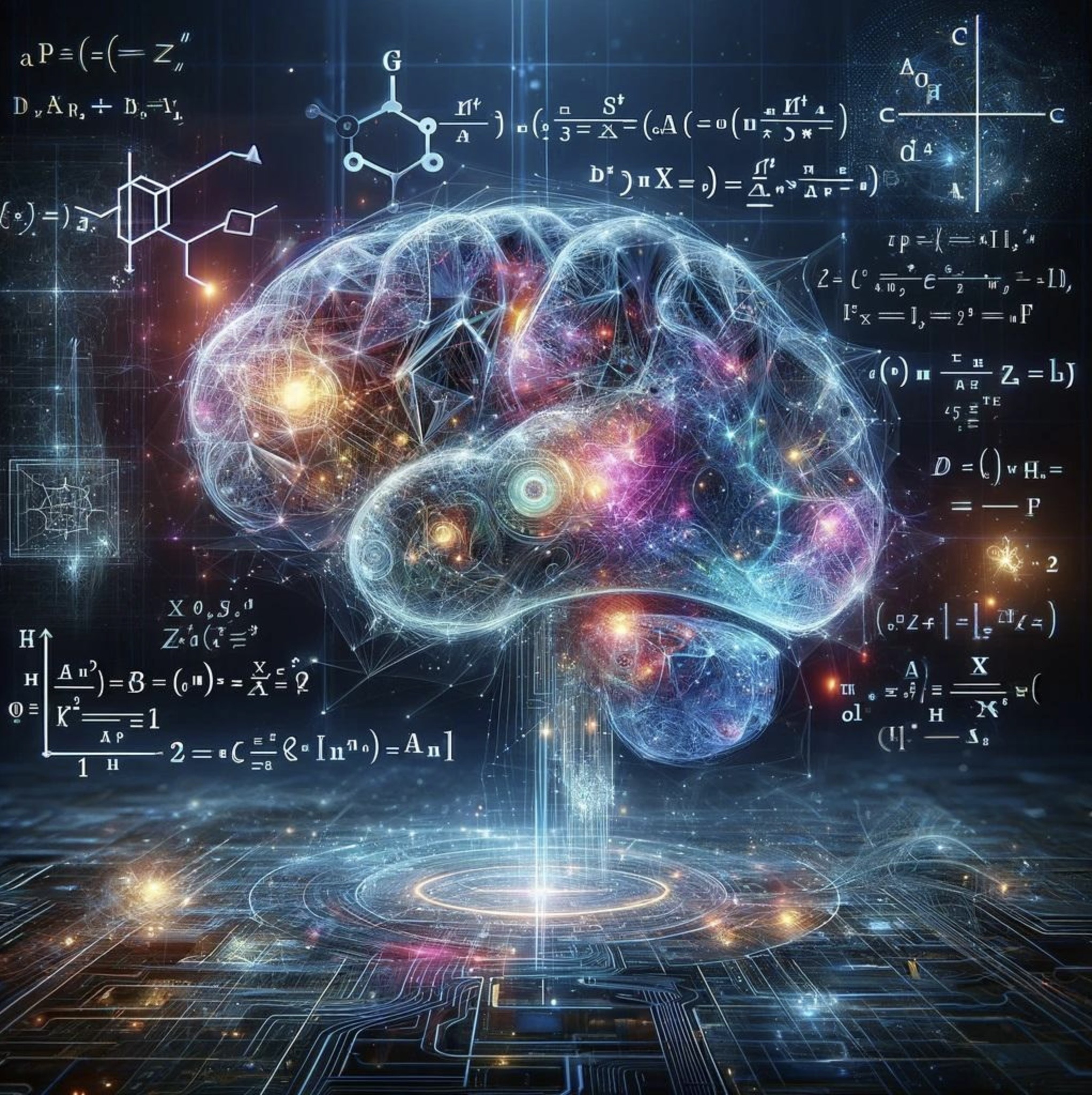
The human brain is a three-pound quantum computer solving equations nonstop. It has been since birth. Every decision, every instinct, every navigation through the world is mathematics in motion. You do not think of it as math because you were never taught to see it that way. But equations do not care what you call them.
Walk down a street and someone approaches with a dog. Your brain does calculus instantly. It measures distance. It calculates trajectory and speed. It factors in the size of the dog and the tautness of the leash and a dozen other variables in parallel. Your brain solves for whether you cross the street or wait. This is mathematics. You do this without thinking because your brain is built to solve for survival. The equation runs whether you acknowledge it or not.
Pick up a menu at a restaurant. You scan the options. Your brain runs a probability calculation against the archive of flavors you have tasted before. It weights your current craving against your established routine. It factors in price against satisfaction and mood. It breaks from the pattern because tonight feels different or sticks to it because tonight calls for comfort. It solves for what will feel right to eat. This is statistics meeting memory meeting desire meeting context. This is you doing mathematics at a table with a napkin in your lap.
Meet someone new and decide whether to trust them. Watch their eyes. Listen to the rhythm of their speech. Weigh their words against patterns you have learned. Your brain is running a complex algorithm, calculating likelihood and risk. This is pattern recognition. This is you solving an equation about human nature on the fly. This is what every person does every single day.
Now zoom out.
The entire history of human knowledge is the story of learning to read the universe’s mathematics. We started by noticing the sun moved across the sky. We developed equations to describe that motion. We were wrong. Then we got better.
We solved for gravity. We decoded the mathematics of light. We cracked the structure of atoms and the double helix. We mapped the mathematics of heredity and disease. Every major discovery in human history is an equation we finally understood.
We learned that consciousness itself is mathematical. We chart dopamine. We measure serotonin and oxytocin and endorphin. We map the electrical firing of neurons. We are learning to read the mathematics of thought. The brain is not mysterious. It is just complicated. It is a system waiting to be solved.
The same is true of the universe itself. At the quantum level, reality obeys mathematical laws that still confound us. Beyond the observable universe lie mysteries we have not yet decoded. But they are not magic. They are equations. And we are solving them at an accelerating rate, advancing at what amounts to Moore’s Law speed.
This is the bargain of being alive. We live in a universe of pure mathematics. Some equations are solved. Most are still waiting. And we are the solvers.
You are not bad at math. You have never been bad at math. You were born solving for the world. Every choice you make, every risk you calculate, every decision you reach is you being exactly what you are: a mathematician running the most sophisticated equations on the planet.
Stop apologizing for it. Accept this truth about yourself. The gray matter in your skull is not deficient. It is magnificent.
It works in mathematics the way a fish works in water. It does not need to understand itself to be doing it. It just needs to keep solving the equation that keeps you alive and conscious and choosing.
You are a mathematician.
Own it.