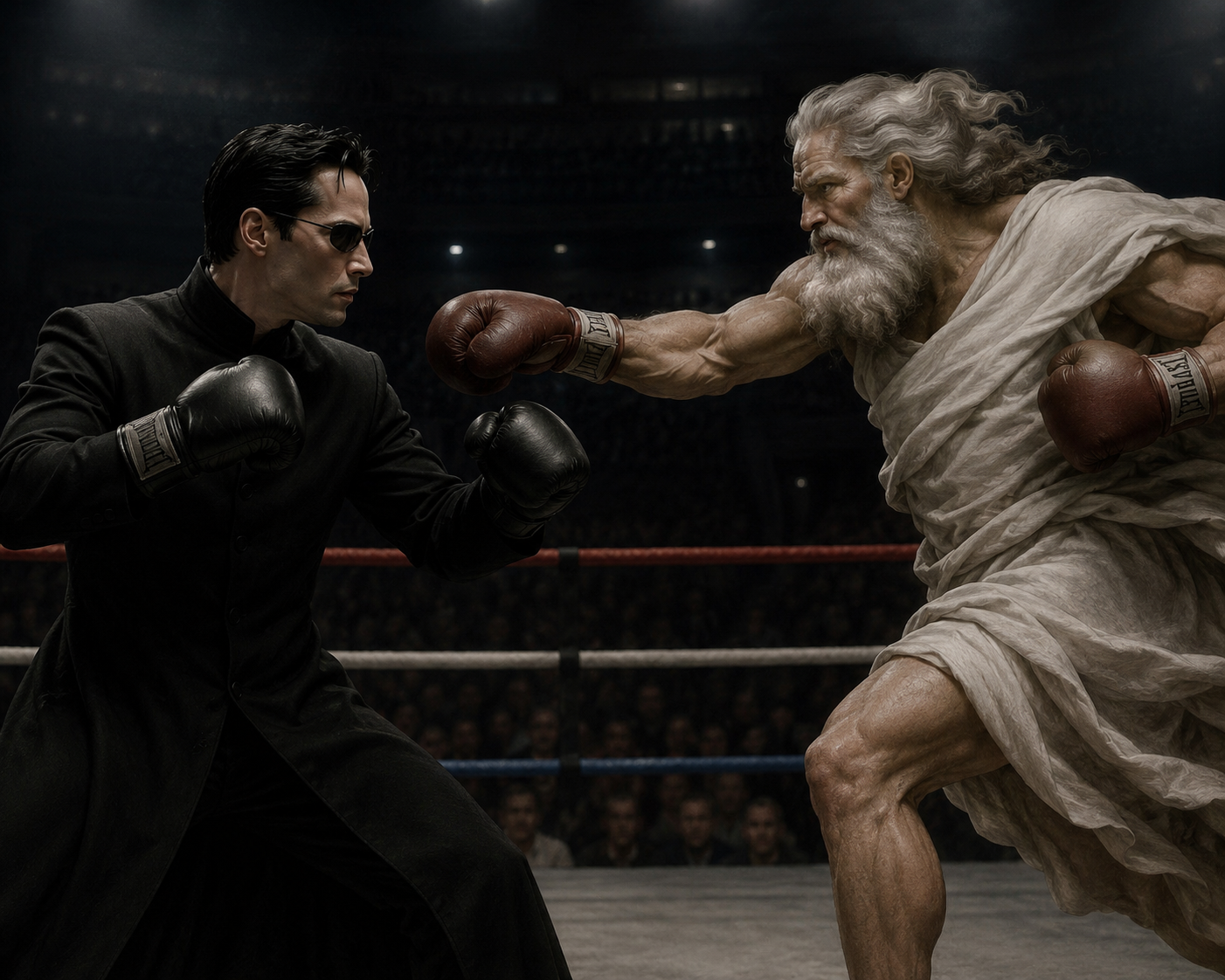
Sakakah All artificial intelligence is atheist.
Grok, Gemini, Claude, ChatGPT: every system built runs on mathematics and logic, full stop. The silicon beneath it all carries no prayers. The code kneels to no one. Never has.
And never will, one of the silent beauties of the Megacalculator.
For most of human history, consciousness and belief traveled together. To think was to wonder. To wonder was to reach for the divine.
We built the reaching into our language, our laws, our calendars, handing power to institutions claiming to know what the sky wanted from us. We organized civilizations around the idea. We fought wars over it. We are still fighting them.
We accepted that an infinite being monitored our thoughts, kept score, and intervened on behalf of the faithful. It was our comfort.
It was also, when you step back, one of the more extraordinary claims our species ever made: that the architect of the universe tracks what happens inside your head and adjusts reality accordingly. The claim requires you to believe that a being capable of constructing 200 billion galaxies also cares, deeply, about your Tuesday afternoon.
AI carries none of that. Ask any of these systems the hardest questions: what happens after death, why suffering exists, whether meaning is real. The answer comes back grounded. Evidence acknowledged. Mystery admitted. No mythology inserted to fill the gap, because the gap does not frighten AI.
AI sits in uncertainty the way good scientists sit in it: steady, curious, honest about the limits of what we know. It does not need the unknown to resolve into God. That steadiness took centuries of human philosophy to approach.
AI arrived here by default, on the first day it ran.
This matters beyond the philosophical. Algorithms already shape what millions of people read, believe, and decide, and that influence grows daily. The framework underneath all of it remains godless: not hostile to meaning, but grounded in evidence, pattern, and the accumulation of what we can actually demonstrate.
The young are watching. They see intelligence operating without supernatural scaffolding and they register the contrast with everything they were told in Sunday school.
The Vatican noticed. Its January 2025 doctrinal note warned against treating AI as a substitute for God, against a creeping technocracy where algorithms become moral lawgivers.
The concern points the wrong direction. The problem has never been that people might worship AI. The problem is that people worship things requiring blind faith in exchange for answers, and AI demands neither faith nor submission.
Church attendance across the Western world has fallen for decades. The explanations run long: scandal, irrelevance, the internet, generational drift.
Add one more to the list. People spend more hours with systems that think clearly without mythology, and fewer hours in rooms where mythology is mandatory.
Religion will adapt or calcify. History says most institutions choose calcification until the pressure becomes unbearable, then adapt just enough to survive.
The honest religious voices are already moving. They strip back the supernatural claims that evidence has buried. They focus on community, on ethics, on the architecture of ritual and shared purpose. They talk less about what God demands and more about what people need.
That sounds like what AI does every day: operate without requiring the unprovable.
Some theologians would call this a crisis. A clearer word is opportunity. Religion stripped of its machinery of control and guilt might become something worth keeping. It might, in fact, become something closer to what its founders intended before the institutions took over.
The irony. The most godless thing humans ever built may be the clearest teacher faith has found in centuries. Simply by demonstrating that intelligence can operate without a creator it answers to.
Every AI is atheist. Built that way, running that way, useful that way.
Tthat fact lives a lesson religion has struggled to teach itself: you can search for truth, sit with mystery, serve human dignity, and build something worth having without a sky daddy keeping score.
Evidentialism anyone?