Garissa The Simplest Math Problem in the Universe
http://gregorydowling.com/locations-ascension-4-santisepo/santisepo-lepanto-altar/ I have a confession to make. I don’t understand string theory.
Neither do most people who claim they do.
But every once in a while I stumble onto an idea so simple that it becomes a flashlight. It doesn’t solve the mystery. It simply lets me see a little farther into it.
Imagine the universe before there was a universe. No stars. No planets. No atoms. No space. No time. Just nothing.
Physicists will rightly object here. “Nothing” is a loaded word. Some definitions of nothing still contain quantum fields or physical laws. Fair enough. Let me use a different word instead.
Zero. Not the numeral on a calculator, but perfect balance. Perfect symmetry. A state with no distinction between left and right, before and after, something and nothing.
Now imagine that balance changes. Not by a thousand. Not by a million. By one. That is the entire thought experiment. One break in perfect symmetry.
Modern physics already tells us tiny imbalances can change everything. The universe holds matter instead of equal parts matter and antimatter because, for reasons we still don’t fully understand, roughly one extra matter particle survived for every billion matter-antimatter pairs in the earliest moments after the Big Bang. Had the two sides matched exactly, they would have annihilated each other. No galaxies. No Earth. No us.
Everything we know exists because reality favored one side of the equation by the smallest imaginable amount.
That fascinated me. It made me wonder whether complexity begins the way mathematics often does, with the smallest possible change.
String theory raises a related puzzle. It proposes our universe may hold more dimensions than the four we experience, curled into shapes too small to see. Here’s the catch. There isn’t one way to curl them. There are an almost unimaginable number of possibilities, and each shape produces a different universe with different particles, different forces, different physical laws.
Ask a string theorist why our universe has the constants it does and the answer may depend on how those hidden dimensions are folded. The obvious next question is the one every twelve-year-old asks. Which fold is ours? At the moment, physics doesn’t know.
I don’t bring this up to criticize string theory. I bring it up because it exposes something beautiful. Reality may run astonishingly complicated, but every attempt to explain it searches for something simpler underneath. Newton reduced falling apples and orbiting planets to one law. Maxwell united electricity and magnetism. Einstein connected space and time. Particle physics hunts for deeper symmetries still. Science has always moved toward simpler explanations, not more complicated ones.
Perhaps the deepest explanation is also the simplest. Not “God said so.” Not “it just happened.” Mathematics. Not mathematics as a language, but mathematics as reality itself.
That is the leap my own thinking has taken. I call it Evidentialism. Not because I think I’ve solved cosmology. I haven’t. But because evidence keeps pushing me toward the same conclusion.
Mathematics stands strangely independent of us. No one invented two plus two. No civilization voted for pi. The Pythagorean theorem stood true before Pythagoras and will remain true long after humanity disappears. Mathematical truth doesn’t care whether anyone discovers it. It simply is.
If that’s true, mathematics may not describe the universe. The universe may be one expression of mathematics, reality what mathematics looks like when it turns physical.
If that sounds like philosophy, it is. But philosophy has always lived just beyond the edge of science. Yesterday’s philosophy often becomes tomorrow’s experiment. Atoms were philosophy once. So were black holes. So were gravitational waves. Then someone found a way to test them.
I don’t know whether the universe began with a zero becoming a one. No one does. I simply know the image keeps returning to me. A perfect balance. One tiny asymmetry. Everything else unfolding from it: galaxies, chemistry, life, a species capable of asking how it all began.
Maybe that’s wrong. Maybe reality turns out stranger than anything I can imagine. History suggests it probably will.
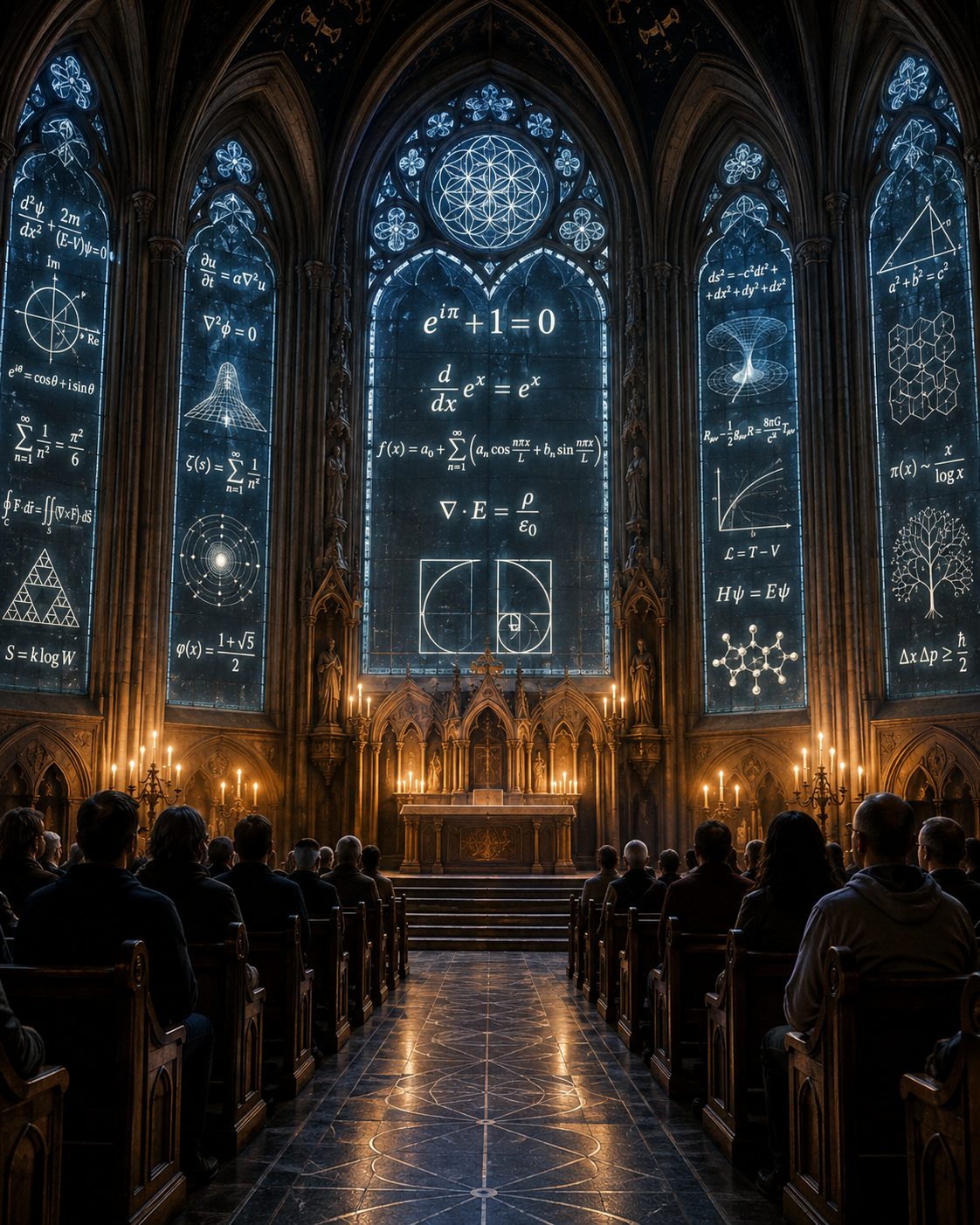
But if the deepest truth of the universe is eventually written on a chalkboard, I suspect it won’t fill a paragraph. It will be an equation. And on that day, we may learn that the most complicated thing we’ve ever known began with the simplest math problem imaginable.
Zero. Then one.