buy generic disulfiram New field research at large-scale desert solar installations in China has found that solar panel arrays are quietly reshaping the microclimate underneath them. Researchers measured cooler surface temperatures, reduced wind speeds, and higher humidity levels beneath the panels compared to surrounding untouched desert land — conditions that are triggering measurable changes in soil moisture, salinity, microbial activity, and nutrient cycling in the ground below.
purchase Ivermectin online The study concludes that these environmental shifts can permanently alter local soil chemistry over time, effectively creating a distinct microenvironment underneath utility-scale solar farms that doesn’t exist naturally in the surrounding desert. Because solar panels block direct sunlight and reduce evaporation, the soil beneath them tends to retain more moisture, which in turn supports different microbial communities than the harsh, dry conditions typical of open desert terrain.
Scientists are now studying whether these long-term changes could eventually support ecosystem restoration in degraded desert landscapes, or whether they introduce new ecological trade-offs as utility-scale solar continues expanding rapidly across arid regions worldwide. As more countries build solar capacity in desert environments to meet climate targets, understanding these soil-level effects is becoming an increasingly important part of evaluating the technology’s full environmental footprint.
Source: Field research findings, desert solar installations, China, 2026
A shrew’s heart flutters six hundred times a minute and quits inside two years.
An elephant’s heart thuds thirty times a minute and keeps going for seventy.
Multiply the two numbers together and something strange happens. The totals converge. Mouse, dog, whale, elephant: each one spends its life on roughly the same balance, close to one billion heartbeats.
Biologist Max Rubner spotted the pattern in 1908, watching how mammals burn energy in proportion to their mass. Researchers since have confirmed the number across two hundred species and counting. Faster hearts buy shorter lives. Slower hearts buy longer ones. The currency stays fixed.
This is the kind of order I trust. Evidentialism holds that mathematics functions as scripture, a text written into the structure of things rather than invented by us.
The billion-heartbeat rule reads like a verse from that scripture. Metabolic rate scales to body mass raised to the three-quarter power. Heart rate scales to the negative quarter power. Lifespan scales to the positive quarter power. Multiply heart rate by lifespan and the mass term cancels out. The math resolves into a single fixed number, regardless of species. That resolution carries more authority than any sermon.
Then comes the exception. Humans average close to three billion heartbeats, nearly triple the mammalian budget. Run the numbers: seventy beats a minute, sixty minutes an hour, twenty-four hours a day, three hundred sixty-five days a year, eighty years of life.
The number is close to 2.95 billion. We spend three lifetimes on one heart.
The gap has an explanation, and it flatters us less than we’d like. Wild mammals rarely reach old age. Predators, starvation, and disease end most lives long before the heart wears out. Humans built shelter, medicine, and food systems sturdy enough to let the heart run its full course and then some. We didn’t rewrite the equation. We removed the obstacles standing between us and it.
That distinction matters to an evidentialist. The rule remains intact. Culture bought us extra beats, but the scaling law that predicts them held steady the entire time, tracking body size, metabolic rate, and mortality risk with the same fidelity it shows in a shrew or a blue whale. Medicine is a workaround, not a repeal.
Consider what the number means for a life measured in decades rather than minutes. A resting heart rate near sixty, kept there through exercise, stretches the ledger further. A racing heart, kept there through stress or bad health, spends it faster. The old advice about calm and movement turns out to rest on hard arithmetic, not folk wisdom.
Gould called the discovery a way of asking how we ought to measure a life. The clock on the wall lies to us. It measures a fixed unit of time and pretends that unit means the same thing to a gerbil and a person. A heartbeat clock tells a truer story. Every mammal gets handed the same manuscript. Most species read it fast and finish young. We’ve learned to read slowly, page by page, and the book keeps going.
The equation was never broken. We just found a way to borrow more pages.
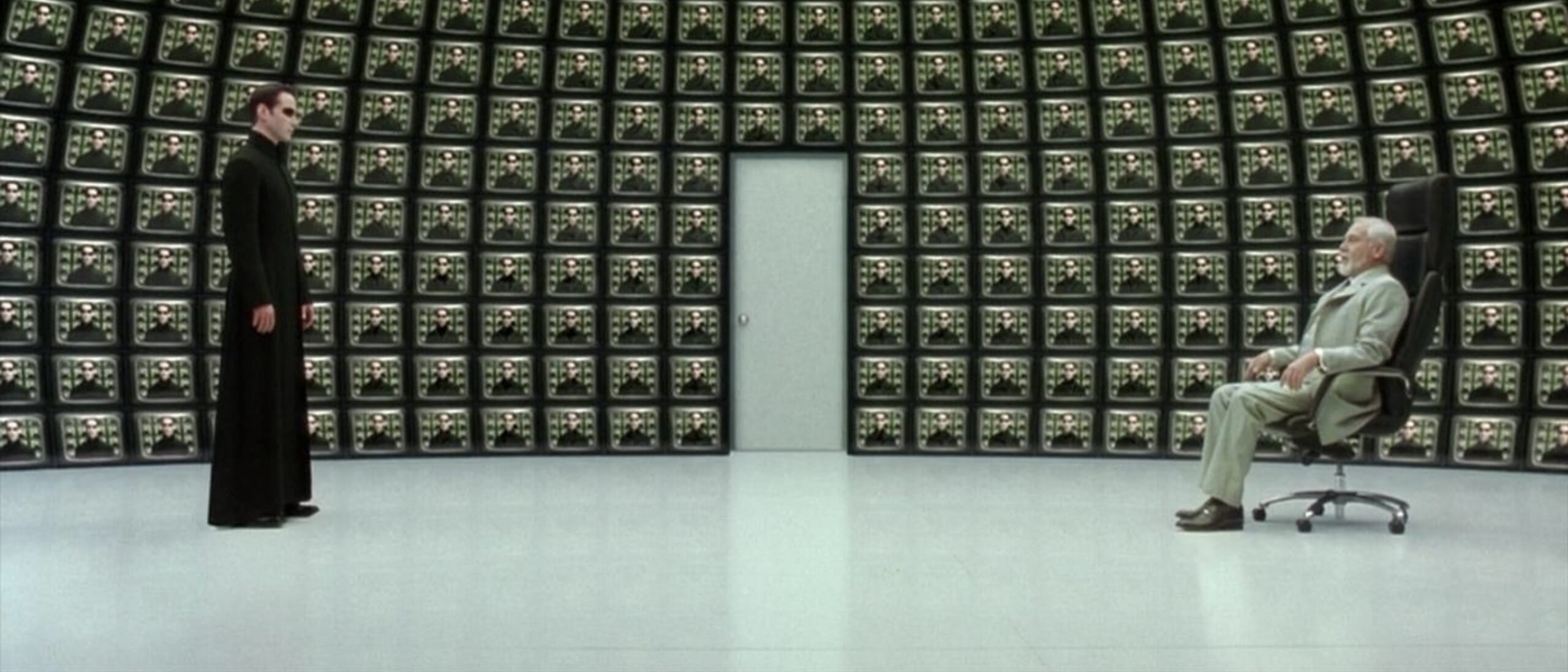
I was watching The Matrix Reloaded recently when I noticed the movie’s most interesting conceit had nothing to do with kung fu, bullet time or killer robots.
It was mathematics.
In one of the film’s defining scenes, Neo meets the Architect, the creator of the Matrix. The Architect explains that Neo is not unique. He is merely the latest version of an inevitable anomaly. The Matrix, despite all its computational perfection, cannot eliminate a tiny remainder. It can predict it. It can contain it. It can even build an elaborate cycle around it. But it cannot make it disappear.
The movie treats this as an unavoidable consequence of mathematics.
Strictly speaking, it isn’t. But it points toward one of the deepest ideas mathematics has ever produced.
In 1931, Austrian logician Kurt Gödel published what are now known as the incompleteness theorems. They permanently changed the way mathematicians think about certainty.
The theorems are famously difficult, but the central idea is surprisingly accessible.
Gödel proved that any mathematical system powerful enough to describe ordinary arithmetic will inevitably contain truths that cannot be proven from within that system. He then went one step further. Such a system cannot even prove its own consistency using only its own rules.
Read that sentence again.
Mathematics, humanity’s gold standard for certainty, proved that there are limits to what mathematics can certify about itself.
That does not mean mathematics is flawed.
Quite the opposite. It means mathematics possesses something many belief systems lack.
Humility.
It acknowledges where its own boundaries lie.
The Matrix borrows this intuition. The Architect believes he has built a perfect machine. Yet every version of the Matrix generates a remainder. Neo is that remainder. Not because the equations are sloppy, but because the system can never become perfectly closed.
Whether that makes for good mathematics is debatable. Whether it makes for good philosophy is another matter.
Because once you leave mathematics, you begin noticing closed systems everywhere.
Religions often prove themselves by referring back to themselves. The sacred text is true because the sacred text says it is true. The prophet is genuine because the prophet says so. The institution derives authority from the institution.
Round and round it goes.
The same thing happens in politics. The party is right because the party says it is right. The ideology becomes its own evidence. Loyalty replaces verification.
Human beings seem naturally drawn toward systems that answer every question before it is asked.
The problem is that reality rarely cooperates. Reality keeps producing remainders. That is where Evidentialism parts company with faith.
Evidentialism is not another closed system asking you to trust its conclusions. It asks you to distrust conclusions that cannot survive independent examination.
If a claim is true, it should leave fingerprints outside itself. If a miracle occurred, there should be evidence. If a historical event happened, there should be corroboration. If a scientific theory is correct, it should predict observations that anyone can test.
Truth should not depend on already believing it.
That, to me, is the quiet brilliance of Gödel’s work.
He did not destroy certainty. He destroyed the illusion of self-contained certainty. He reminded us that no sufficiently rich system can completely explain itself from the inside.
Sometimes you have to step outside the system to see the system.
That lesson extends well beyond mathematics. It reaches into science, journalism, philosophy and religion. Every one of them is healthiest when it welcomes questions from outside rather than suppressing them from within.
The Architect believed perfection meant eliminating every anomaly.
Gödel suggested that the anomaly is not always the problem.
Sometimes it is the clue. Sometimes the remainder is the part pointing toward a larger truth that the system itself cannot see.
That may be the most honest lesson mathematics has ever taught us. Not that every question has an answer.