Category Archives: Reviews

Call ‘The Pharmacist’ for Refills

Image result for netflix the pharmacist

http://childpsychiatryassociates.com/treatment-team/kathryn-cobb-stoner/kathy_stoner-600/ Spend enough time as a reporter, and you’ll quickly learn: There comes a moment in any interview when you tell yourself, ‘This is the quote. This is the interview. This is the story.’

The same must happen with non-fiction movies.

Sometimes when you watch a documentary – particularly one of the new wave of true crime serial documentaries – you can’t help but imagine the moment when the producers first met their key interviewee and, within a couple of minutes, realized they were looking at factual-film-making gold.

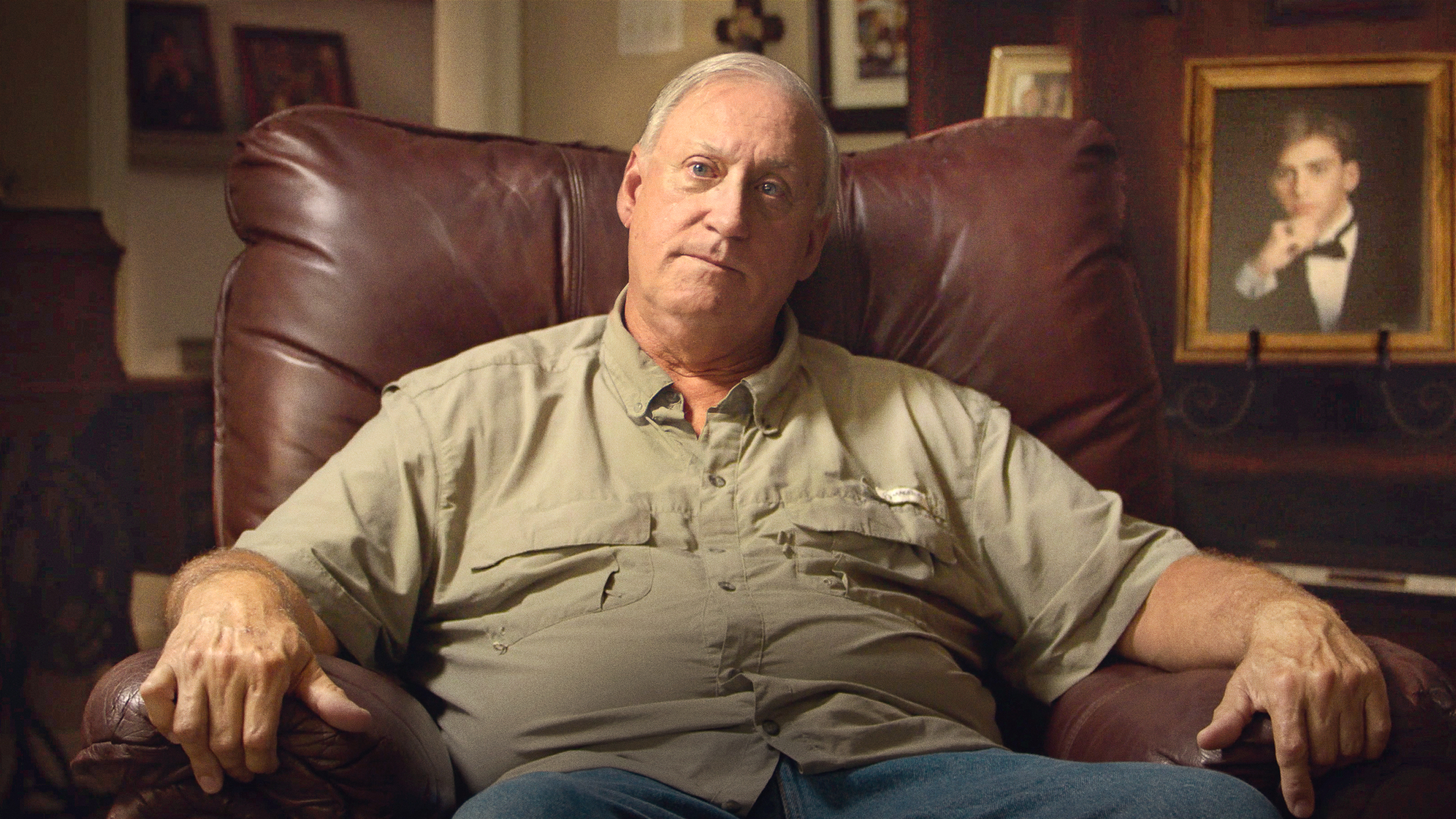
Dan Schneider, the hero – and here, that’s not hyperbole – of Netflix’s rollicking new four-parter, The Pharmacist, is such an interviewee. An open-hearted, grey-haired bear of a man who is articulate and eager to tell his shattering tale, often through thick tears and repeatedly invoking God as a helper and witness, Schneider has an attribute even the best sources don’t usually offer: he has recorded, on film or audio cassette, everything he has been through, meaning The Pharmacist has a vivid immediacy most documentaries can’t achieve.

Appalled at the lack of police interest in the case and with acute grief occluding his instinct for self-preservation, Schneider launched his own investigation, hunting for and interviewing suspects and witnesses while ignoring strong advice not to proceed. In the hope of one day presenting his evidence at trial, Schneider taped all his phone calls and even spoke his private thoughts into his recorder, as if narrating his own story.

That story, of who killed Schneider’s son and how he found them, is a breathless thriller with a sensational twist in the middle. But, in episode two, The Pharmacist reveals that Danny’s murder is merely a horribly tragic prelude.Image result for netflix the pharmacist

Indeed, Schneider’s investigations did not end with the killing. He used his day job to look into an even bigger problem than crack: opioids. Oxycontin prescriptions are coming through his pharmacy’s door far too often, clutched by patients too young and not in enough pain to warrant taking the drug. When he recognizes a young user in a news report on her premature death, Schneider takes his audio equipment and his unstoppable curiosity and picks up the case: thanks to one rogue doctor, there are young people on their way to dying early just like Schneider’s son did. But unlike Danny, some of them can be saved.

What follows is a rapidly expanding narrative of medical, corporate and law-enforcement corruption, doggedly chipped away at by a lone individual who simply won’t shut up and be quiet. The you’re-kidding-me revelations that power any good true crime doc come regularly – the moment when a simple piece of investigative work by Schneider makes the DEA, FBI and local sheriff’s office all look stupid is a corker – as The Pharmacist scores interviews with all relevant parties, holding some of them back for maximum storytelling impact.Image result for netflix the pharmacist
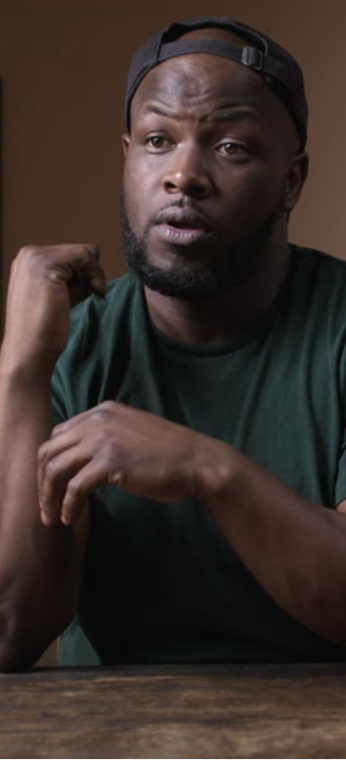
The show is blessed with several compelling talking heads apart from Schneider himself, not least a reformed big-pharma drugs rep who announces yet another abrupt shift in the plot by dramatically barking, more than halfway through the series: “That wasn’t the end! That was … the beginning!”

In the last two episodes, we arrive at the real point of The Pharmacist, as it pulls back to look at the history of a national opioid crisis that has claimed hundreds of thousands of American lives since Schneider correctly outlined its mechanics at a local level. It is a story of inhuman capitalist greed on a huge scale, described here as being on a par with the lies told about tobacco in a previous century. The final twist is that when the scandal goes national, the humble Louisiana pharmacist keeps up with it, scaling up the same fussy, stubborn common sense to help stem the tide.

The Pharmacist raises an impeccably important global issue, but its power as television all comes from one individual. Schneider, always dogged by sadness (the program never forgets young Danny’s loss) but resolute in his faith and his desire to right wrongs, also has the self-awareness necessary to be a truly great documentary protagonist:

“I was driven,” he says in one of many wry examinations of his own motives. “Other people would say ‘obsessed’.”

Quentin Tarantino’s Long Oscar Con

Image result for once upon a time in hollywood"

Warning: Spoilers loose here!

First, full disclosure: I love Once Upon a Time…in Hollywood. I think it’s one of the best movies of the year, one of Tarantino’s finest in a career of fine films, and as fitting an homage to Los Angeles’ Golden Age of film as any ever rendered. And it’s getting too much praise.

Hollywood has been nominated for 10 Oscars, and has already collected 102 trophies over more than a dozen award ceremonies, including the Golden Globes and the BAFTAs.

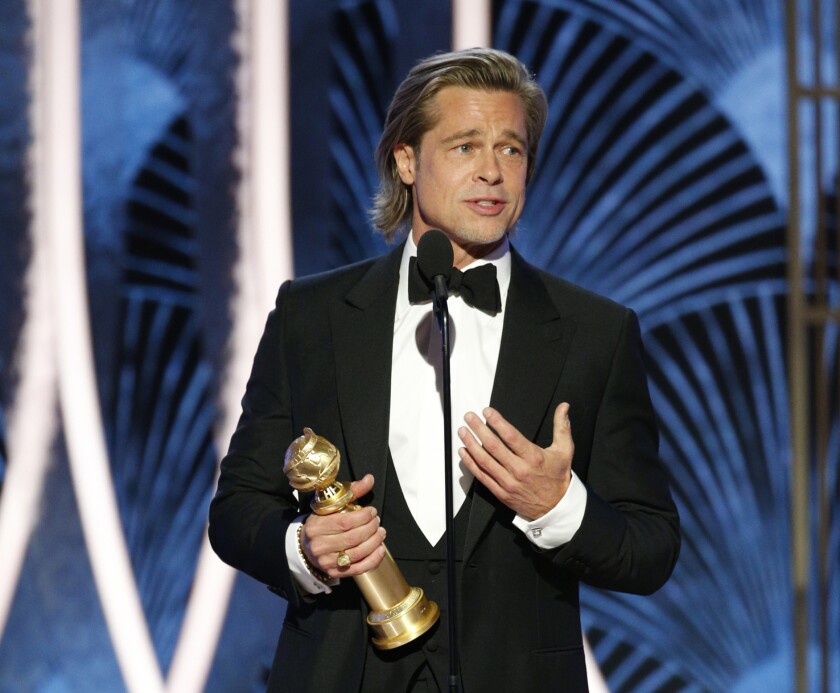
Those plaudits for the films aren’t the problem. The problem is the praise heaped on supporting star Brad Pitt. He, like the film, has been showered in praise and gold plating, nabbing a Best Supporting Oscar nomination and taking home supporting acting statuettes from said Globes/BAFTAs. Should Pitt win the Oscar, his first order of business should be to thank Tarantino for pulling off the greatest heist since Ocean’s Eleven. In fact, classic films were part of the heist.Image result for pitt golden globe"

You see, Tarantino is this year’s Oscar’s darling for his love letter to 1960’s Hollywood, when the industry’s  ability to sell a concocted happiness was at its peak. Families were nuclear and daddies knew best. Kids didn’t swear, adults didn’t screw, and cowboys didn’t miss or bleed (unless they were bad). Killers met with unfettered justice — often dealt out by likes of Rick Dalton, Tarantino’s leading man in Hollywood.

Dalton is one of those Bonanza cowboys, at least on the outside. Steady. Steely. Sure-handed. Inside, though, he’s a wreck. He drinks too much, swears up a storm, has a nervous stutter, and is having trouble coming to terms with age and relevance.

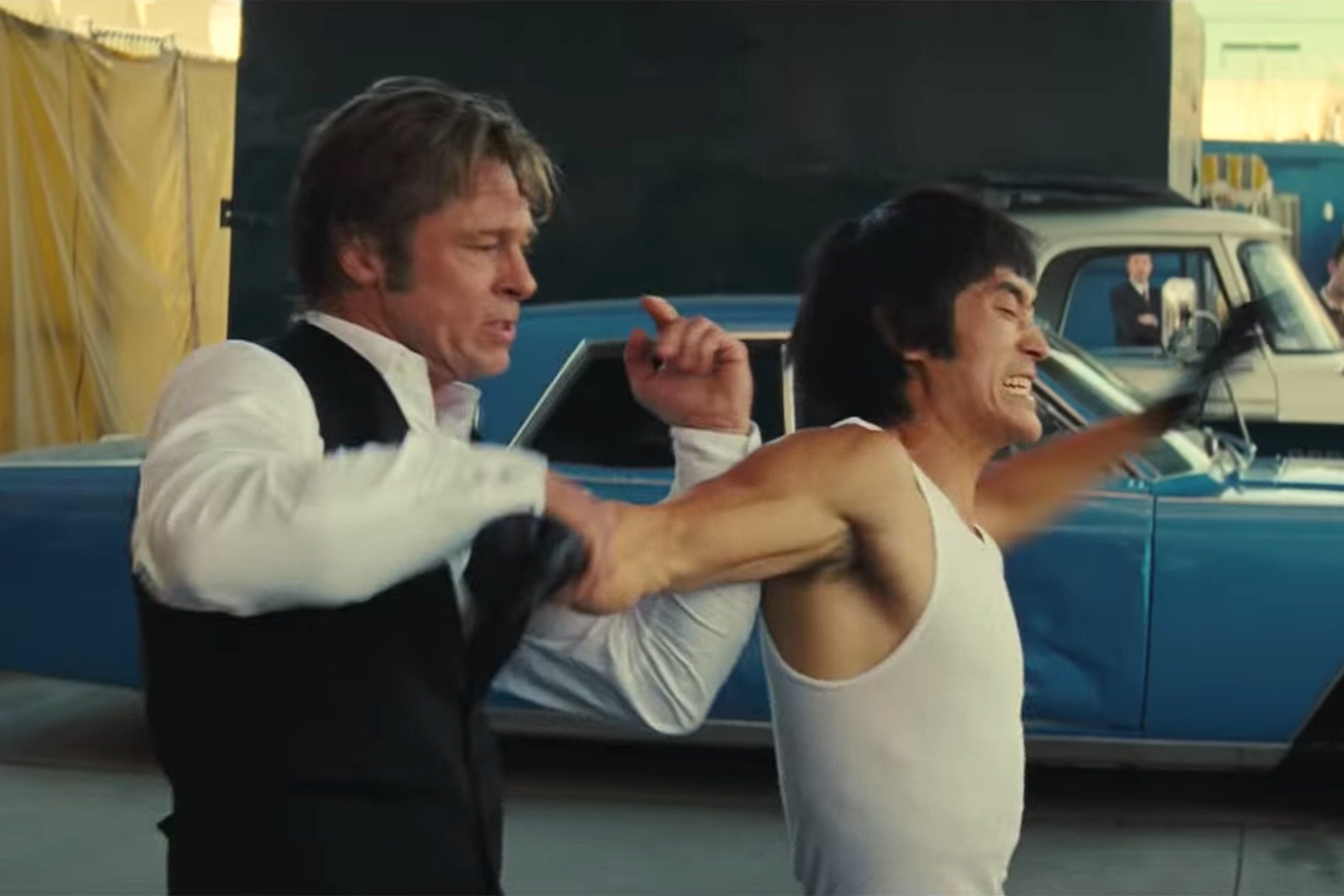
Now consider Cliff Booth, Pitt’s likable, buff stunt double to DiCaprio’s Dalton in Hollywood. Cliff is an understated Missouri boy who, in the span of three hours, saves his buddy’s career, kicks Bruce Lee’s ass in a street fight and single-handedly prevents the Manson family murders. He is as stalwart a Hollywood hero as any produced 50 years ago. And like all good 60’s movie cowboys, his acting sucks.Image result for bruce lee cliff booth"

Like, really sucks. I challenge anyone who has seen the film: Name one scene in which Pitt is called upon to act. One scene in which he sheds a tear. Or loses his temper. Or becomes nervous, uncomfortable or caught unawares. He is Shane, mysterious, unflappable and Ivory pure.

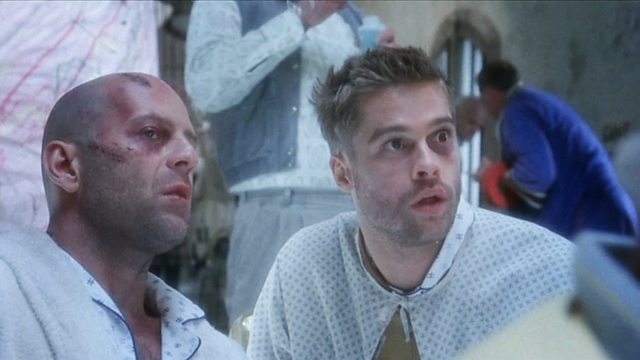
This isn’t Pitt’s fault. He’s a solid actor (See Twelve Monkeys, Moneyball, The Curious Case of Benjamin Button). It’s just he’s playing John Wayne without the temper, and is never asked to express anything approximating range. Tarantino must know: DiCaprio acted circles around Pitt, gaining weight, shedding tears, allowing insecurities to surface. But while Pitt won honors, DiCaprio had to settle for honorable mentions among the Globes and BAFTAs.Image result for twelve monkeys"

Not that anyone need shed a tear over Hollywood‘s fortunes. But if Pitt manages to pull off a win, and beat co-nominees Al Pacino, Anthony Hopkins, Joe Pesci and Tom Hanks, he should silently signal to Tarantino Sting-style, with a nod of the head and forefinger gently brushing his nose. Image result for the sting rub nose"

Because that’s a helluva take.

Putting out Fire with Gasoline

Image result for don't fuck with cast"


Netflix is a data-driven dance floor, an algorithmic treehouse . The company  monitors the viewing habits of its 158 million subscribers so closely that it not only knows what you watch, but when you watch it, how much of it you watch, the trends that are most likely to hook you —  even the thumbnail images most likely to convince you to watch a new series. Its breadth is both impressing and daunting.

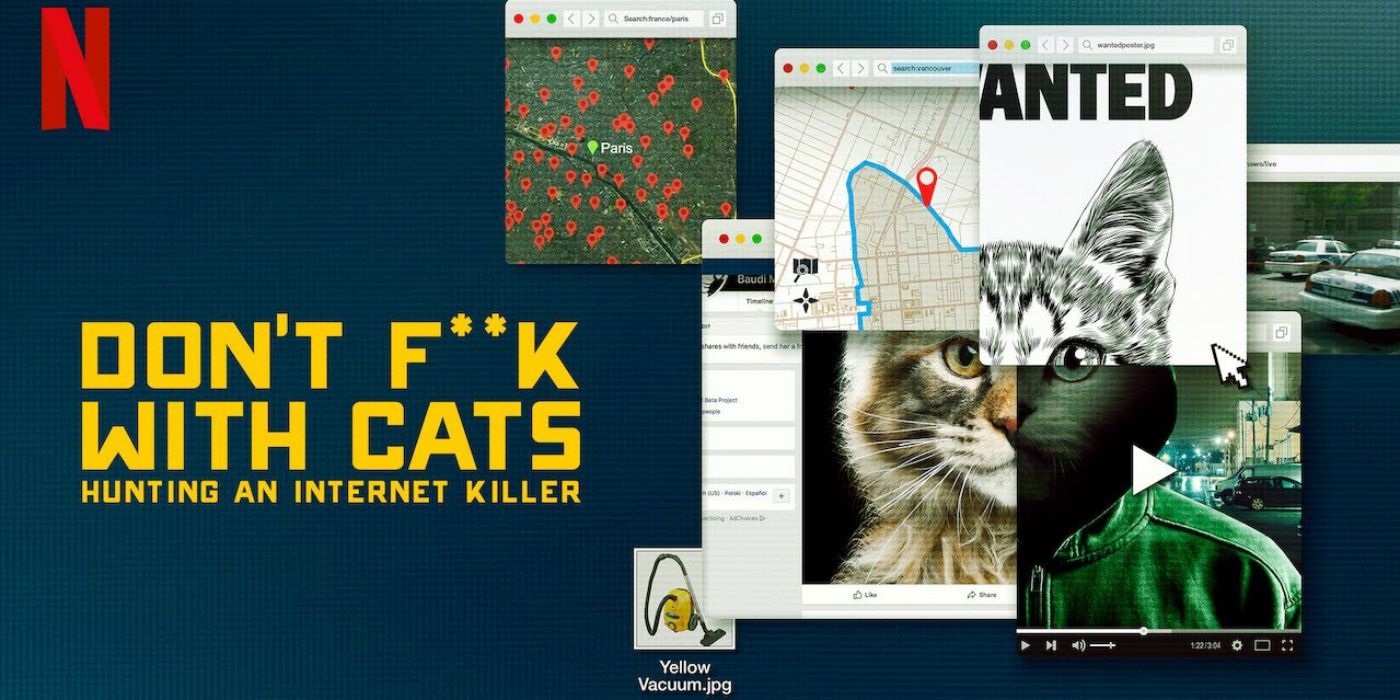
Don’t F**k With Cats is a case in point: Netflix has analyzed the data and deduced that what the world needs more than anything  is a true crime documentary series about obsessive internet users and cats.

What a genius move. What a home run. What a no-fail combination of everything that everyone likes, bundled up together in perhaps the most high-profile film about cats ever made (besides Lion King).Image result for the lion king"

The story of Don’t F**k With Cats doesn’t really matter; you’d watch it even if you thought – as I initially did – that it was going to simply be an America’s Funniest Home Videos compilation of cats clawing people to shreds during attempted baths.

However, the masterstroke here is that the narrative is simply unbelievable. And – this should be said upfront – it’s incredibly upsetting. This aspect can’t really be overstated. There are moments that are viscerally harrowing. The story begins with a video uploaded to YouTube that graphically depicts the torture and murder of two small kittens. You don’t see the video – or any subsequent similar videos – in the documentary, but there are plenty of Grizzly Man-style reactions nevertheless. One is by a senior police officer who ends up reduced to tears. It is a violently distressing display of human depravity. If you’re even slightly queasy about this sort of thing, I’d seriously recommend giving it a pass.

Nevertheless, the story is incredible. An anonymous user uploads the kitten video, and it appalls a group of Facebook users so strongly that they use every tool at their disposal to track him down. They parse the video frame by frame for something – anything – that will give them a clue to the killer’s whereabouts. Plug sockets and cigarette packets are scrutinized. A specific blanket is tracked down through eBay. The expertise of an incredibly niche online vacuum cleaner forum is consulted. Metadata is cross-referenced with Google Maps. This is the hive mind at its most clever.

One key member – a woman named Deanna Thompson – is the de facto narrator of the series. As you’d expect from someone as Very Online as her, she’s incisive and witty, and quick to pull the threads together in a dynamic way.Image result for don't fuck with cats"

But that’s arguably the biggest problem with the series. This is a show with a jokey title and a self-aware narrator that splashes around in some of the worst human behavior imaginable. As soon as the horror of the cat videos subsides, we’re off on a wild goose chase of reverse image searches, Google Street View sweeps and fake identity databases. And then we learn who the murderer is, and that his murders are about to escalate beyond cats. We meet the family of his victim, and the lurching duality of the series threatens to become almost untenable.

Still, it is beautifully presented and the final episode includes a flourish of bow-tying not seen since the climax of The Usual Suspects. But it still makes me deeply uneasy that a man who committed an awful crime purely to gain notoriety has now been dragged out of obscurity to be celebrated in a buzzy Netflix show. At least Don’t F**K With Cats’ filmmakers are aware of this. Hives are just too riveting — even malformed one — to look away.

https://www.youtube.com/watch?v=VpdHMaccjw4