Category Archives: Reviews

A Midsommar’s Nightmare Dream

(AP)

Ari Aster must have grown up with some freaky treehouses.

We got a glimpse of one in last year’s Hereditary, one of the most subtly frightening films of 2019. In that treehouse A-frame, demons were worshipped, humans sacrificed, and a lot of fire hazards went ignored.

Aster returns us to rustic living in Midsommar, a movie that help establishes him as one of the most nuanced horror directors working today. Again, Aster places human actors in what appears to be oversized dollhouses, underscoring a favorite theme of his: We are ushered through nightmares by forces greater than us.

Indeed, Midsommar is a waking nightmare. And I mean that in the best possible way.

For over two hours you will be transported to a beautiful village in the middle of nowhere in a foreign land where the sun never seems to set and everyone is wearing ornate flower crowns and enchantingly embroidered frocks. The details of why you’re there will seem fuzzy and dubious. Someone’s thesis, maybe? But you go along with it even when things start getting weird.

You will eat strange food and drink strange drinks. You will take drugs you don’t want and be subjected to ceremonies and rituals and a language you don’t understand. You will witness some of the most disturbing things you’ve ever seen. You will not be too concerned when people start disappearing. You will lose the ability to rely on your one anchor to the real world. And even though you will barely comprehend what’s going on around you, you won’t be able to leave or look away.Image result for midsommar

Writer and director Aster is to thank, or blame, for this extraordinary experience that’s equal parts befuddling and enthralling. It’s only Aster’s second feature film following the terrifying family drama “Hereditary” and it’s clear that the talent and deranged verve he teased there was no fluke.

But enter with caution: Midsommar is not as straightforward a horror as Hereditary was. It’s hazier and harder to grasp, despite taking place almost entirely in blunt daylight. This is an experiment in escalating uneasiness absent any release or catharsis.

As in Hereditary, a family tragedy sets an ominous tone, but this time it hits you right at the beginning before you’ve gotten to know anyone. We meet Dani (Florence Pugh) while she is frantically trying to contact her family to make sure her sister is OK, but no one is responding. It’s the worst possible outcome.

Unfortunately for her the only person she has for comfort is a boyfriend, Christian (Jack Reynor), who has already broken up with her in his mind but hasn’t gotten around to communicating that to her just yet. Too bad for Christian and his unsympathetic friends (Will Poulter, William Jackson Harper, Vilhelm Blomgren) Dani’s family crisis makes the otherwise imminent split all but impossible. So, Dani, a haunted shell of a human, becomes a permanent fixture at Christian’s side, even going so far as to accompany the four guys on their bro trip to the Swedish commune where one of them was raised for a midsummer festival that happens every 90 years.Image result for midsommar

Aster literally turns the camera upside down as the five travel to this blindingly bright area. It helps you arrive a little queasy and disoriented (although not quite as much as the characters, who’ve just ingested some psychedelic mushrooms).

Still, the drug-induced visions are nothing compared to what they will experience as clear-minded tourists in this village, which at first seems like a quirky novelty. But as with so many chic cults, there is unfathomably grotesque violence and brutality lurking underneath the Instagram-worthy aesthetics. Aster lures you in with relative normalcy, including often very funny dialogue and situational absurdity as the Americans try to fit in in this world. But before you know it, it’s too late to turn back and you’re stuck patiently watching this floral paradise curdle into a pagan inferno.

Midsommar is audacious filmmaking and totally transfixing despite its lengthy run time. It’s heartening to know that big, original cinematic swings like this have not gone extinct.

And yet, as with Jordan Peele’s highly anticipated sophomore feature Us, Midsommar might not actually add up to anything especially satisfying, or completely coherent, in the end. Aster also curiously reuses some of the striking images he used so effectively in Hereditary, such as pagan iconography and starkly naked and de-sexualized bodies. And somehow these characters never evoke empathy on par with the Hereditary ensemble.Image result for jordan peele us

But the journey is fascinating enough that it’s still worth the trip. Aster’s films, like David Lynch’s, are about entering menacing dreamscapes, where the only reality is dread. You don’t watch Aster’s movies. You submerge in them. And by the point of Midsoomar‘s mid-immersion, you’ll  just be grateful that you’re finally allowed to wake up.
“Every day, once a day, give yourself a present. Don’t plan it. Don’t wait for it. Just let it happen.”

Image result for what did jack do?

Leave it to David Lynch to give the gifts on his birthday.

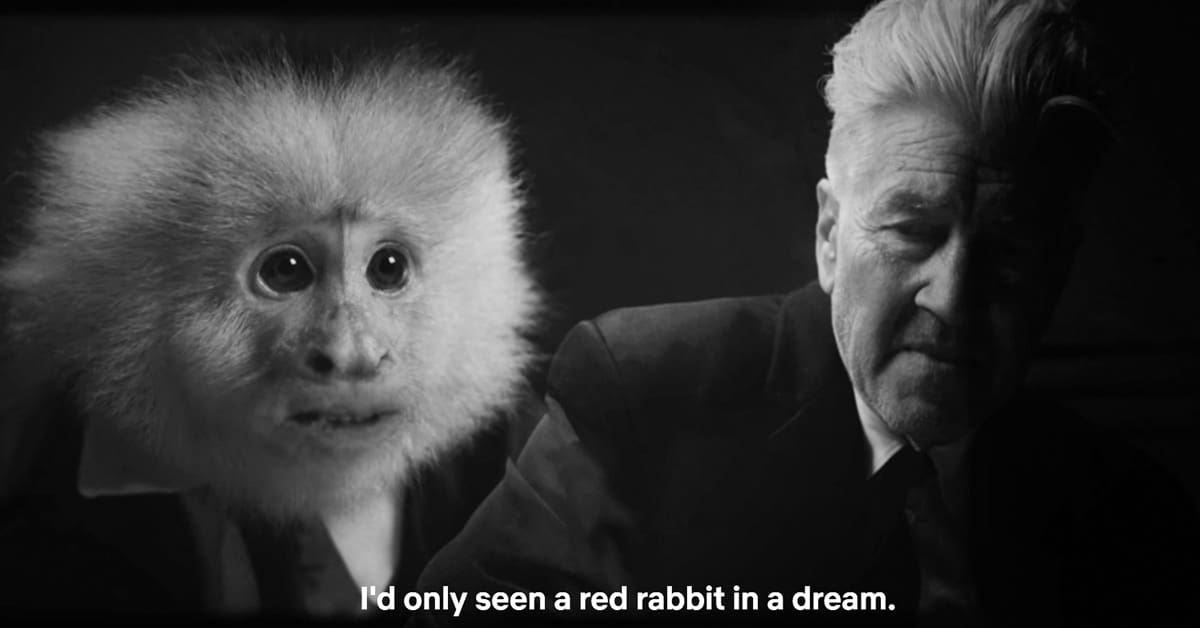
The gift, on his 74th birthday today, is a peculiar and hilarious 17-minute short film titled What Did Jack Do?, which debuted on Netflix with a very enticing one-sentence synopsis: “In a locked down train station, a homicide detective conducts an interview with a tormented monkey.”Image result for eraserhead

Shot in grainy black-and-white, reminiscent of classic movies of yesteryear, and Lynch’s own 1977 feature film debut, Eraserhead, the short film features Lynch playing a detective, interrogating the “Jack” in the title about a murder investigation, in the typical darkened, windowless interrogation room. The twist? Jack is a suited small monkey that actually speaks.

As you’d expect from Lynch, it’s  bizarre and unsettling, but also very funny, whether intentional or not.

It’s an oddity of a film that Netflix categorizes as a crime drama, but it really can’t be adequately put into words, and is best experienced in non-synopsis form. On Martin Luther King Jr. Day, it will easily be one of the strangest things that viewers at home for the holiday can watch.

The monkey’s voice is credited as “Jack Cruz,” but it’s unclear exactly who is really behind it. There’s also a waitress who appears for a few seconds, played by Emily Stofle.

What Did Jack Do? demands multiple viewings, whether to make sense of it, or just to marvel in its surrealism. (The story may or may not also involve a chicken named Toototabon. Classic Lynch.)

In 2019, Lynch received an Academy Honorary Award, which represented his very first Oscar win, despite a storied resume.Image result for twin peaks sayings

His last major project was the Twin Peaks revival series, which was released in 2017 to much critical acclaim. There has been much speculation as to whether there we’ll see another season. Although Lynch has not denied the possibility, he has said if it were to happen, it would not air before 2021.

In the meantime, for Lynch-starved viewers, What Did Jack Do? will have to do. And does.

The Hail Mary Quarterback Sneak

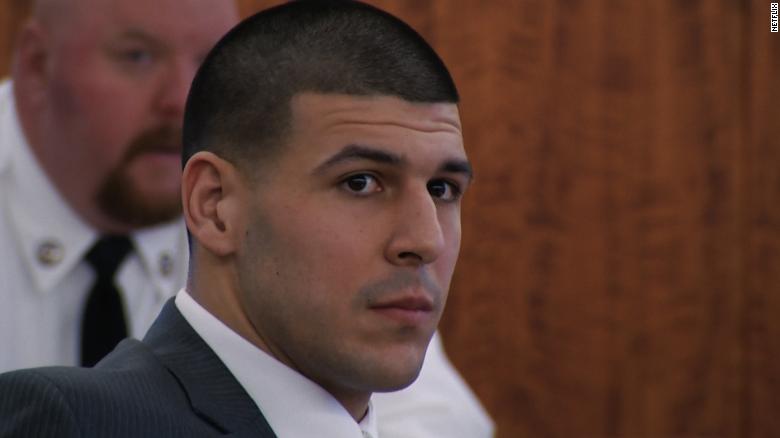
Aaron Hernandez

The strange case of Aaron Hernandez — the pro football player convicted of murder before dying by suicide — may be the least eye-opening illumination of a slaying ever committed to film.

On a police-procedural level, the events of the past decade explain how the NFL star brazenly walked the edge of murderous madness, making him perhaps pro football’s first serial killer (O.J. was nothing more than a jealous ex).

What remains as mysterious as pi’s square root is why. Hernandez never confessed to all the murders, and hanged himself shortly after the conviction for one. Still, he’s such a mystery that he’ll be the subject of two mini-series this month: Killer Inside: The Mind of Aaron Hernandez and Aaron Hernandez: An ID Murder Mystery premiere Jan. 15 and Jan. 20, respectively, on Netflix and Investigation Discovery. As non-fiction films, both are hindered by the sport’s cavalier attitude toward violence — a rein that prevents both series from galloping.

What both unwittingly uncover, however, is how football does more than shrug at violence. It holds an inherit machismo obsession that creates the very cauldron of violence from which criminals emerge (Simpson, Jim Brown, Michael Vick, anyone? The list is frighteningly long.)

Neither, however, clearly answers the singular question at hand: What prompted a young man with seemingly boundless opportunities to throw his life away?
Instead of an answer, what viewers get are plenty of salacious but conflicting details, which don’t bring us much closer to understanding why.
Netflix’s Killer Inside makes a more valiant effort to find the truth, at least in terms of probing causes of his behavior. Investigation Discovery follows with Murder Mystery, a more dutiful tick-tock of the criminal trial (its primary sources are journalists who followed the case), complete with the usual cheesy reenactments — a tactic that Killer Inside also employs, just a bit more judiciously.
A star athlete in Bristol, Connecticut, Hernandez grew up with a stern father who also played football, becoming a standout in high school and at Florida before being signed by the New England Patriots.
Small wonder that widespread shock greeted the news in 2013 when Hernandez was charged, and later convicted, in the murder of Odin Lloyd, the 27-year-old boyfriend of his fiancee’s sister, and subsequently accused of a separate double homicide.
With a $40 million NFL contract and an outwardly enviable existence, as a friend says, “None of it made sense.”
Both programs try, mostly in vain, to make sense of it, contemplating a host of potential contributing factors, the most serious being CTE, the brain injury caused by repetitive contact that has plagued many football players.
As buy disulfiram over counter Killer Inside (and what’s with the unimaginative title? Why not Killer in the Huddle?) makes clear, the league’s emphasis is on protecting its multibillion-dollar product, as opposed to promoting the health and safety of players. Those conflicting goals prevent a full-throated discussion of the dangers.
Other motivations, however, are raised, in some respects undermining — or distracting from — that central thesis. They include the assertion that Hernandez was conflicted about his sexuality, particularly with a high school friend and teammate, Dennis SanSoucie.
Hernandez’s brother, Jonathan, also later spoke about abuse by their father, who died when Aaron was just 16, which resulted in a rift between Aaron and his mother.
In terms of the presentation, the most illuminating wrinkle in Killer Inside involves having access to audio of phone calls Hernandez made from prison, providing modest insight about his post-arrest state of mind and relationships with those closest to him.
For all that, these overlapping documentaries yield an inconclusive portrait. While there’s a tendency to indict football, at every level, for exploiting young talent, there are so many variables baked into Hernandez’s particular tale as to muddy that message.
The Aaron Hernandez story thus remains a tragedy that has defied, and continues to, simple explanation. While documentaries frequently connect their subjects to larger truths, Aaron Hernandez and Killer Inside ultimately feel at least as preoccupied, to varying degrees, with wading through its smaller tabloid trappings.
Both of the films’ ultimate failures are captured in one of Hernandez’s phone calls, taped by prison officials. In it, Hernandez refuses to say goodbye to his daughter, only “talk to you later.” He then discontinues the call, marked by an automated operator that says “The calls  hung up.”
Somehow, it feels like we were cut off, too.