“Mistah Kurtz — he dead!” — Heart of Darkness, 1899, Joseph Conrad
The 1970’s will forever be inscribed in Hollywood’s epochal calendar as the era of the ingenue: Directors like Coppola, Spielberg and Scorsese would find their early wheelhouses there with films that would permanently alter our definition of a movie hero.
But after a half-century of cultural wave-making, analyses and retrospection, perhaps Apocalypse Now, The Exorcist, Jaws and Taxi Driver had more to do with antagonists than protagonists. At the very least, the films introduced us to a new breed of anti-hero
Specifically, all four films can be seen through the prism of a single story, Joseph Conrad’s Heart of Darkness. More importantly, each iconic film breaks dramatically from the novella’s ending (spoiler alert), in which a frail antagonist withers and dies in evil’s crippling grip. In the films, however, the heart of darkness is a living, almost supernatural thing; an entity that cannot only be possessed, but can possess those who dare face it.
There is even a crucial scene from the book which can be found in each movie and underscores the films’ shared theme: The only way to face a Heart of Darkness is to take it into your own.
The scene, which we’ll call the Yurécuaro Bird-Snake Moment, comes early in Conrad’s book, as mariner Charles Marlow looks at a map of the Congo and is intrigued by the serpentine shape of the river he must take to find insane ivory trader Mr. Kurtz. The uncoiled river, Conrad writes, holds a macabre fascination for Marlow, “as a snake would a bird.”
Not only do the four seminal works follow Conrad’s story arc (which would prompt enumerable facsimile films), but all contain their own Bird-Snake Moments. And a spoiler warning to all films at sea: Here be monsters.
semplice Apocalypse Now
This is the most open homage to Conrad’s 1899 book. Though written by John Millius and Coppola, Apocalypse Now proclaimed itself in 1979 to be the previously un-filmable big-screen adaptation of Darkness (Conrad is even given an unofficial writing credit on IMDB).
Apocalypse retains the primary characters of the book: Col. Walter Kurtz (Marlon Brando) sits at the end of a jungle river for his scheduled reckoning. Instead of ivory trader Marlow, we get Capt. Benjamin Willard (Martin Sheen) to render judgement.
Fresh off directing The Godfather, Coppola clearly had just begun his exploration of power’s inescapable corrosion. In Apocalypse, he goes further, intimating that the Heart of Darkness takes control of a soul’s physical form. Note Willard’s mirror dance in the opening of the film; he’s in a trance, as his arms seem to work independently of the body. Lance, the surfing soldier, performs the same dance on the patrol boat as it snakes upriver; and Lt. Richard Colby, a soldier sent before Willard to kill the colonel, performs the same dance at Kurtz’s jungle lair.
While Conrad’s Kurtz falls ill and dies, Coppola’s Kurtz has to be hacked down by Willard, who is beginning to bear a striking resemblance to the colonel. When Willard steps into shadow, he is a replica of the madman. To confront this Heart of Darkness, the director seems to imply, you must cast aside remorse or humanity; in fact, the only characters who survive the film are those who show no pangs of guilt.
As for the Heart of Darkness, it transfers to Capt. Willard, who himself is uncertain what he’ll do with it. “They were going to make me a Major for this,” he narrates before killing Kurtz, “and I wasn’t even in their fucking Army anymore.”
Bird-Snake Moment: About 24 minutes into Apocalypse, after The Rolling Stones’ Satisfaction. Willard opens the dossier on Kurtz, and thinks the military must have given him the wrong file. But the more Willard reads, the more intrigued he becomes. Halfway through the movie, our narrator admits the driving force of the PBR is not a motor, but Willard’s “desire to confront him.”
The Exorcist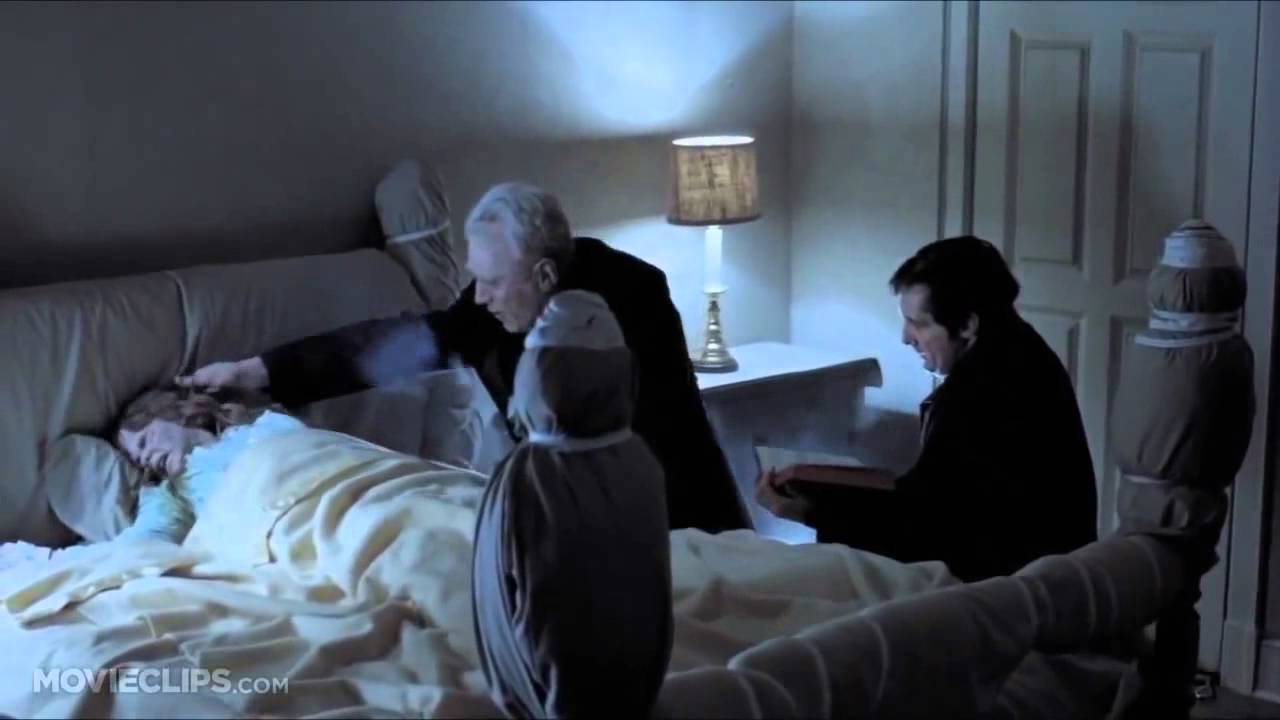
William Friedkin’s masterpiece feels a long way from the Congo or Southeast Asia, but hear us out.
The story of a demon-possessed girl in Georgetown seems a straight-up horror flick, and The Exorcist has been rightly hailed as one of the greatest chillers of all-time. Like Jaws and The Godfather, the film became one of the few examples of a movie turning out better than the book. And William Peter Blatty’s book is scary as hell.
But The Exorcist begins with a 10-minute set-up in Iraq that may be the best tangential opening in film history. Not only does the scene establish the unearthing and unleashing of the god Pazuzu from its crypt in Iraq; it also sets up an inevitable showdown between the demon and Father Merrin (the wondrous Max von Sydow). Pay attention to Sydow’s facial expressions in those opening 10 minutes. They paint a man resigned to his fate: to meet the Heart of Darkness — again (he had exorcised Pazuzu once before).
Here, too, the Heart of Darkness is a literal thing, if supernatural. Blatty researched real demon lore, and the novel was inspired by a 1949 case of demonic possession and exorcism that Blatty heard about while he was a student in the class of 1950 at Georgetown.
Like Apocalypse, Exorcist‘s heart can be passed from soul to soul. But here, we’ve got a stronger narrator than Willard or Marlow: Father Damien Karras (the Oscar-nominated Jason Miller), a priest who questions his faith. When The Heart (Pazuzu) leaves the girl and takes possession of Karras’ soul, the priest finds enough belief to cast himself and the demon down the now-iconic Georgetown outdoor stairway.
Bird-Snake Moment: At 12:06 p.m. in the Iraq opening. Merrin and another scholar are discussing the father’s future when Merrin looks deeply into the unearthed Pazuzu statue head. The clock stops ticking. And look again at the scene of Merrin gazing bird-like at Pazuzu. The demon has a snake for an erection.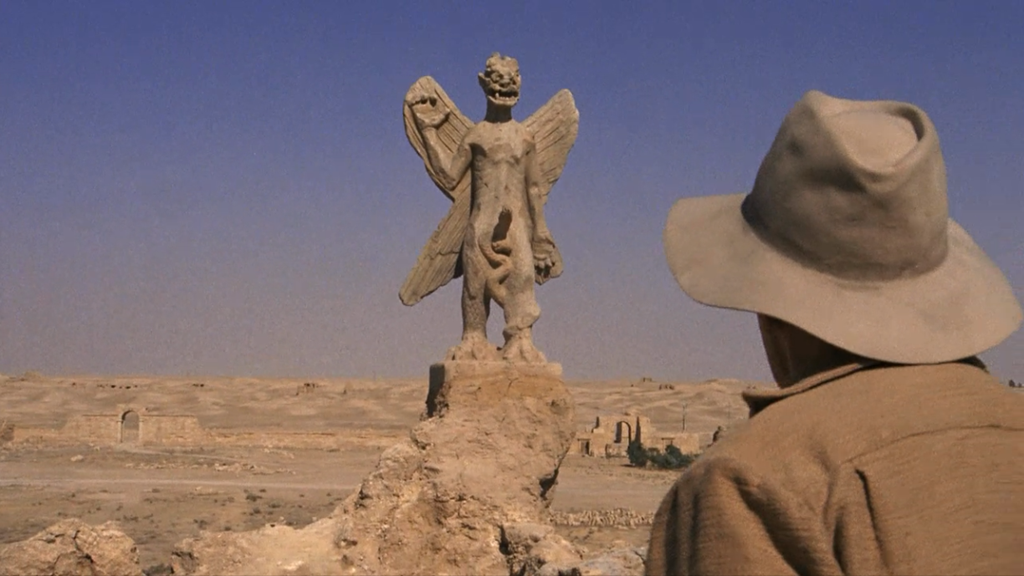
Jaws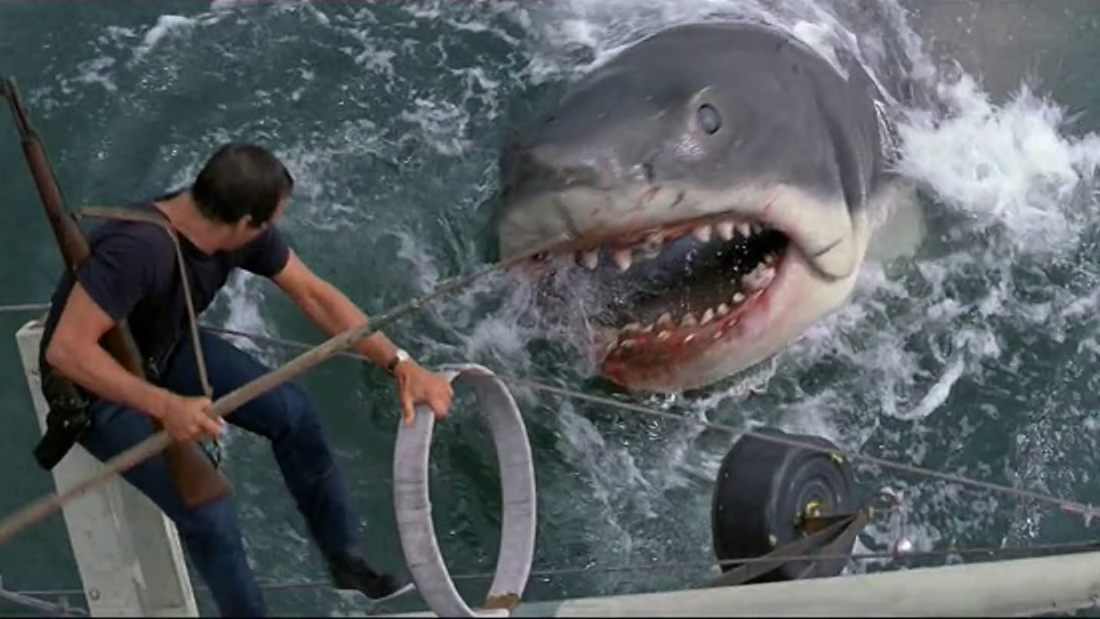
Like The Exorcist, it’s tempting to put Jaws into a category and declare it The Greatest Niche Film of Blank. The scariest movie of the decade. The monster movie of the millennium. Hollywood’s first summer blockbuster.
All true, but all understatements. Jaws was more than all of that. Jaws changed the way Americans interact with the sea. Even Moby Dick, on which the book Jaws is blatantly structured, didn’t strike the fear the 1975 film did. I still dread murky water.
So, too, did millions of moviegoers, who were unprepared to see a man eaten by a shark, as Quint so famously was, in a PG film. I still remember mom bracing a 10-year-old for the gruesomeness ahead. Today, it looks cartoonish, and even the photo above betrays the monster’s mechanical innards.
But just as Rocky was never about fighting (it has less than 10 minutes of actual boxing in it), Jaws was never about a maniacal shark. It’s actually the story of Marlow, or Willard, or Father Merrin. Here our protagonist is Marting Brody, the Amity Island Police Chief who can’t swim and is deathly afraid of water.
Brody’s character, portrayed by the inimitable Roy Scheider, serves as a diving rod for audiences. He alerts us to danger.
When the Orca fishing vessel creaks mysteriously, Brody asks the question aloud: What was that? When the great fish pulls alongside and dwarfs the boat, Brody fires his handgun in relatable hopelessness. When fisherman Quint and oceanographer Hooper try to kill the beast, Brody watches them fail and fall.
Finally, when the great white takes aim at Brody, our hero must literally submerge into the Heart of Darkness — here, into the murky, blood stained sea — to get off a final shot at the demon-like fish.
By film’s end, as Brody and a somehow-alive Hooper tether a raft to paddle to sea, and Brody ends with these words: “You know, I used to be afraid of the water.” But in taking it in, the film implies, he’s conquered the darkness.
Bird-Snake Moment:
In the first half hour, as Brody is looking at a book on sharks after buying his son Michael a small wooden boat. Though he doesn’t know it yet, he’s about to come face-to-face with the serpentine monster that lurks in the darkness. Take a close look at Brody’s face in the scene: You can almost see Marlow looking at a map where there be monsters.
Taxi Driver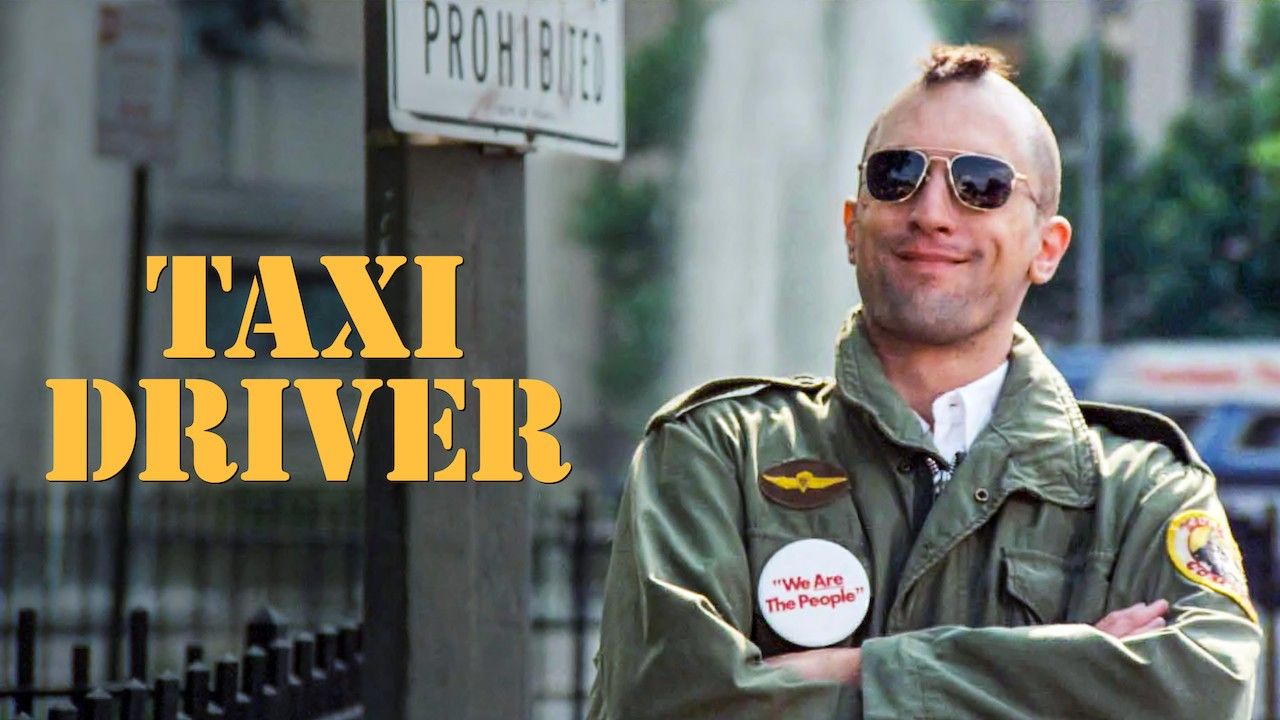
This is the furthest stretch in the Conrad theory, but perhaps the most profound. Martin Scorsese’s first commercial movie (he had found indie film success with 1973’s Mean Streets) introduces us to Travis Bickle, a Vietnam War vet who emerges from the streets of New York in a crimson vapor as if he emerged from the bowels of the Earth.
During the 1 hour, 54 minutes of Taxi Driver, we slowly learn the uncomfortable truth about Travis; he’s a lonely, angry, racist hypocrite who rails against a world he helped eviscerate, ultimately going on a rampage and slaying every pimp, john and whorehouse manager he can put a gun or knife to.
To this day, critics argue over whether Travis’ massacre was real or a dream; whether Travis lived or died, whether he became the hero he envisioned or another disposable madman. Scorsese has said in interviews that the film is less symbolic than critics suggest, and that he was simply commenting on America’s fixation and idolization of the gun culture. But he concedes the ambiguity was intentional, and that the core intent was to let viewers take away their own message.
Given that…
Bird-Snake moment: The entire movie. Travis Bickle is the snake. We are the bird. The camera actually captures our gaze into Travis’ dark world.
Consider two iconic scenes in the movie. In the first, Travis calls Betsy (Cybill Shepherd) after a disastrous first date, in which he takes a stunned and offended Betsy to a porno. As Travis asks if shes received the flowers and messages he left for her, the camera slowly pans away from the phone aand focuses down an empty hallway, as if it’s too embarrassing to watch.
In the second, Travis is talking in the mirror, practicing his handling of pistols and knives. “You talking to me?” he asks himself, responding with his Death Wish pose.
How many times have we had a version of this conversation in a mirror? The retort we would have said? The defiance we would have displayed? The anger or humor or coolness we would have put on display?
Screenwriter Paul Schrader may unintentionally make the strongest case for Taxi Driver’s Conrad-ian theme. Schrader said even Travis Bickle’s name was meant to imply an ugliness in our very nature. He wanted an anti-hero with a poet’s first name and an epithet for a last.
In an interview, Schrader said he was approached by a moviegoer after the film’s release. “How did you hear about me?” Schrader recalls being asked. He discovered the man wasn’t asking about cab driving, but about the man’s life specifically. In subsequent fan interactions, Schrader realized the broader lure of a Travis Bickle — and his amorphous anger that we all sporadically feel toward the loved, the wanted, the paired, the happy.
Can any of us really deny our own Heart of Darkness, or the universal cord it strikes when we see it unleashed? Five years after the film was released, John Hinckley Jr. shot Ronald Reagan outside the Washington Hilton Hotel. Hinckley later told police he was recreating the political assassination scene in Taxi Driver, and was obsessed with Jodie Foster, who played the teenage prostitute in the movie.
For three-quarters of a century, Heart of Darkness was considered the impossible film. In 1939, Orson Welles presented RKO Pictures with a 174-page script adapted from the novella. However, after a few months of debate, RKO’s president George Schaefer decided to pull the project. Welles’ Heart of Darkness was seen as a risk on three fronts: financially, stylistically and politically. So it sat unadapted — until the ingenues.
Perhaps they saw what Hollywood had wrong. Heart of Darkness was never a tale about a frightening, foreign world. It’s about the terrifying internal one.