Category Archives: Reviews

The Genius of ‘Chicago 7,’ Despite Its Genius

The Trial of the Chicago 7' Review: They Fought the Law - The New York Times

Dazhou Like David Mamet, Aaron Sorkin is less a screenwriter than a songwriter. Sure, Goo goo j’goob doesn’t make a lick of sense, but its got a great beat.

So, too, does The Trial of the Chicago 7, Netflix’s latest pandemic entrée. Granted, our time in isolation has made us more welcoming than ever to visitors. And Sorkin, the mind behind The West Wing, has yet to see a trope he won’t hit on.

But the movie connects despite some sizable flaws, perhaps because of its underpinning message and unmistakable parallels between the politics of a half-century ago and today.

The film is based on the 1969 federal trial of seven men accused of inciting a riot at the 1968 Democratic National Convention in Chicago.

The film has taken its lumps for making the trial too theatrical. Rolling Stone railed, “The Trial of the Chicago 7 feels outright outlandish at times.”

Note to Rolling Stone: Look up the real trial. Defendant Bobby Seale really was bound and gagged at the trial. And unlike the film, which showed Seale as literal hostage once, the order stood for several days. A defense attorney stated, for the record, “This is no longer a court of order, Your Honor, this is a medieval torture chamber.”

The Trial of the Chicago 7 True Story: What The Movie Changes
The real Bobby Seale, left, in a courtroom sketch.

No, the flaws of Chicago 7 are about storytelling. The trial was such a circus, the film needs less dramatic flare, more documentarian finesse. In a throwaway scene apparently meant to peacock, one defendant asks another if he knows what’s going on as lawyers huddle. “I haven’t known what’s been going on for years,” the other replies with a poignant sigh.

In another, a defendant says he is keeping a list of soldiers who died in Vietnam during the case, noting that “with the trial starting, it might get easy to forget who this is about.” He later hands the list to Tom Hayden (a terrific Eddie Redmayne), whose final words to the court are to read the casualty list.

Too bad the speech — and list — are pure fiction.

And while chameleon star Sacha Baron Cohen bears a strong resemblance to Abbie Hoffman, the Brit simply can’t get beyond a “pahk the cah” Northeastern accent, and it weaves like a drunk driver on a two-lane highway.
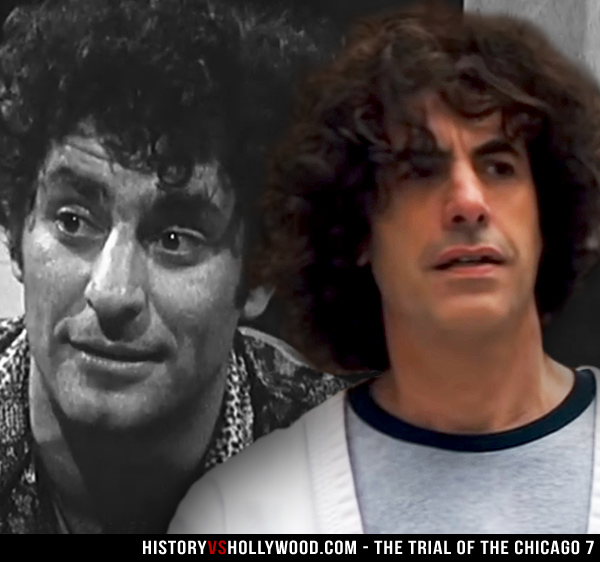
Abbie Hoffman and Sacha Baron Cohen
Abbie Hoffman, left, and Sacha Baron Cohen

But it’s still worth the cost of admission, if only because it will nudge the occasional viewer to Wikipedia or YouTube for a remote-learning history lesson.

The film duly notes what became of the protesters, from Tom Hayden’s 5-term Senate run to Hoffman’s in 1989.

More importantly, Chicago 7 puts the upcoming presidential election into some much-needed context. As Sorkin does get spot on, the 60’s make these times look downright simple.

Back then, liberal voices got shot in the head for demanding to be heard.

In that sense, the election — like the sentiment of the Chicago 7, is already settled.
Deja Viewed: There Will Be Blood

There Will Be Blood | Jerusalem Cinematheque – Israel Film Archive

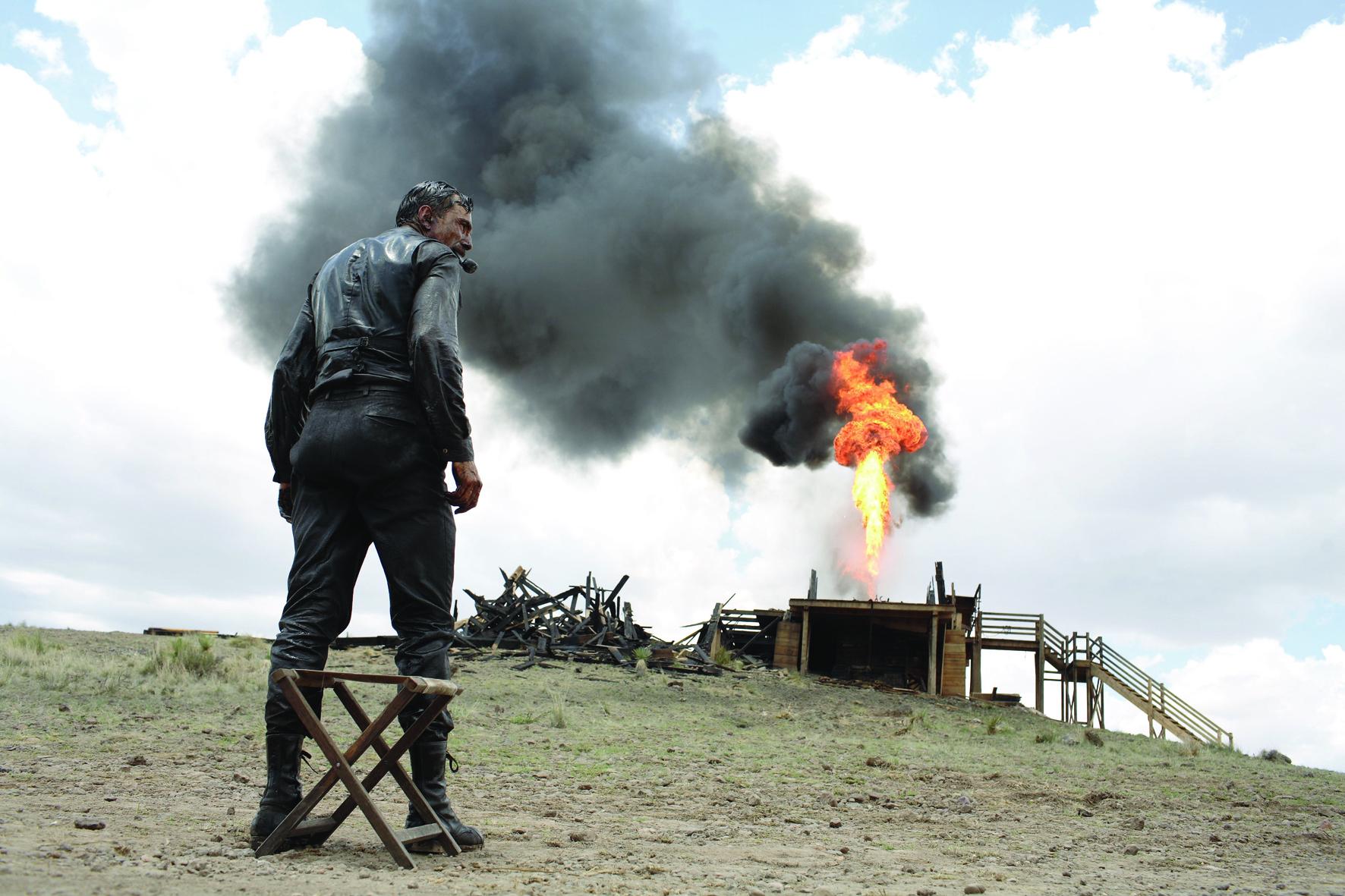
There Will Be Blood is ostensibly about real-life California oil tycoon Edward L. Doheny, and even includes the now-famous “I drink your milkshake!” quote, attributed to Doheny during Congressional investigations of the industry.

But on Deja-View, it sure seems like Blood director Paul Thomas Anderson is actually paying homage to Stanley Kubrick, particularly 2001: A Space Odyssey.

And if you really want to go Kubrickian, one could argue that Blood itself is a prequel to 2001. After all, 2001 documents the dawn of mankind. There Will Be Blood documents the dawn of American capitalism.

But we’ll get back to that. As for the first few minutes of Blood, it seems inarguable now that Thomas was paying homage to the 1968 movie:

  • Both movies begin in utter darkness to a rising musical score. 2001‘s intro is an extended blackout as Also Spake Zarathustra swells. Blood percolates to Radiohead’s Jonny Greenwood’s original score.
  • Both first scenes are of desert mountains.
This image has an empty alt attribute; its file name is 0AAEC980-F3B5-4D7C-B8F5-4C064DC773AF-1024x901.jpeg
  • Both have a “Moon Watcher” scene, as the huddled characters gaze into uncertain skies.
  • Both have pivotal scenes of clubbing.
This image has an empty alt attribute; its file name is A8B315D2-3875-4EBC-BB7F-B3FBB7354610.jpeg

And it’s the clubbing scene that suggests the larger, loopier theme (of course, this is 2001, so what is loopy). Throughout Blood, we watch Plainview (played by the inimitable Daniel Day-Lewis) as he graduates from gold to oil as he perfects his weapon of choice.

The film, which uses its characters as avatars of American corruption, also tracks the corrosive effect capitalism has on religion (here embodied by Paul Dano). As both men find themselves growing in wealth and power, they also find themselves inevitably and inextricably at odds.

The frenetic finale even works as a handoff to the beginning of 2001. As Plainview sits over his opponent and offers the apocalyptic final line, “I’m finished!” viewers are left with their own metaphorical riddle: What happens when business and religion are in a war to the death?

Anyone’s guess, but it’s reasonable to expect a great leap forward — or back.

To Make Sexy Time with Moviefilm

Borat 2: Sacha Baron Cohen is back to mess with your head — and heart |  Star Tribune

There is no reason a Borat sequel should work.

It comes 14 years after the surprise original — a lifetime and a half in movie metrics. Borat’s fish-out-of-water schtick should be a one-trick pony, just as SNL films are glorified sketch jokes. And everybody should know Sacha Baron Cohen’s chameleon mug by now; he’s already punked Sarah Palin, Dick Cheney and a raft of unwitting stars, TV reporters and dim bulb politicians. His goose should be cooked by now.

And yet, Borat: Subsequent Moviefilm is a small wonder. While not the seismic discovery of the 2006 original — and what could be? — the follow-up is laugh-out-loud funny, surprisingly touching and still remarkable in its ability to get citizens, particularly elected ones, to act like asses for the camera.

Or, in Rudy Giuliani’s case, like a child molester.

Like the first film, the sublime Borat: Cultural Learnings of America for Make Benefit Glorious Nation of Kazakhstan, the sequel has a knock-knock joke simplicity. Cohen plays a correspondent and unofficial statesman from Kazakhstan, and he uses the ruse to get America to drop its guard and describe itself, assworts and all.

Cohen takes a bead on some of his favorite targets: gun rights advocates, evangelicals, and just about any country bumpkin willing to sign a rights waiver. And there are a lot.

But it’s the politicians who always make the best bait (Palin was skewered on Cohen’s Showtime series, Who Is America?) This time around, Giuliani is in the crosshairs. and Cohen nails him the way Bob Woodward nailed Donald Trump in Rage.

Borat releases new video statement about Giuliani scene

Actually, exactly like that. If you remember, this site criticized Woodward for saving a news story about the president’s COVID subterfuge to help sell his book. Here, the stakes aren’t nearly as high, and Cohen rightly used the scene for the, ahem, climax of the film. But Cohen could have made news with the footage alone — if it’s legit.

The scene begins with Giuliani seated on a couch, answering questions from Borat’s “daughter,” an adult actress playing a 15-year-old. When the actress asks the former mayor if they can continue their discussion in the bedroom. he agrees, and is then shown sitting on a bed, as she appears to take his microphone off and he appears to pat her. The segment then cuts to the image of Rudy, reclining on the bed, placing his hands down his pants. Borat then bursts into the scene, screaming “She’s 15-years-old! She’s too old for you!”

Giuliani has vociferously denied any wrongdoing, and accuses the filmmakers of doctoring the scene, which may be true. This is, after all, a feature film.

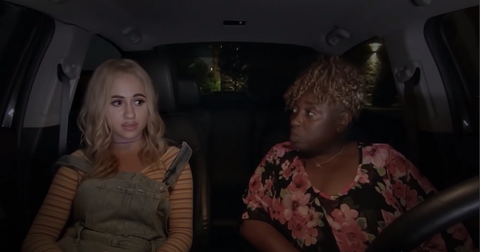
But Cohen strikes a documentary-like chord every time he turns on a camera, and Moviefilm is gloriously no exception. Perhaps the film’s biggest surprise is its tenderness. Namely, Jeanise Jones, an African-American babysitter who is stunned and offended when Borat instructs Jones to feed his daughter water from a dog bowl if she’s been a good girl. Jones ultimately gives the daughter a sincere, near-tearjerker about the girl standing up for — and finding pride in — her unpolished self.

borat-babysitter-1603552123189.png

There’s nothing new or earthshaking to Moviefilm. It is, after all, a direct-to-Amazon sequel, and you probably got it free with your order of bulk paper towels.

But given the year, the disappointment of $250 million movies like Tenet, and our junk food overload on crap like Tiger King, Borat couldn’t be more timely or welcome. He addresses everything from COVID to religion to gender roles in an hour and a half that seem to time warp by.

Very niiiice.