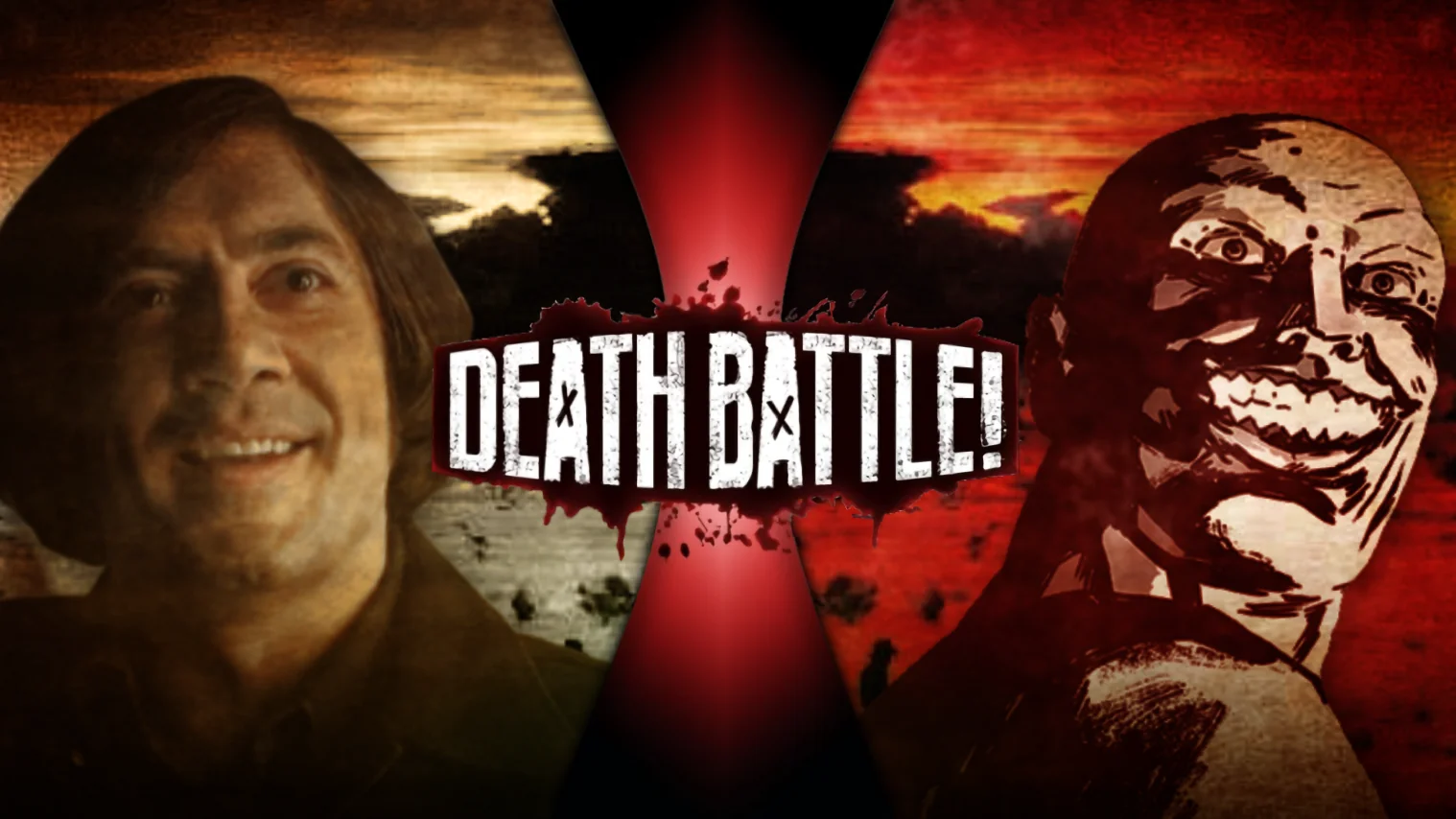
Cormac McCarthy’s villains feel less like men and more like demon spirits, storm systems moving through America, flattening anything resembling mercy.
Which makes them the greatest antagonists in American literature.
Judge Holden in Blood Meridian and Anton Chigurh in No Country for Old Men operate in different centuries, but they speak the same horrifying language: That morality itself is a superstition invented by people who cannot bear the silence of the universe.
Holden lectures, collects, dances, and kills with the calm of someone who knows he has already won an argument. Chigurh flips a coin because even he understands that human choice needs a costume.
Both characters are terrifying because they refuse the one story Americans rely on to survive their own history: That violence happens for reasons.
In McCarthy’s West, violence happens because it can.
Holden is a philosopher of blood who treats war as the only honest religion left, while Chigurh is a minimalist who reduces life and death to a binary switch. Both men share the same certainty that the world has no built-in moral structure waiting to rescue us.
Chigurh moves through the world like death itself. He slips through vents, survives crashes, and keeps advancing with the patience of something that knows it will outlast everyone in the room.
The coin toss is not a game. It is a ritual that lets fate pretend it is fair.
Holden goes further.
He does not just kill, he explains why killing is sacred. Ageless and vast, he believes war is the engine of creation itself, which is why he feels less like a man than a satanic force wearing human skin. Or godly power dressed as the devil.
This is where McCarthy stops being a novelist and becomes a national diagnostician.
America likes to pretend its brutality is always in service of something noble, whether it is Manifest Destiny, free markets, or national security. But McCarthy keeps handing us villains who act without that comforting cover.
Holden does not claim to be building a country or saving a civilization, and Chigurh does not pretend he is correcting a wrong, because both of them know that once you strip away the story, power is the only thing left standing.
That is what makes them so recognizable.
We live in a culture that worships winners and excuses cruelty when it is profitable. In that distortion, Holden and Chigurh do not feel like monsters so much as distilled versions of attitudes Americans already reward.
Holden talks about war as a natural state of mankind, and anyone who has listened to modern political language about enemies, borders, and necessary force knows exactly what he means. Chigurh decides who lives based on a coin toss, and anyone who has watched lives hinge on insurance coverage, court calendars, or market crashes has already seen that logic at work.
McCarthy never allows these men to justify themselves in human terms. They do not claim trauma, poverty, or wounded pride. They simply act.
That is what makes them terrifying, because it removes the safety valve that lets readers pretend this kind of evil belongs somewhere else.
The American appetite for moral vacancy appears every time winning matters more than how the win was achieved. Holden and Chigurh are not aberrations in that landscape.
They are its purest products.
McCarthy understood that a society built on force will eventually stop hiding behind ideals, which is why his villains do not arrive to shock us. They arrive to show us what we have always been willing to live with as long as it worked.
McCarthy did not invent monsters. He just stripped away the excuses for them.
In the dawn there is a man progressing over the plain by means of holes which he is making in the ground. He uses an implement with two handles and he chucks it into the hole and he enkindles the stone in the hole with his steel hole by hole striking the fire out of the rocks which God has put there. On the plain behind him are the wanderers in search of bones and those who do not search and they move haltingly in the light like mechanisms whose movements are monitored with escapement and pallet so that they appear restrained by a prudence or reflectiveness which has no inner reality and they cross in their progress one by one that track of holes that runs to the rim of the visible ground and which seems less the pursuit of some continuance than the verification of a principle, a validation of sequence and causality as if each round and perfect hole owed its existence to the one before it there on that prairie upon which are the bones and the gatherers of bones and those who do not gather. He strikes fire in the hole and draws out his steel. Then they all move on again. — Epilogue, Blood Meridian