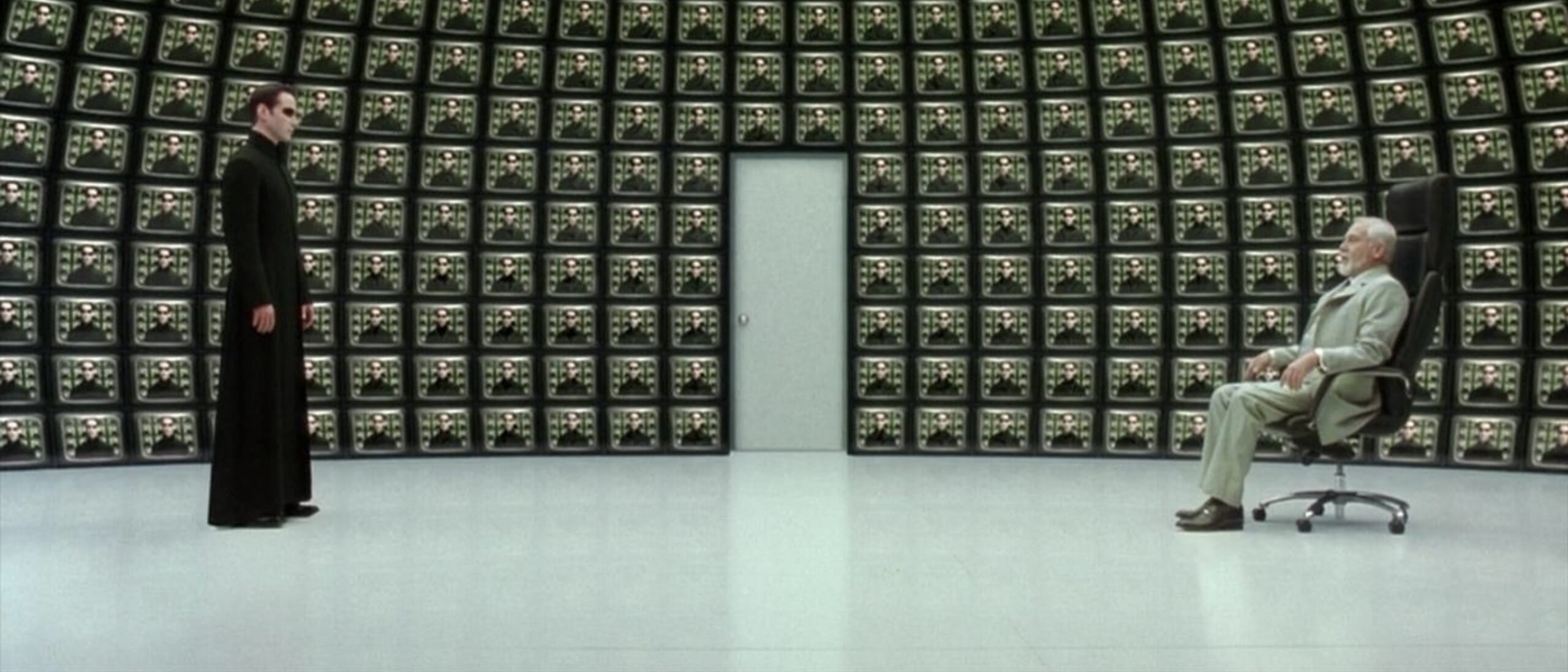
http://childpsychiatryassociates.com/molly-bruening-lisw/ I was watching The Matrix Reloaded recently when I noticed the movie’s most interesting conceit had nothing to do with kung fu, bullet time or killer robots.
It was mathematics.
In one of the film’s defining scenes, Neo meets the Architect, the creator of the Matrix. The Architect explains that Neo is not unique. He is merely the latest version of an inevitable anomaly. The Matrix, despite all its computational perfection, cannot eliminate a tiny remainder. It can predict it. It can contain it. It can even build an elaborate cycle around it. But it cannot make it disappear.
The movie treats this as an unavoidable consequence of mathematics.
Strictly speaking, it isn’t. But it points toward one of the deepest ideas mathematics has ever produced.
In 1931, Austrian logician Kurt Gödel published what are now known as the incompleteness theorems. They permanently changed the way mathematicians think about certainty.
The theorems are famously difficult, but the central idea is surprisingly accessible.
Gödel proved that any mathematical system powerful enough to describe ordinary arithmetic will inevitably contain truths that cannot be proven from within that system. He then went one step further. Such a system cannot even prove its own consistency using only its own rules.
Read that sentence again.
Mathematics, humanity’s gold standard for certainty, proved that there are limits to what mathematics can certify about itself.
That does not mean mathematics is flawed.
Quite the opposite. It means mathematics possesses something many belief systems lack.
Humility.
It acknowledges where its own boundaries lie.
The Matrix borrows this intuition. The Architect believes he has built a perfect machine. Yet every version of the Matrix generates a remainder. Neo is that remainder. Not because the equations are sloppy, but because the system can never become perfectly closed.
Whether that makes for good mathematics is debatable. Whether it makes for good philosophy is another matter.
Because once you leave mathematics, you begin noticing closed systems everywhere.
Religions often prove themselves by referring back to themselves. The sacred text is true because the sacred text says it is true. The prophet is genuine because the prophet says so. The institution derives authority from the institution.
Round and round it goes.
The same thing happens in politics. The party is right because the party says it is right. The ideology becomes its own evidence. Loyalty replaces verification.
Human beings seem naturally drawn toward systems that answer every question before it is asked.
The problem is that reality rarely cooperates. Reality keeps producing remainders. That is where Evidentialism parts company with faith.
Evidentialism is not another closed system asking you to trust its conclusions. It asks you to distrust conclusions that cannot survive independent examination.
If a claim is true, it should leave fingerprints outside itself. If a miracle occurred, there should be evidence. If a historical event happened, there should be corroboration. If a scientific theory is correct, it should predict observations that anyone can test.
Truth should not depend on already believing it.
That, to me, is the quiet brilliance of Gödel’s work.
He did not destroy certainty. He destroyed the illusion of self-contained certainty. He reminded us that no sufficiently rich system can completely explain itself from the inside.
Sometimes you have to step outside the system to see the system.
That lesson extends well beyond mathematics. It reaches into science, journalism, philosophy and religion. Every one of them is healthiest when it welcomes questions from outside rather than suppressing them from within.
The Architect believed perfection meant eliminating every anomaly.
Gödel suggested that the anomaly is not always the problem.
Sometimes it is the clue. Sometimes the remainder is the part pointing toward a larger truth that the system itself cannot see.
That may be the most honest lesson mathematics has ever taught us. Not that every question has an answer.
But that every answer deserves a question.