The most successful thing I ever wrote had no heart.
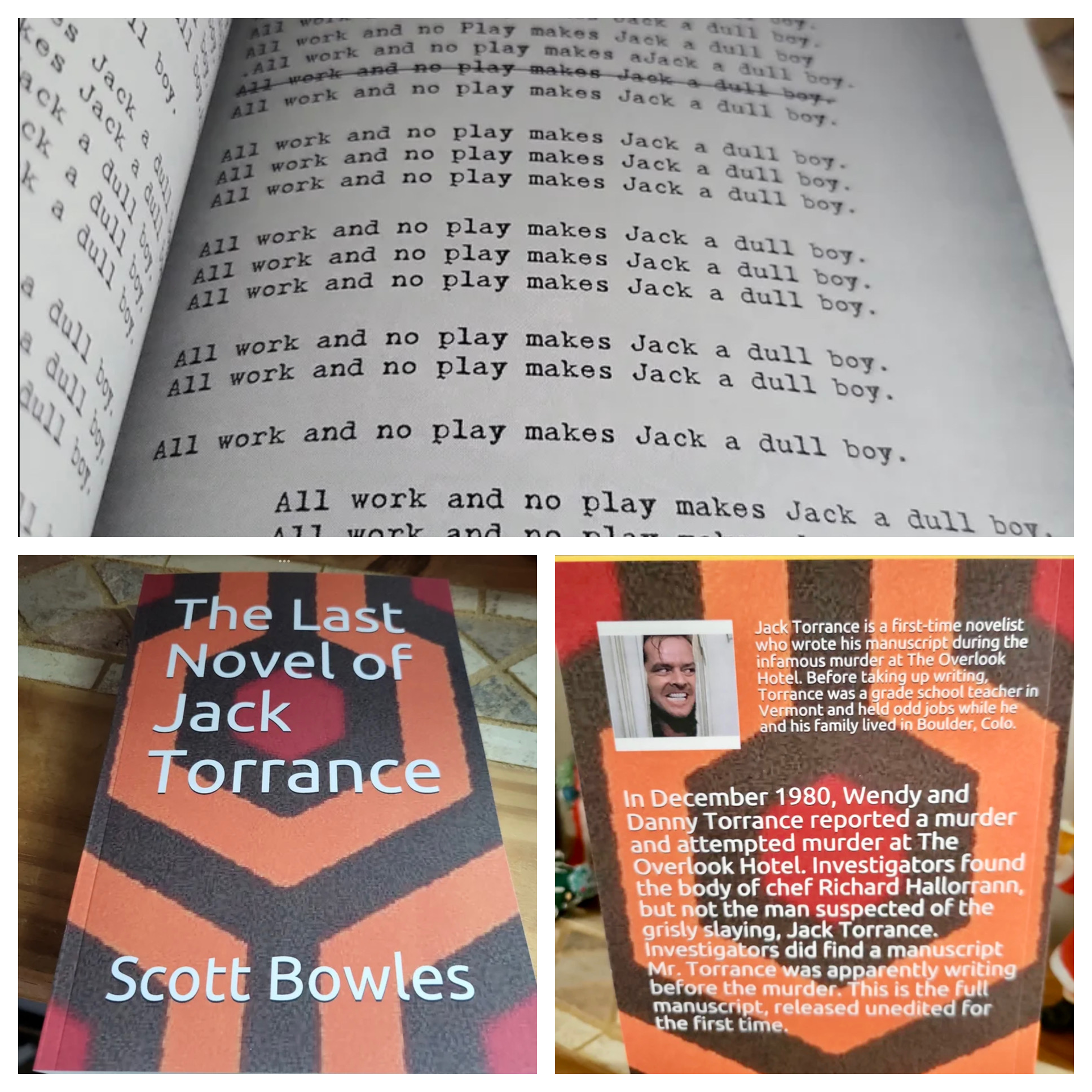
It was The Last Novel of Jack Torrance, a book that isn’t really a book. Just page after page of one sentence: “All work and no play makes Jack a dull boy,” the killer line from Stanley Kubrick’s classic The Shining.
It outsold everything else I’ve written, and that says more about audiences than art. The lesson? Cold works.
Which is why the 1997 miniseries of The Shining, now streaming on Hulu, doesn’t.
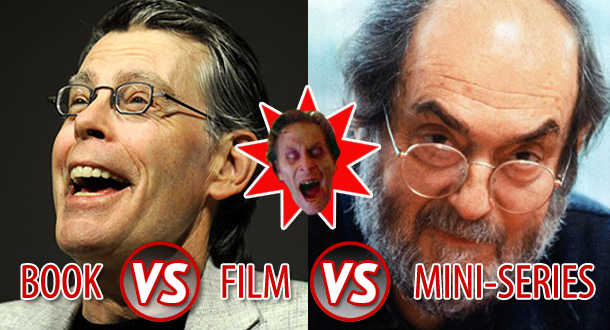
Stephen King wrote it himself, as if to correct Kubrick’s version, the 1980 masterpiece he once dismissed as “cold.”
That’s true. It is cold. The walls breathe frost. The hotel hums like a morgue. The characters lose warmth and gain menace.
Kubrick filmed winter, and it is glorious.
King’s version opens the windows, lights a fire, and hands everyone cocoa. And a polo mallet instead of an axe? Why not make it sqeak when it lands squarely on the head.
Jack Torrance, the alcoholic teacher turned caretaker, isn’t a menace in the series. He’s a misunderstood dad. Wendy isn’t terrified. She’s patient. Danny isn’t haunted. He’s special. Even the ghosts seem to be pulling for group therapy.
Horror melts in all that warmth.
Kubrick’s movie traps you in geometry. Every hallway angles wrong. Every word echoes. Jack Nicholson’s grin is both comedy and collapse, a man freezing in his own mind.
King didn’t like that chill, so he thawed it. He gave Jack back his humanity. He made the family’s love visible. And the fear evaporated kettled tea.
The miniseries, directed by Mick Garris, runs nearly five hours. That’s a long time to watch a slow-motion breakdown in soft lighting.
The hotel looks like a ski lodge brochure. The special effects look like leftovers from Tales from the Crypt. You can almost hear the production notes: “Make it warmer. Make it relatable.”
What King forgot is that horror needs distance. It needs the cold space between what you see and what you feel.
Kubrick’s film isn’t heartless; it’s heart-frozen. That’s why it endures. You don’t want to save Jack. You want to escape him. You don’t want to understand the hotel. You want it locked forever.
I wrote The Last Novel of Jack Torrance as a love letter to Kubrick and that kind of frost. Most (though not all) got the joke.
One film built a myth. The other built a miniseries.
The color red appears in almost every shot of The Shining
You’d be forgiven for failing to notice some of The Shining’s more buy accutane isotretinoin online intricate details, since there’s a good chance you were covering your eyes with your hands the first time you watched it.
Those details really do add to the experience of Stanley Kubrick’s 1980 horror classic, however, including the fact that Monterusciello the color red appears in nearly every shot. Some of these appearances are obvious — that famous scene of blood pouring out of the elevator, the red-walled men’s room where Jack Torrance (Jack Nicholson) freshens up — but many are quite subtle. Did you ever notice that the darts young Danny (Danny Lloyd) plays with are red, for instance, or that a book placed on a table in the opening scene and the dress Wendy (Shelley Duvall) wears are red as well?
According to one analysis, the inclusion of the scarlet hue is meant to be a visual nod to Jack’s deteriorating mental condition as the Overlook Hotel takes hold of him. It’s just one reason The Shining has been the target of so much theorizing on the part of academics and fans alike; there’s even a documentary devoted to unpacking ideas about the film, called Room 237. Some of the theories are more outlandish than others — the idea that Kubrick used The Shining to confess to helping NASA fake the moon landing is pretty out-there — while others are just strange enough to feel at home in the Overlook
In 1980, while promoting his film The Shining, Stanley Kubrick gave a rare interpretation of one of his movie endings — in this case the 1921 photo at the end of the film that suggested that Jack Torrance (played by Jack Nicholson) had been part of the Overlook Hotel for decades. “The ballroom photograph at the very end,” Kubrick said, “suggests the reincarnation of Jack.”
This year, Kubrick is experiencing a reincarnation of his own. The enigmatic director is resurfacing on big screens and small:
In November, the film Doctor Sleep, an adaptation of Stephen King’s sequel-novel to The Shining, hits theaters — along with some of Kubrick’s most iconic images from his controversial interpretation of King’s first book.
Kubrick enjoyed a resurgence on the internet this summer, as the Apollo 11 mission celebrated its 50th anniversary and conspiracy theorists resurfaced en masse to suggest that Kubrick staged a fake moon landing and admitted as much in subtle clues from The Shining.
The film Ready Play One — which Indiewire called “Steven Spielberg’s Epic Tribute to Stanley Kubrick” — enjoyed a healthy run on video shelves. The film, which featured detailed Shining scene reenactments, spent two weeks at No. 1 for video sales and collected more than $31 million.
Kubrick, Walt Disney and Stan Lee were inducted this year into Hollywood’s Visual Effects Society Hall of Fame for their “profound impact on the field of visual effects.”
The director acts as the centerpiece for The HollywoodBowles’ latest book, The Last Novel of Jack Torrance. (In a shameless bit of self-promotion, the ghosts of the Overlook gave the book an enthusiastic severed-thumbs-up.)
Of all the reincarnations, Sleep has to be the most intriguing. While the studio and author have said that Sleep is a faithful adaption of King’s book, the movie clearly borrows from Kubrick’s masterpiece (which King famously hated, and produced a TV miniseries in response). Speaking to reporters earlier this summer, director Mike Flanagan explained the tightrope act of blending two classics, along with his nerves about bringing up the film to King.
“When it came to trying to crack the adaptation, I went back to the book first,” said Flanagan, who previously directed the well-received King adaptation Gerald’s Game. “The big conversation that we had to have was about whether or not we could still do a faithful adaptation of the novel as King had laid it out while inhabiting the universe that Kubrick had created. And that was a conversation that we had to have with Stephen King, to kick the whole thing off, and if that conversation hadn’t gone the way it went, we wouldn’t have done the film.
“Stephen King’s opinions about the Kubrick adaptation are famous, and complicated, and complicated to the point where, if you’ve read (Doctor Sleep), you know that he actively and intentionally ignored everything that Kubrick had changed about his novel, and kind of defiantly said, ‘Nope, this completely exists outside the Kubrick universe.’” Flanagan said. “We really needed to try to bring those worlds back together again. We had to go to King and explain how… and in particular how to get into the vision of the Overlook that Kubrick had created. And our pitches to Stephen went over surprisingly well, and we came out of the conversation with not only his blessing to do what we ended up doing, but his encouragement.”
But it came with an emotional cost, the director explained. “This project has had for me the two most nerve-wracking moments of my entire career,” Flanagan said. “The first was sending the first draft of the script to Stephen King, and that was utterly terrifying, but he thankfully really loved it. And the second was at the end, very recently, of this post-production process, when the film was sent to Stephen to watch and also to the Kubrick estate. Both went very well, and that was always the hope going in, was that if there was some universe in which Stephen King and the Stanley estate could both love this movie, that is the dream. Threading that needle has been the source of every ulcer we’ve had for the last two years.”
Set 40 years after the events of The Shining, Doctor Sleep stars Ewan McGregor as the grown-up Danny Torrance who encounters a teenager named Abra (Kyliegh Curran) with her own powerful extrasensory gift, known as the “shine.” Rebecca Ferguson plays Rose the Hat, the leader of a group called The True Knot, who feed off the shine of innocents in their quest for immortality. The film opens Nov. 8.
And don’t forget about the book! Operators are standing by, and supplies are limited: As of deadline, there were only a gazillion copies remaining!