All Hail the Dancing Damned

I can remember five dreams in my life. Two were pleasant, two were unpleasant, and I can’t figure out the fifth after eight years of analyzing.

Parintins The best one, though, atones for any nightmare.

I had it when I was in Washington, DC, my last stint as a crime writer. After my stint in Detroit as a crime writer. A friend once suggested the dream was borne of reporting on street existence for so long. I dismissed it, but perhaps she was correct.

In the dream, I am walking through a familiar-yet-alien block in a downtown city. People are bumping, brushing, bustling past one another. No one apologizes for the collisions.

Amidst the chaos, I see a black man dancing in the middle of the street, keeping tune with a song only he can hear. Full dance moves. Impressive. Certain. No partner, no care who sees. Older, with hair as gray as uncertainty. homeless man

A woman sees the street waltz, and shakes her head in disgust. “That’s awful,” she mutters. “He shouldn’t be dancing in the street.” She has a Southern accent, though I don’t know why. Perhaps because so many bible thumpers below the Mason-Dixon still consider joy a sin.

Then, I hear a man’s voice in response, though I never see his face. “He’s not dancing,” the voice says. “He’s running from heaven.”

I always puzzled over who it was I pictured dancing. Now I’m thinking it may have been Derrick T. Tuggle.

Tuggle was a part-time security guard who was to appear in The Black Keys’ video Lonely Boy. He thought he had won the lottery by scoring a brief scene in the three-minute movie, shot outside a rundown motel in California. The concept: Tuggle would play the hotel manager, accept the room key from the musical duo and hand it to a group of nubile female dancers, who would provide a sexual undertone to the video.

But as the crew prepared to shoot, the director noticed Tuggle, listening to the song, bobbing his head to the beat and dancing ever so slightly as he stood on his mark. The director was intrigued. He asked Tuggle if he could dance on camera and cue.

“Sure,” Tuggle said. “I can dance. Everyone can dance!”

Tuggle asked for an hour to memorize the lyrics. He thought of dancers who made an impression: John Travolta from Saturday Night Fever  fever and Pulp Fiction fiction; Carlton Banks’ moves on The Fresh of Bel-Air.

He mentally choreographed a dance to accompany the lyrics.

Then the cameras rolled. And in one take, all other dancers were sent home. Within a week of the video’s release, 250,000 people watched on YouTube. Today, it has more than 44 million views.

There’s nothing to the video, really. It’s one, uninterrupted shot as Tuggle plays disco mime outside the motel office. It’s a cinematographic nightmare, as the camera catches sunlight dappling a receding hairline. There’s even a goof at the 30-second mark (check out the office window).

But the director made the canny call to embrace imperfection. There’s something hypnotic to its simplicity. And enthralling, as Tuggle becomes a modern-day Tony Manero, a real-life Vincent Vega, a contemporary Carlton. Watch as his sleeves unroll in the frenzy.

Tuggle doesn’t seem to care. He seems the type perfectly comfortable dancing in the middle of the street, critics and tongue-cluckers be damned.

Keep running from heaven, Mr. Tuggle. And thank you for the sinful joy.

A Confederacy of Ounces

I really should be banned from pet stores. With a wanted poster, like the one for John Wilkes Booth.

booth

Because whenever I walk into a store, or any locked settlement of animals, my thoughts turn to conspiratorial liberation. Or at least fantasies of widespread adoption. I am my landlord. I could be Octodad. I already have two dogs; what’s a half dozen more?

This weekend, I went to Petco where Teddy gets his mani-pedis and hair done. I had to replace his leash, which has been worn thin over the years by dog bites.

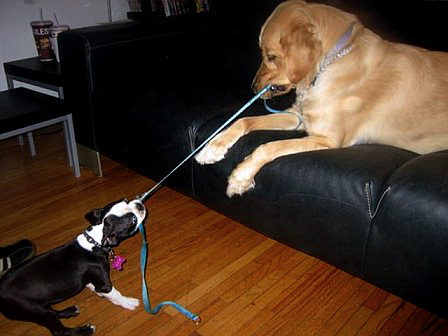
But not Teddy’s. Every time I leash the dogs for a walk or a ride, Esme chomps down on the same spot of Teddy’s leash, just below his thick noggin. And she’ll shake her head violently, like a Great White shredding a shark cage. I’m sure she’s just steaming off the energy of anticipation. But I like to think she’s telling Teddy, whose car sickness occasionally ends a road trip prematurely, “Do not ruin this for me.”

tugowar

This time I was dogless (Teddy kind of goes bat shit for all the toys and company). As I headed to the leashes, I passed the hamster/guinea pig/mouse/rat section.

There was a boy, maybe 12, peering into the glassed hamster section. Mom was over him, holding his shoulders as he watched the one-wheel circus as if he were interpreting a Monet.

And I thought of the Lost and Found Mouse, a rodent neighbor when I was married and living in Sherman Oaks.

Our neighborhood was Grand Central for domestic pets. There were the beautiful chocolate labs on the corner, a protective German Shepherd across the street and the asshole Chihuahuas two doors up.

And there was the massive Doberman further up the block. He belonged to a guy I nicknamed Big John, a mentally-askiewed behemoth who walked his dog religiously. I used to think he looked like John Popper, the formerly-globular  lead singer and harmonica player for Blues Traveler. popperBut I’d later realize he was the living version of Ignatius J. Reilly, the mesmerizing, mentally-questionable hero of A Confederacy of Dunces.

John was a frightening guy. He walked his dog down the middle of the street. I once saw him yell at a car. That was parked. And empty. His Doberman had lunged for a squirrel crossing the road, pulling him into my Jeep parked out front. John didn’t reprimand the dog. Instead, glowered at my car and cursed it out like a drunken sailor.

One day, while walking Larry, I saw dozens of hand-written posters on nearly every tree and telephone pole on the block. The posters stood at least seven feet up every tree, and taped so completely that no one could reach, let alone remove, owner’s plea.

“MISSING,” the notes read. “1 PET MOUSE. 50 CENT REWARD.” There was a grainy photocopy, though I’m not sure why. If it’s not albino, what makes for a distinguishable mouse? mouse

“Poor kid,” I thought to myself. “That mouse is crow poop by now.”

But the next day, Julie called. While walking Larry, she found a mouse, just sitting upright in the middle of the road. She thought it would run off upon seeing human and canine, but it just sat there, as if paralyzed. Though she figured he would be long gone, she went home to grab the cat carrier, just in case. Man, Linus would scratch you to the bone if you tried to put him in that thing. He knew: No good ever comes from a cat carrier.

To her surprise, the mouse was there when she returned. Stock still (still) in the middle of the road. Not dead, but perhaps wishing he were. She walked up and ushered the little guy, who seemed more than pleased to enter a safe jail, even if it did smell of cat piss. She called and left a message on the number from the poster. She had to go to work, and didn’t want to leave Mickey locked in the house, particularly with cats.

I suggested she put the cat carrier outside our patio, perhaps will a little water and cheese, the only thing I figured a mouse ate.

I got home two hours later, and found the cat carrier open, with a hand-scrawled note ripped from the corner of a legal pad sitting atop it. “THANK YOU FOR FINDING MY MOUSE.”

Anchoring the note were a quarter, two dimes and a nickel. My god! what an ending. I beamed for days.

A week later, our next door neighbor saw me outside. “I heard you found John’s mouse,” he said.

What?? John was not the guy I presumed. That he could love something that fragile, so much. That he’d wallpaper Knobhill Drive to find a mouse. That he’d remove every poster with those giant paws after his child was returned. That he’d post a reward, and follow through on the promise.

Since then, I’ve wanted to do a children’s book, Lost and Found Mouse. I figure I could write for kids; how many editors consider me a petulant brat? But I can’t draw worth shit.

Still, I picture a child who discovers the mouse — and an important lesson about book cover judgements and fearing the world in which we reside.

But for me, it’s also proof that love is the one thing that is at once priceless and a bargain at any cost. Even at a quarter, two dimes and a nickel.

Today


Today was like any other.

I woke up…queasy. Why is the night such a goddamned beast? I swear to god, I don’t remember the last time I went to bed when it was dark and awakened to sunlight. It’s been 15 years, I believe, since nausea has allowed five straight hours of sleep.

Finally ambulatory, about 9:40 a.m. (not bad),  I trudged to the kitchen, gave Teddy his meds, fed the dogs and ushered them into the backyard.

I wrote a little, selected a lesson plan for the next class. I surfed Netflix for a bit, found a documentary, and by movie’s end it was time to medicate and feed the dogs dinner.

B

u

t.

As I set the food down, hit the Mellow Mix on the stereo and settled to inthe backyard lawn chair — always facing west — I began to recall the day. The way days should be recalled:

I woke up…again!

I gave the medicine Teddy needs to live a life free of disease, epilepsy. I gave them a dinner they routinely scarf so quickly I feel like a sous chef (they love a good Snausage chaser). They depend on me. For food, a roof, a scratch. And all they ask in  rental fee is that I let them love me, unconditionally, uninhibitedly and publicly. How many souls can lay such claim?

I wrote today. I taught today. Those things matter. I am a zealot for both. Somehow, I have been permitted to chase those loves, court those passions, my entire adult life. How many souls can lay such claim?

I watched an amazing film called The Camden 28, about a raft of Vietnam War protesters, including a Catholic priest, arrested for breaking into and trashing a local draft office. They destroyed hundreds of files so the military wouldn’t know which kids were left to send to Southeast Asia. When the feds realized the PR nightmare of jailing a priest for opposing Vietnam, they reduced all felony charges to a single misdemeanor. Not one protester took the deal. They believed that a jury would acquit them, simply because the war was wrong. And the jury did. To the last, accused and peer chose to do the right thing, even if it weren’t the legal thing. How many souls can lay such claim?

As I watched the day prepare to punch its time card, as Cat Stevens’ Don’t Be Shy began its trickling piano, as the dogs, bellies full, stretched out on a patio toasted by a sun as warm and regular as a heartbeat, I realized:

Jesus.

Today was like no other.