Category Archives: The Everyman Chronicles

The Encapsulation Effect


buy disulfiram implant Artificial intelligence was pitched as the great connector. Algorithms would bring together ideas, products, and people that might otherwise remain hidden.

In practice, though, its most potent effect has been insulation. We are learning to live in capsules of our own making: curated realities arrive not through friction but through code.

The clearest example is news. You don’t need to face a morning paper with stories that unsettle or bore you. Instead, feeds generated by AI-curation systems that hand you headlines most likely to keep you engaged.

The cost of that convenience is obvious: when everyone reads a different paper, shared reality becomes a rarity. One person’s newsfeed may be thick with celebrity gossip, another’s may focus on conspiracy, another’s may read like a political action memo.

None of them, however, offers the messy sprawl of a front page that forces you to glance at events beyond your interests.

That same narrowing logic applies to socializing. Apps once promised to broaden horizons, connecting people across geography and social groups.

Now they rely on AI-matched algorithms that filter potential partners based on preloaded preferences. You may scroll past dozens of faces, but the underlying system has already decided which ones fit the capsule you’ve constructed; your type, your politics, your humor profile, your consumption patterns. Instead of chance encounters across difference, dating becomes a mirror gallery of what you already know you like.

Entertainment only deepens the cocoon. Streaming services no longer just provide access to a library; they nudge viewers toward what their past behavior predicts.

“Because you watched…” has become the cultural tagline of our era. You binge a show, and the system offers five nearly identical shows to keep you in orbit.

AI ensures you rarely stumble onto a foreign classic, an odd documentary, or a genre outside your norm unless you fight your way past the recommendation engine.

Discovery used to happen by wandering aisles at Blockbuster, judging covers, or taking a flyer on a random pick. Now the act of stumbling itself is rare.

Daily life has followed suit. Why go to a restaurant when Uber Eats delivers? Why push a cart down a grocery aisle when Instacart can stock your fridge from your phone?

Convenience has become the enemy of contact. Where once you might have struck up conversation with a waiter or discovered a fruit you’d never tried by seeing it in a bin, the algorithm ensures your order is filled with the familiar. You don’t even need to greet a delivery driver—notifications and tip buttons make the exchange frictionless.

This insulation carries cultural consequences. Democracy depends on common ground: a shared set of facts, a minimum level of interaction across differences.

If AI creates a world where you can tune out news you dislike, avoid neighbors you don’t know, and bypass stores and restaurants entirely, then the rough edges that make society possible smooth away into solitude. Political divides harden not only because people disagree, but because they literally no longer see the same world.

Tthis effect isn’t accidental. AI systems are designed for retention. They feed you more of what you’ve already proven you’ll click, because that maximizes engagement and profit.

And the isolation is profitable. A person who never leaves their house orders more. A viewer who never leaves their lane binges longer. A voter who never challenges their worldview is easier to mobilize.

There are benefits, of course. For the elderly, disabled, or geographically isolated, delivery services and online curation can mean access to necessities and connection otherwise impossible.

But the ease of insulation makes it tempting for everyone. The capsules are cozy.

The question is whether we can build systems that encourage porousness rather than enclosure.

For now, the trend points to the hermetic. Encapsulation is easier than ever, and AI refines it with each click. The paradox is sharp: we have more access to the world than at any time in history, and yet fewer reasons to step into it.

The future will depend not only on how well AI can insulate us, but on whether we find the will to crack open our capsules.
Fact Social


The Times needs a Trump Truth beat.

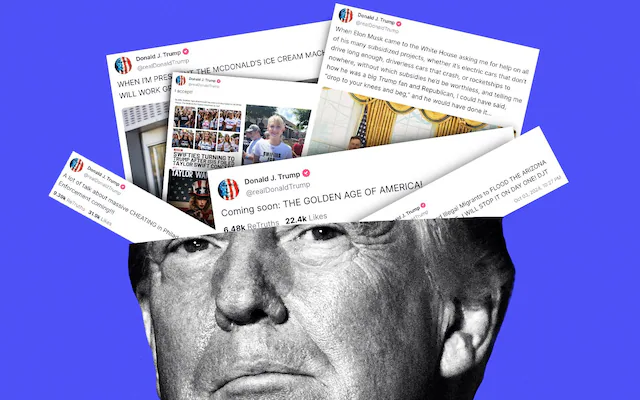
For a newspaper that bills itself as the paper of record, the New York Times is falling short on one of the strangest and most important stories in American history: the fact that the sitting president communicates with the country through a self-made social media echo chamber, largely unfiltered, often unhinged, and always revealing.

Even if you argue these rants are not traditionally “newsworthy,” the sheer accumulation of them demands attention. What matters is not whether they pass the usual editorial test, but that they show the unfiltered state of mind of a commander-in-chief whose words reach millions.

The case for a dedicated Trump Truth beat is straightforward. This is not about platforming every outrageous claim. It is about chronicling history in real time.

When Franklin Roosevelt took to the radio for his Fireside Chats, the press covered them not because they were universally wise or profound, but because the president of the United States had chosen that medium to speak directly to the people.

The same is true now. Truth Social is Trump’s version of a fireside chat, only the fire is gasoline.

To understand the scale of what the Times is ignoring, consider just a handful of recent posts:

  • Trump branded the Democratic Party “the party of hate, evil, and Satan.”
  • He amplified an AI-generated video mocking Chuck Schumer in a yarmulke and Hakeem Jeffries in a sombrero, reducing them to crude ethnic stereotypes.
  • He accused the FBI of planting more than 270 undercover agents to incite the violence of Jan. 6.
  • He threatened to cut federal funding to colleges that allowed what he called “illegal protests.”
  • He shared a campaign message that included the phrase “unified reich,” language pulled from the darkest corners of 20th-century history.

Each of these is unprecedented for a U.S. president. Each of these is worthy of front-page coverage, not buried in the back of the paper or left to cable news chatter.

By failing to treat Truth Social as a daily reporting assignment, the Times leaves the record to partisan outlets and second-hand summaries. That is a disservice both to readers and to history.

There is an argument, of course, that coverage only magnifies Trump’s messaging. The Times fears becoming a megaphone.

But journalism is not about comfort. It is about bearing witness. The paper’s editors know this, which is why they report on war atrocities even at the risk of amplifying propaganda.

Truth Social is a battlefield of its own, one where the commander in chief fires off salvos at his enemies, at institutions, at democratic norms. To ignore those salvos is to deny the public the raw evidence of what leadership looks like under Trump.

Think, too, of the practical function of a dedicated beat. A Trump Truth reporter would do what no single journalist has time for now: track every post, confirm its accuracy, trace its origins, and place it in context. Was that meme lifted from a fringe site? Did that accusation come from a debunked conspiracy? What is the intended audience?

These are not questions for an op-ed. They are questions for the news pages, and they deserve daily answers.

The Times has always understood that the presidency demands special scrutiny. It maintains a White House team, a Capitol Hill team, even a Supreme Court desk.

Yet the loudest, most revealing channel of presidential communication has no dedicated reporter. Instead, Truth Social slips by piecemeal, covered sporadically, with the most explosive posts often filtered through outside sources.

Imagine future historians combing the archives and finding scattered references, instead of a steady record. The absence would look deliberate, as if the Times chose to shield readers from their own president’s words.

A Trump Truth beat would also provide accountability. By cataloging posts in real time, the Times would make it harder for Trump to revise or erase his statements. Already, he deletes or edits posts once they draw fire. A beat reporter would capture those digital footprints before they vanish. That is journalism at its most basic: preserving the record.

The public appetite is there. Readers want clarity about what is true, what is false, and what is dangerous. A single column or occasional news story cannot provide that clarity.

A beat can. And in a media environment where outrage travels faster than fact, the Times could reclaim its role as the steady hand, the trusted ledger.

Trump has given the country a daily window into his thinking. He has chosen Truth Social as the glass. The New York Times should choose to look through it, directly and consistently, not with one eye closed.

History is watching, and the record is being written with or without the paper of record.


Cần Giuộc What we know

  1. Initial removal
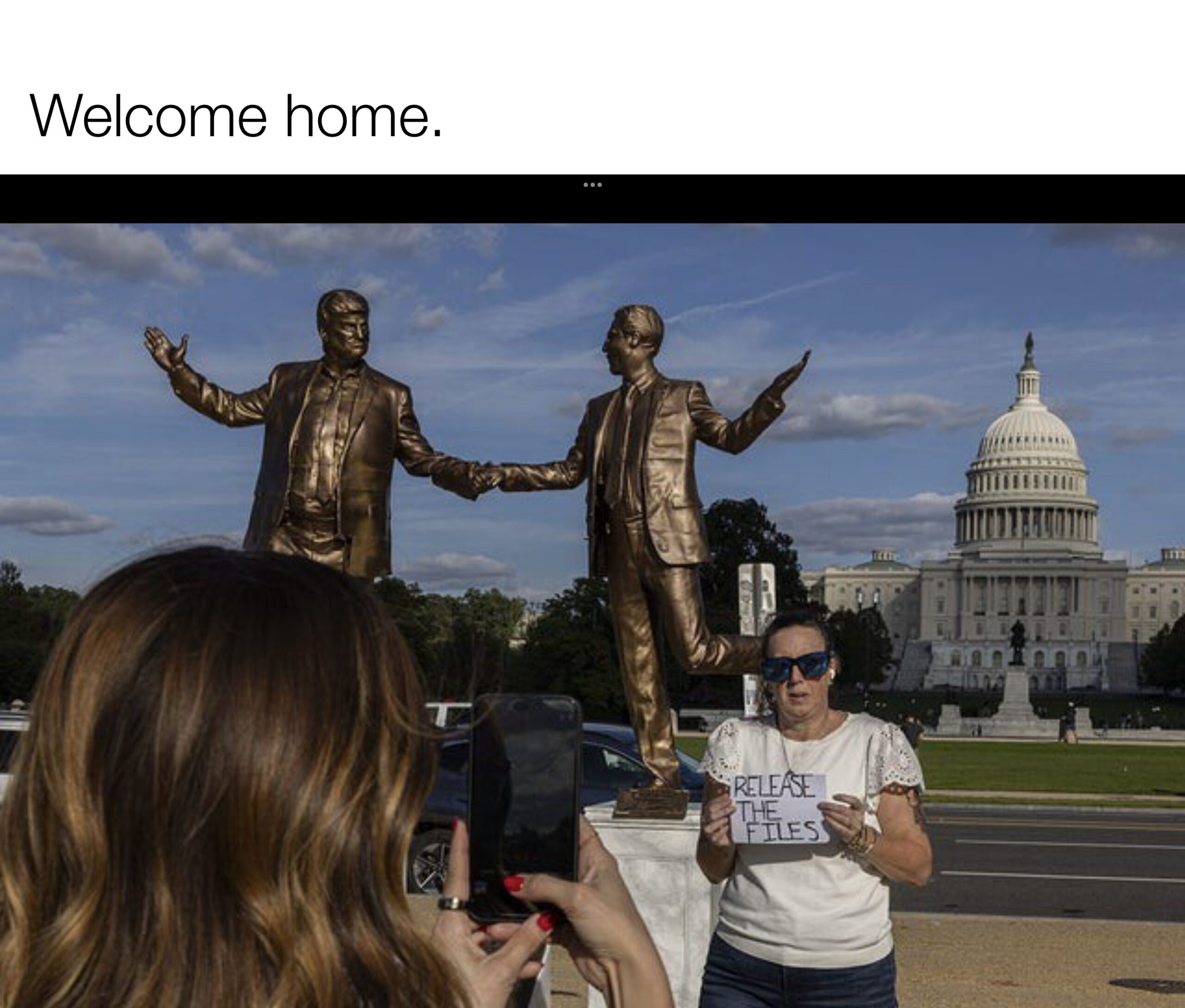
    The National Park Service (NPS) removed the statue because it was not compliant with permitting rules.  During that removal, parts of the statue were damaged—its hands had been disconnected, and sections were broken apart.  
  2. Repair and reassembly
    The artist group behind the statue (often called “The Secret Handshake”) repaired and reassembled it before reinstalling it.  They restored it “mostly intact,” with only minor damage still visible (for example, where joins had been stressed).  
  3. Permit reapproval
    The crucial procedural move was securing a fresh permit—or having one approved—so that the installation was legally permissible.  According to a Sept. 30 email, the NPS acknowledged a permit application and stated that, by rule, the application is deemed granted within 24 hours unless a denial is issued.  Because of a federal government shutdown, the Park Service was unable to publicly comment immediately, which may have made the timing easier.  
  4. Reinstallation
    With the permit accepted (or not denied) and the statue restored, the group re-installed the statue on the Mall.  It was placed back in its former location, hands clasped, rebuild complete.