Category Archives: The Everyman Chronicles
The Word Worth a Thousand Photos
(Part of an occasional series, because, well, most fuckers don’t deserve the headlines they get.)

Ronan Mattin doesn’t say much. But in these bloviated days…Maybe just enough, in fact.
See, Ronan is autistic. Or on the spectrum. Or however we’re limbo-ing around words we’re unable to admit we live, let alone utter: Ronan is sick, so infirmed he rarely communicates with words. I became so enamored of Ronan I looked up local Boston-area TV stations who interviewed the 9-year-old.
Or tried to interview him. Whenever a stranger asked him a question, Ronan would put his forefinger to his thumb, forming a circle he’d place on his lower lip. As if his hand was closing the lock to his mouth. But he was an adorable kid, never losing the smile or earnest head nod. But never speaking, either.
During one interview, Ronan’s grandfather put on classical music. The lock dropped away. The mouth opened into into a smile that make emoticons jealous. He ran to his grandfather’s lap to look at the classical album he began. “That’s how he communicates,” grandad said.
The grandfather had taken his progeny last week to see The Handel & Haydn Society, which had just finished its rendition of Mozart’s “Masonic Funeral” at Boston’s Symphony Hall. As the piece settled to its conclusion, Ronan could not help but blurt loudly: “WOW!”
Boston classical music station WCRB-FM, which was recording the concert, captured the exuberance on audio. The crowd can be heard bursting first into laughter and then rousing applause for the child. “That actually brought me to tears,” said concertgoer Mary Jane Leach, of Valley Falls, New York.
The Handel Society (America’s oldest performing arts group) launched a viral “Find the WOW Child” campaign, which quickly did. The Handel Society introduced Ronan to Harry Christophers, the society’s artistic director who was conducting the night of the performance. They then handed kid and grandpa a pair of tickets where the two would be the guest of honor.
The lock circle had returned to Ronan’s mouth by the time he took the tickets from Christophers. Granddad put a gentle hand to Ronan’s head. “What do we say when someone does something nice?”
“Thank you,” Ronan eked.
Doesn’t say much. Just enough, in fact.
Havlicek Stole the Ball!
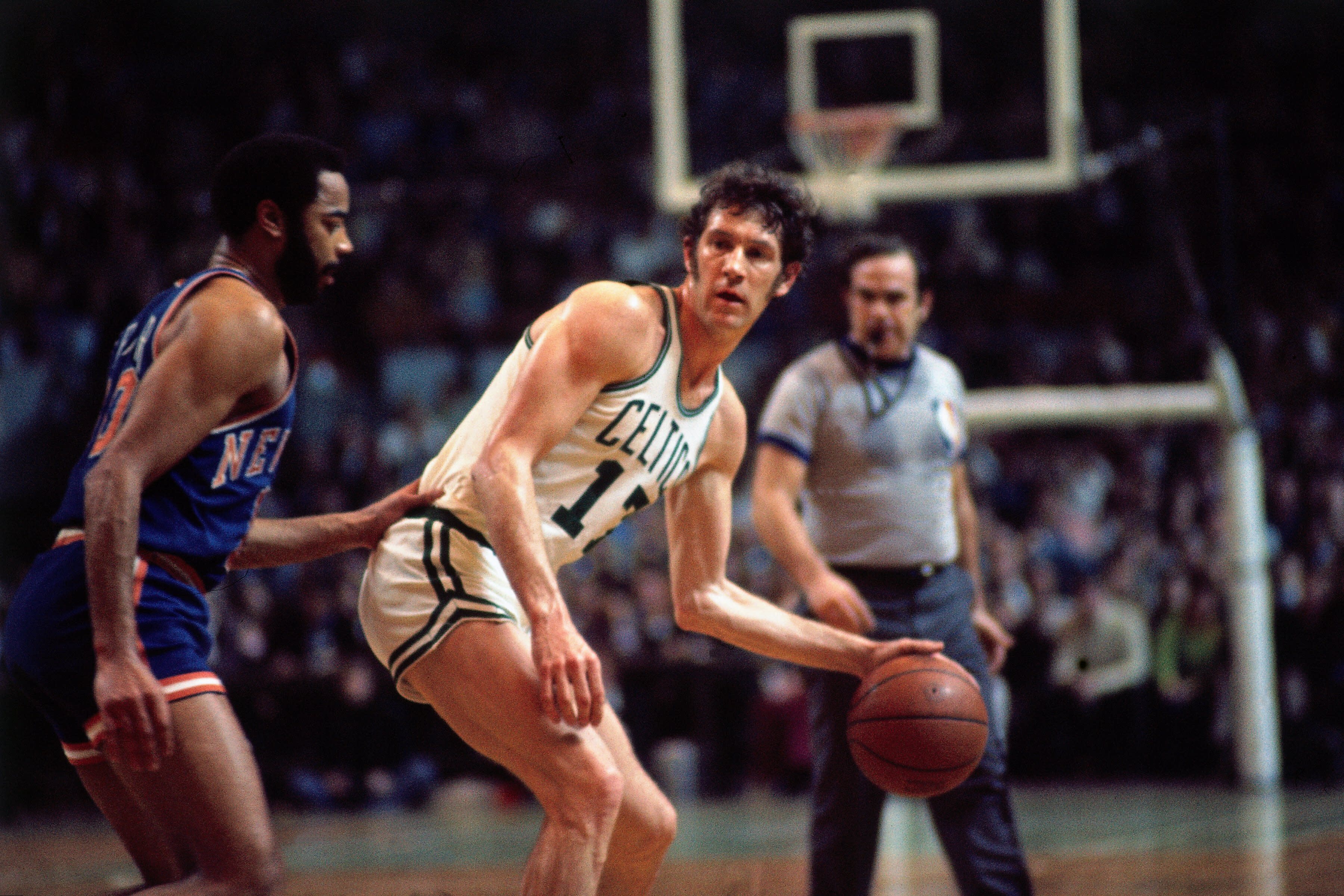
Living in LA, I know this is heresy, but fuck it. Heretics are some of my favorite sinners. And this is my heretical confession: Celtic blood runs through my veins.
And my blood ran a little cold yesterday; John Havlicek died.
I never saw Havlicek play a game in his life. But, in many ways, Havlicek, nicknamed “Hondo,” bonded me with my father. He would tell me stories of the Celtics in the 50’s, 60’s and 70’s, when they were perhaps the most successful professional sports team in history, regardless of sport. Bill Russell, Bob Cousy, Jo Jo White, Dave Cowens and John Havlicek made up their core, and dad would spend hours telling me stories of their unselfish heroism. And the Celts had the record to prove it: They won eight straight world championships from 1959 to 1966, and 12 out of 18 through 1976. 
As I got older, my fandom intensified. Larry Bird became my Havlicek.  Though we lived in Detroit, we had a hifi system the size of a Buick. On clear night, we could hear Boston games as relayed by WBZ commentator Johnny Most, a guy whose voice sounded like he gargled with vinegar and gravel. Many a night, bedtime required I turn in before the game ended. Every morning, dad would leave an index card on the kitchen table for me, with the game’s outcome and players’ stats. I may even have become a journalist to bond with dad, but that’s another story.
My favorite of dad’s stories centered on Hondo and the pick-and-roll. A pick-and-roll is when a defender is covering you too closely to get a shot off. So Havlicek would dribble as fast as he could past a big teammate, usually Russell or Cowens, who acted as a human barricade for Hondo. Havlicek would pass a teammate so closely their shoulders would brush, sending the inattentive defender careening into the monstrous men — and the floor. Today’s players use the move to clear a path for a flashy, ESPN-friendly dunk. Hondo, though, would simply leap for an unimpeded jump shot. “You’ve never seen someone pick-and-roll like Havlicek,” dad would say. “It was a thing of beauty.”

And devastation. Hondo would collect more hardware over his career than a carpenter: eight championship rings, 13 All-Star Games, inducted into the NBA’s 50 greatest ball players of all time. Oh, and he was drafted by the NFL’s Cleveland Browns, too, but took a less concussive path.
And he didn’t even start most games. Coach Red Auerbach would use Havlicek as a reserve as a sort of psychological torture: Can you imagine busting your ass chasing the starting Celtics for 10 minutes — only to see Havlicek take the court, fresh as a daisy? Russell, who owns 11 championship rings, calls him the most versatile player he’s ever seen. Four years after he retired, the NBA created the Sixth Man Award, to recognize great role players off the bench. Though the NBA won’t admit it, I’m convinced the award exists because of Havlicek.
Alas, he could not pick-and-roll Parkinson’s, which claimed him at 79 last night.
In honor of the man, I suggest two tributes. One, that the NBA officially change the name of the 6th Man Award to the John Havlicek Award. Shit, the award can even be informally shortened to winning a Hondo. Think of what that would mean to a bench player, to share such company.
The second is personal. I’ve never been a sports memorabilia person. When I worked the cop beat, an FBI agent told me at least 85% of autographs are forged. But if I ever happen into a shop and find Hondo’s playing card, or authentically-signed jersey, or come across a ball with his verifiable signature, I’m gonna do something different at the cash register.
Pick and roll.