Category Archives: The Contrarian

The Big, Beautiful B.S.


Los Patios If I hear “Big Beautiful Bill” much more, I’m going to have a big, beautiful barf.

http://landmarkinn.com/?plugin=calpress-event-calendar The phrase is everywhere now. It’s in press releases. Cable news. Op-eds. Podcasts. Even the jokes—especially the jokes—can’t stop repeating it.

And that’s exactly the problem.

This isn’t just about language. It’s about psychology. Specifically, the illusory truth effect—a well-documented phenomenon in cognitive science. The more you hear a phrase, the more familiar it feels. The more familiar it feels, the more likely your brain is to believe it.

Even if you know it’s false.

The Trump movement understands this. They’ve weaponized it for years, from “witch hunt” to “fake news” to “Kung Flu.” Say it, repeat it, laugh at it, meme it—just keep it moving. That’s the game. And now they’ve loaded it into legislation.

The One Big Beautiful Bill Act isn’t just a name. It’s a trap. It’s branding disguised as governance. And every time we echo the phrase—whether we’re mocking it or dissecting it—we reinforce it. That’s how illusory truths work: sarcasm still counts. Repetition is repetition.

So let’s call this bloated legislative creature what it is: the Megabill.

Because it’s massive. It’s packed with policy. And it’s laced with poison.

Start with the numbers. The Megabill clocks in at over $2.6 trillion, a Frankenstein of tax breaks for corporations, spending cuts for the poor, and gimmicky offsets for a debt ceiling that somehow keeps rising. The bill slashes EV tax credits. It imposes new work requirements on Medicaid. It greenlights oil leases and weakens environmental review. It’s the legislative equivalent of a vending machine for donors—and a locked cabinet for everyone else.

And yet all we keep hearing is how big and beautiful it is.

That phrase didn’t just appear. Trump and his House allies wrote it into the title. Formally. On purpose. As if policy didn’t matter—only branding did. Because, in their political calculus, that’s not just an insult. It’s a strategy.

And it works.

We’ve seen it before. When Trump wanted to discredit the Mueller investigation, he didn’t have to argue evidence. He just called it a “witch hunt”—over and over and over. Within months, the phrase eclipsed the findings. It became the frame. And for many voters, that was the truth that stuck.

Or take “fake news,” which started as a warning about misinformation and morphed, through Trump’s relentless repetition, into a punchline against journalism itself. It was clever. It was simple. It was repeated.

Then came the pandemic. Trump dubbed COVID-19 the “China virus,” then “Kung Flu.” Both racist. Both viral. Both repeated so often that they helped normalize anti-Asian slurs and sparked real-world violence. The repetition worked. Even when it hurt.

And then, in September 2024, came Springfield.

At a debate, Trump claimed—falsely and grotesquely—that Haitian immigrants in Springfield, Ohio, were “eating the dogs, eating the cats.” Local officials immediately debunked it. There was no evidence. But Trump repeated it again. And again. Soon there were bomb threats at schools. Police patrols at shelters. A city under siege from a lie that had been said too many times to ignore.

That’s how the illusory truth effect works. Say anything loud enough, long enough, and even the absurd becomes ambient. Even the disgusting becomes debate.

Which brings us back to this bill.

The Big Beautiful Bill is not big for working families. It is not beautiful for the climate. It is not a bill that anyone outside of a donor circle should celebrate. It is a wrecking ball painted gold.

But every time it’s repeated—especially by critics—it gains ground. Every repetition, no matter how ironic, becomes another thread in the flag.

So here’s the fix: stop saying it.

Mention it once if you must, as a quote. Attribute it to Trump, and move on. Do not center it. Do not headline it. Do not hashtag it.

Call the legislation what it actually is—a Megabill. Call it massive. Call it reckless. Call it what it is, not what it’s pretending to be.

Because if we don’t learn to fight linguistic propaganda with linguistic precision, we will lose—not just the messaging war, but the substance underneath it.

We’ve been here before. We’ve seen the damage repetition can do. And if we keep repeating this phrase—even with our tongues in cheek—we’ll be left holding the punchline to someone else’s lie.

The more you say “Big Beautiful Bill,” the more real it becomes—so stop saying it, and start naming what it really is: a Megabill in makeup.
The Jackboot Doctrine: Martial Farce in L.A.


They came in Humvees, flak jackets, and silence.

Seven hundred Marines, fresh out of Twentynine Palms, rolled into Los Angeles under federal orders not requested, not needed, and not lawful. Backed by 2,100 federalized National Guard troops, they weren’t sent to aid in wildfire relief. They weren’t here for earthquakes. They came because Donald Trump didn’t like the sound of protest.

And now the city that helped define protest in the 1960s finds itself staring down a militarized bluff from a president who still hasn’t invoked the Insurrection Act—but is practically begging for an excuse to.

Make no mistake: this is a test deployment.

The mission, officially, is to “protect federal property and personnel,” a recycled justification from the playbook of authoritarian ambition. Protesters have rallied near ICE offices and federal courthouses, furious over the latest wave of raids and deportations ordered by Trump’s second-term crackdown on immigration. And so, like a fever dream of Nixon with better tanks, Trump dispatched troops to California’s largest city without consulting the state or its people.

It is, legally, a flex. The Marines cannot arrest. They cannot search, seize, or subdue. That’s thanks to the Posse Comitatus Act of 1878, which prohibits active-duty military from engaging in domestic law enforcement. Unless, of course, the president invokes the Insurrection Act, which allows that very thing if rebellion—or the threat of it—is declared.

Which is why this should terrify anyone west of Washington.

Trump doesn’t need cause. He needs a headline.

And all it takes is a protest that lingers too long, or a Molotov too close to a federal office, and a general somewhere with political ambitions might declare, “Sir, we have grounds.” The invocation of the Insurrection Act then becomes a matter not of law, but of loyalty.

What we’re witnessing is not just a violation of California’s sovereignty. It’s the execution of a doctrine that says statehood is conditional. That red states may govern themselves, but blue states must kneel.

If this were Alabama or Mississippi, does anyone truly believe Marines would be walking the streets without a governor’s request? Does anyone imagine the White House would override local mayors and police chiefs, bypass state legislatures, and roll armored vehicles into Jackson or Mobile?

California did not ask for help. California did not consent. But under Title 10 of the U.S. Code, Trump federalized the Guard and dispatched Marines under the claim of “imminent threat to federal property.” That phrase is now as elastic as “weapons of mass destruction” or “enhanced interrogation.” It is language meant to bypass Congress, bulldoze governors, and dare the courts to keep up.

Let’s pause for a moment on what these Marines can and cannot do:

  • ✅ Can: Protect federal facilities (ICE offices, courthouses, storage depots)
  • ✅ Can: Assist National Guard troops with logistics and security perimeters
  • ✅ Can: Intimidate with presence
  • ❌ Cannot: Make arrests
  • ❌ Cannot: Search private property
  • ❌ Cannot: Engage in direct law enforcement
  • ❌ Cannot: Use force on civilians unless under Insurrection Act

Yet how many Americans will stop to parse legal nuance when they see camouflage-clad soldiers flanking downtown?

This isn’t law and order. It’s theater and threat.

And it’s drenched in hypocrisy.

For decades, Republicans have cloaked themselves in the sanctity of states’ rights—a banner they unfurled to fight desegregation, defy the EPA, and dismantle the Voting Rights Act. But suddenly, when California defends immigrants, when Los Angeles refuses to become a staging ground for ICE raids, states’ rights vanish beneath the treads of a military convoy.

The truth is, states’ rights have always been a conditional principle on the American right: sacred only when they serve federal power’s retreat. And now, in 2025, that retreat has reversed direction.

Trump’s calculus is simple. Create chaos, claim control. The border is his excuse, California is his foil, and the Marines are his middle finger to anyone still clinging to the illusion of federalism.

Meanwhile, LA officials—mayors, councilmembers, police—are left in the dark. Governor Newsom, along with Attorney General Rob Bonta, has sued the federal government, calling the deployment “unconstitutional and unlawful.” But litigation moves at the pace of molasses, while military boots move at 60 mph.

This is the paradox of protest under authoritarian drift: the more peaceful your demonstration, the easier it is to ignore. The more urgent your cries, the more quickly they’re criminalized.

And somewhere, a president who has already spoken warmly of military rule in other nations watches the results unfold. He doesn’t need Los Angeles to explode. He needs one spark. One tweet’s worth of footage. One moment of unrest to spin as a civil war.

Because then, the Insurrection Act is “needed.”

Then, Posse Comitatus is “suspended.”

Then, the Marines go from standing by to standing in.

And then, California burns not from fire, but from betrayal.

The Battle for Los Angeles


Trump is laying kindling.

As he ramps up talk of “rigged elections,” “invasions” at the border, and “fighting like hell,” the country inches toward something darker than political division.

Since January 2021, more than 300 acts of political violence have been recorded nationwide, with over 50 in the first half of 2024 alone. Federal data shows threats against election workers, judges, and lawmakers rising each month.

Trump’s rhetoric isn’t abstract.

Before January 6, he told supporters to “fight like hell” or “you’re not going to have a country anymore.” Today, that language persists—now layered with calls to “lock and load,” promises of “retribution,” and boasts about deploying troops to American cities without state approval.

This is not normal political speech.

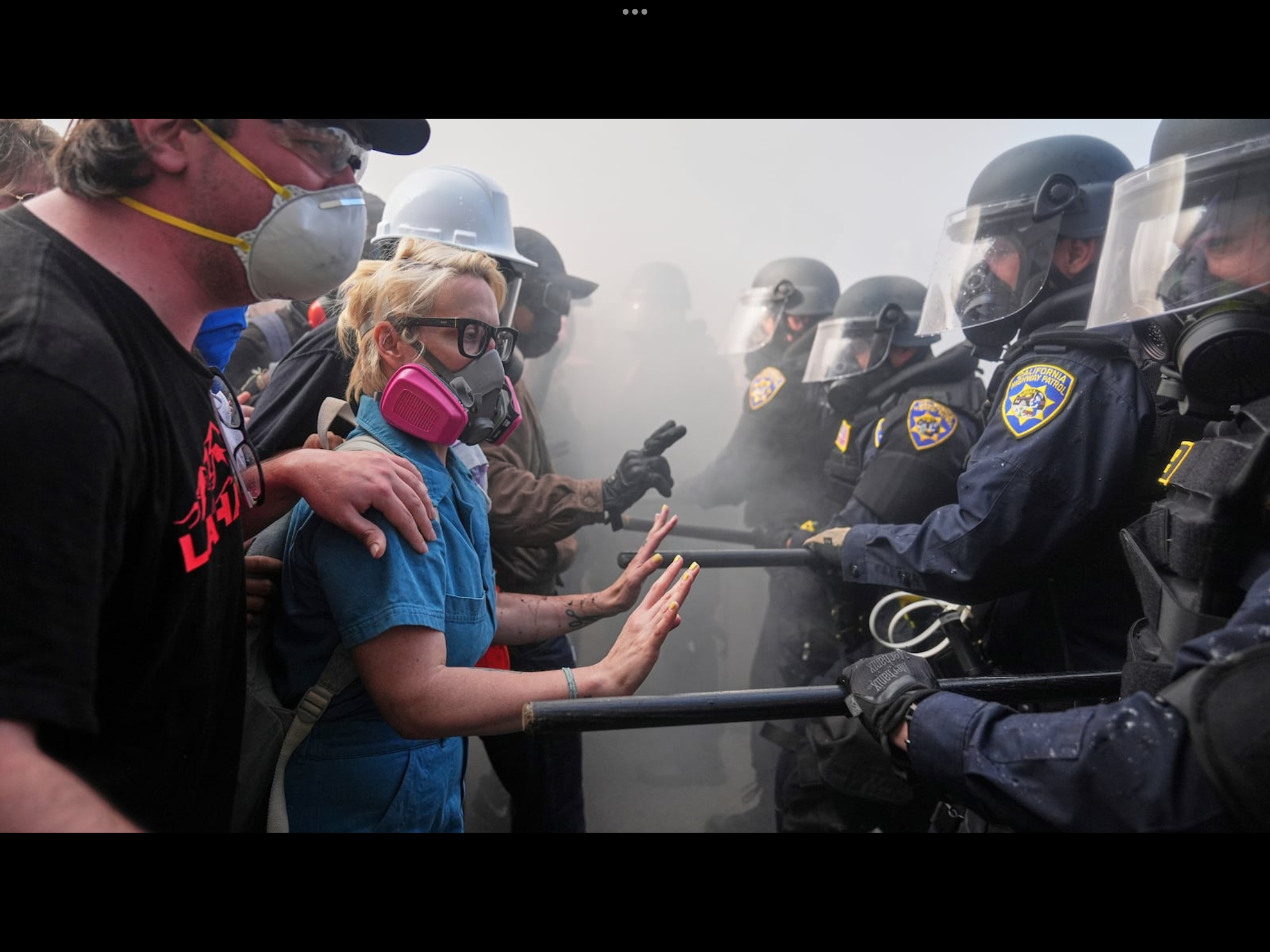
In Los Angeles this spring, violent clashes erupted around ICE protests. Masked demonstrators. Burning vehicles. Tear gas in downtown streets. Trump responded not with calls for calm—but by praising federal force and urging more. Over 2,000 National Guard troops arrived—without the governor’s request.

And the militias are listening.

Proud Boys, Oath Keepers, Boogaloo groups—all born from Trump’s era—speak openly of “civil war,” “1776,” and “taking back” the country. Many participated in January 6. Many remain armed and ready.

Meanwhile, Trump’s Department of Justice has shifted thousands of agents from counterterrorism to immigration enforcement—over 10,000 arrests last year. Critics warn this tilt undermines true national security, prioritizing political theater over actual threats.

The result? Dissent is reframed as insurrection. Protest is painted as war.

Polls show fewer than 5% of Americans support violence to achieve political goals. But in a nation of 330 million, 5% is a powder keg. And Trump’s words pour gasoline.

Is he calling for civil war outright? No.

Is he stoking grievance, glorifying force, and signaling to armed followers? Without question.

This is a campaign built on menace. Trump doesn’t need a civil war—he needs chaos, fear, and enough violence to delegitimize defeat or justify power grabs.

The match is in his hand.

How long before he strikes it?