Category Archives: Reviews

You Talkin’ to Me?

Joe Pesci, left, and Robert De Niro have drinks in a bar in a scene from Martin Scorsese's "The Irishman."

You could make an arguable case that not only is Martin Scorsese America’s greatest living director, but that he’s made the best movie of every decade dating back to the 1970’s. There was Taxi Driver (1976),  Raging Bull (1980),  Goodfellas (1990) and The Departed (2006), all considered masterworks of their time. Even casual moviegoers are likely familiar with Scorsese’s cinematic hallmarks: violence, corruption and an anti-hero spiraling uncontrollably toward a violent fate.

The Irishman is not your average Martin Scorsese film. Sprawling, intimate and oftentimes surprisingly melancholy, Irishman is a moving portrait of the emotional toll of sitting atop the mob underworld.

While the director has tackled daunting subjects before, ranging from Howard Hughes (The Aviator) to Jesus (The Last Temptation of Christ), this may be Scorsese’s most ambitious film yet, spanning most of the 20th Century and using 210 minutes to do it. This bears repeating: Irishman is 15 minutes longer than Titanic. Is it too long? By at least a half hour. Does that dilute the film? Hardly.

For one thing, the director has assembled the Holy Trinity of actors in Robert De Niro, Al Pacino and Joe Pesci. Scorsese could have had the trio reading baking recipes and it probably would have made for compelling viewing.

Here, they gather for the first time in deeply delivered portrayals. De Niro plays the titular character, a World War II-vet-turned-Teamster driver named Frank Sheeran that ends up as a middle man between mafia don Russell Bufalino (Pesci) and the hot-headed-but-lovable union boss Jimmy Hoffa (Pacino). The movie is told from Sheeran’s point of view; he matter-of-factly narrates the story from his perch in an elderly care center. Sheeran recalls his years working for the Bufalino crime family, reflects on his biggest hits and considers his involvement with his good friend Jimmy Hoffa’s disappearance in 1975.

De Niro is terrific, but it’s Pacino and Pesci who truly light up the screen. As Hoffa, Pacino gets to barnstorm the story, giving Irishman most of its kinetic energy. Pesci, meanwhile, who was talked out of retirement to return to acting for the first time in nine years, nearly makes the film unexpected single-handedly. While he was the violent hothead in Scorsese classics including Bull, Goodfellas and Casino, here he infuses the movie with palpable menace simply with a brooding stoicism.

Their performances are augmented by the film’s astounding “de-aging” software. While at first jarring, the special effect is soon a natural element of the world Irishman is creating and becomes as unnoticeable as, say, the special effects in the CGI remake of The Lion King. The 76-year-old De Niro, in particular, transforms from fresh-scrubbed World War II soldier to wrinkled, white-haired octogenarian.  The de-aging is especially effective in the outstanding third act, when Sheeran’s once-fearsome hitman devolves into just another senior citizen who must come to grips with both his past and mortality.

But Irishman offers more than special effects. Screenwriter Steven Zaillian (Moneyball) crams the screenplay with some crackling wit (all without using tired mob dialogue like “fugghedaboutit” or references to guys getting “whacked”). Instead, we get a surprising dose of humor: an animated Hoffa explaining how to best fight a man, depending on whether he’s armed with a knife or gun;  hitmen grousing about smelly fish in the car on their way to a murder; or mob miscreants spiking watermelon with liquor during a sit-down meal. And Ray Romano supplies some laugh-out-loud scenes as De Niro’s perpetually frazzled attorney.

While Scorsese knows violence chapter and verse, he’s also made some melancholic pictures, including The Age of Innocence (1993) and Hugo (2011). Irishman has him working out of both lenses. Yes, we get violence, nearly as soon as Pacino introduces himself to De Niro with the line “I hear you paint houses” — a wink-wink reference to the blood that splatters the walls after a hit.

But what’s striking about the movie is an introspective spirituality that runs through the narrative. This isn’t Ray Liotta declaring in Goodfellas “My whole life I wanted to be a gangster!”  Instead, De Niro is conflicted about his role in the premature deaths of others, right up until his final moments on screen. A young Scorsese could not have made Irishman, just as today’s Scorsese likely could have not made Goodfellas.

Which brings us back to what is possibly Irishman‘s biggest hurdle for audiences: its 3 1/2-hour running time. Oddly, Netflix may be a suitable venue for the film (the streaming service picked up the $170 million movie when Paramount balked). While Scorsese’s underbelly films always look better through the prism of a theater screen, Irishman is in many ways a throwback picture, both in scope and star power. It could also use an intermission. A pause button and smaller screen will not ruin this experience.

Regardless of how you view the film, Irishman deserves viewing. Five years ago, even the notion of such a film seemed impossible, from its de-aging special effects to its availability on TV three weeks after its debut. But let’s face it: The Irishman may be the capstone film of four silver screen legends, turning in performances reminiscent of their mob-story heydays. That’s an offer you really shouldn’t refuse.

Why Studios Should Be Terrified of ‘El Camino: A Breaking Bad Movie’

Image result for el camino a breaking bad movie premiere

Breaking Bad has always kept fans on edge with black humor, inescapable pickles and miraculous getaways.  But with the premiere this month of El Camino: A Breaking Bad Movie, it’s theaters and studios that may be nervous.

Camino reached nearly 8.2 million viewers its opening weekend, according to data from the ratings company Nielsen. The firm’s SVOD Content Ratings service — a new metric for Nielsen — also found the film drew an average minute audience of 6.5 million, with 2.6 million of that coming on its October 11 opening day. Not bad for a show that has been off the air for six years.

But look closer, and you’ll see storm clouds forming in the data. Consider these comparisons with movies that opened in theaters this year:

  • The debut was one of the year’s biggest. The average cost of a movie ticket in America is $9.01, according to Box Office Mojo. That means that, had Camino opened in theaters and performed comparably, it would have secured an opening weekend of $73.8 million or $58.5 million, depending on whether you’re measuring those who briefly tuned into the film or those who watched all the way through. Either way, Camino would have scored the ninth- or the 11th-biggest debut of 2019.
  • The numbers are likely conservative. As Nielsen measures the number of households watching, not the individuals as standard exhibitors measure, the opening was almost certainly larger.
  • Streaming is being taken more seriously. For years, Netflix refused to release viewership data. But in October 2017, Nielsen announced its Streaming Video On Demand (SVOD) Content Ratings system, making Netflix’s marquis shows measurable. As new competitors enter the streaming fray, Nielsen will be pressured to monitor more services — and their products.

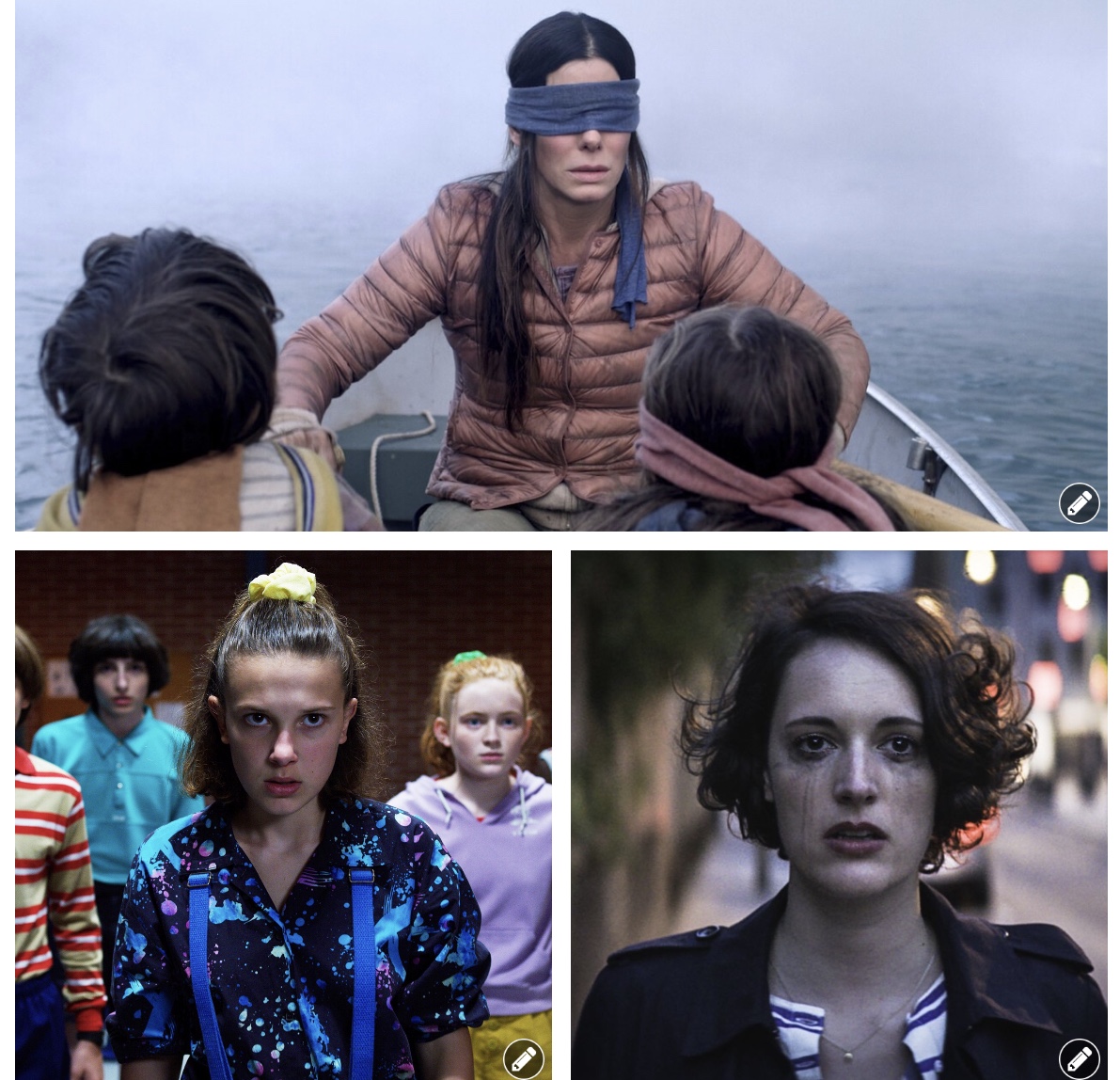
Streamers like Netflix and Amazon have had their share of hits, from Birdbox to Stranger Things to Fleabag. But the companies’ larger strategy is not just about securing hits. The larger target is moviegoing as a whole, and the cinematic landscape is shifting beneath theater owners’ feet. Traditionally, exhibitors have had three months to collect ticket revenues before movies made their way to video.

Now that three month window could be shutting fast. Netflix’s Oscar-hopeful entry this year will be Martin Scorsese’s crime saga The Irishman. Typically, the $169 million film starring Robert DeNiro, Al Pacino, Joe Pesci, would have had run of the theaters through the holiday season. This year, however, it will have only a 27-day theatrical run until it hits TV sets.Image result for the irishman

And if Irishman scores Netflix its first Best Picture Oscar, look for other streaming services to follow suit. Already, Disney+ is heavily advertising its new show to kickoff the service, The Mandalorian, a live-action Star Wars series. Disney and Apple are expected to compete fiercely with Netflix, Amazon, Hulu and other streamers; could original content movies be far behind? Disney+, in particular, will face consumer and corporate pressure to bring more of its properties, from Marvel to Pixar studios, to the on-demand stage.

Already, studios are facing an ugly theatrical truth: audiences don’t mind looking at small screens. From users of smartphones to tablets to laptops to work computers, U.S. viewers seem less and less concerned with the theatrical experience writ small. Already, major studios Warner Bros. and Universal are both said to be considering early video-on-demand releases in 2019 – something that won’t sit very well with theaters.

Directing heavyweights including Steven Spielberg and Christopher Nolan have decried the small-screen experience, and refused to embrace most streaming services. But the Academy Board of Governors has ruled streaming films are viable for Oscar contention, and the defection of filmmakers like Scorsese, David Fincher and others have forced studio chiefs to admit they find themselves on the cinematic tightrope.Image result for steven spielberg and christopher nolan

“Consumers are loving the on-demand world,” Toby Emmerich, president and chief content officer of Warner Bros. Pictures, told The Hollywood Reporter. “The challenge is how to motivate people to commit their time and energy to go to a movie that starts when the movie theater says it does. A movie has to be an event, or it has to be breathtakingly good. There’s never been a smaller margin of error.”

https://www.youtube.com/watch?v=bkdjMxTdrU8


“Fire in the Hole, Bitch.”

Image result for el camino breaking bad

One of the beauties of Breaking Bad TV series was that no truth occurred without consequences: dead bodies needed disposing; stolen money had to be laundered; sins did not go unpunished.

And so it goes with El Camino: A Breaking Bad Movie, the searing new film from Netflix and series creator Vince Gilligan. Taught, tense and forever-time-hopping, Camino is a fitting bookend to one of the finest shows ever on television.

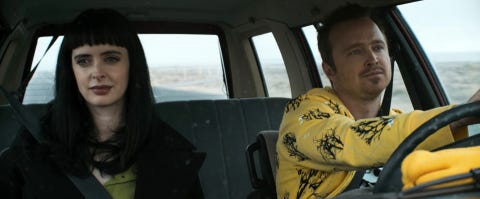
Written and directed by Gilligan, Camino deftly maintains the momentum of the series, even though it ended six years ago, thanks to star Aaron Paul, who always gave the show its sense of levity and, despite being a meth-sling dope dealer, likability as Jesse Pinkman. Despite some missteps on the big screen recently like Need for Speed, Paul demonstrates his range again in Camino. The movie looks terrific, sounds great and if you’re a fan, is filled with references and cameos that are sure to amuse show diehards.Image result for el camino breaking bad

Like many Breaking Bad episodes, Camino picks up immediately where the last scene left off. In this case, its aftermath of the 2013 Breaking Bad finale, with Jesse driving away from the bloodbath that left a lot of neo-Nazis, and also Bryan Cranston’s Walter White, dead. While some series viewers may have assumed Jesse drove off into the sunset, true Breaking Bad fans know the series settles for no such tropes. Jesse remains a fugitive in Camino, on the run from both cops and criminals, who are  sometimes hard to tell apart.

Bad was always a stylish thriller, and in Camino, Gilligan directs just as energetically with a bigger-looking budget and flashier pyrotechnics. In many ways, Camino serves both a reunion show and an alternative series finale (although the original one was terrific).Image result for el camino breaking bad

But make no mistake: with Walt left for dead in the Bad finale, Camino is Jesse’s story through and through. Flashbacks allow dead favorites like mentor Mike (Jonathan Banks), girlfriend Jane (Krysten Ritter), and Walt himself prod Jesse toward a lifestyle change: “Only you can decide what’s best for you,” one character advises him.

But what’s best, Jesse and Camino decide, is a little retribution sprinkled with a lot of freedom. It’s a simple theme, and fodder for countless films and TV series. But in Gilligan’s hands, you’ll find little that resembles a stereotypical film or series.

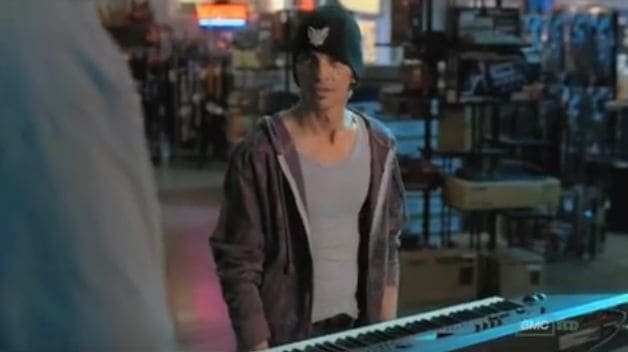
Part of what makes Camino hum is not the continuation of a compelling story, but the unexpected prequel-izing it does with characters we thought we knew, particularly Skinny Pete (Charles Baker) and Todd (Jesse Plemons). We knew Pete was surprisingly sophisticated (he once memorably  tickled the ivories in a BB episode), but Camino establishes him as a near-paternal friend. Baker is mesmerizing; at a little over two hours, it’s a shame Camino couldn’t fit him into more scenes.Image result for skinny pete play piano

The true jaw-dropper, though, is Plemons (Fargo TV series). Todd was always an only-half-detestable killer who was hardly one of the series’ multiple evil geniuses. Here, though, his sociopathic tendencies are on full display. In one scene, he sings the virtues of a bystander he killed without a second thought. In another, Plemons provides the funniest scene in the movie as he drives down the highway after an atrocity, crooning to Dr. Hook’s Sharing the Night Together, signaling like a kid for a passing big rig to sound its horn.Image result for el camino jesse plemons

Camino‘s final showdown lets Gilligan indulge his love of movie Westerns, which always informed the series. It may feel reminiscent of the show’s final episode, Felina, with its meticulous planning and execution. But, like Felina, it’s an example of the pinpoint technical proficiency and directing that runs through Camino.

If any elements of the movie disappoints fans, it may be the lack of surprises and plot twists. But this is, after all, supposed to be Breaking Bad’s final exit. Gilligan couldn’t afford any more questions that needed answers.

Instead, Camino‘s larger purpose may be for us to moderate our perspective about the show. Gilligan always described the series as Mr. Chips becomes Scarface, which was always Walter’s story. But perhaps Gilligan realized just how much narrative truly belonged to Jesse. And if you believed Jesse got short shrift in the finale, Camino goes a long way to making that narrative equitable. Either way, fans will remember just how good it can feel to break bad.