cheap disulfiram online Leave it to Banksy to not only demonstrate that art doesn’t stop just because life does, but to take a skewering jab at our base selves while doing it.
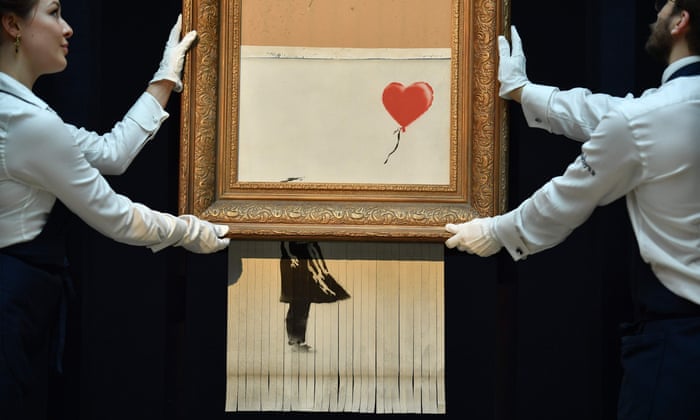
The world’s greatest tagger unveiled his latest work — on Twitter, of all places — earlier this week. Consider it a coronavirus consolation prize; normally his work is painted over by city employees or shredding itself at Sothey’s.
In the very finite reaches of cyberspace, however, Banksy’s work can be freeze-framed in a fashion that must tickle the artist. His latest, captioned My wife hates it when I work from home, even includes several closeups of the piece, as if he wants you to pay particular attention to some corners of the canvas.
People have certainly paid attention. It became a viral sensation, broke Twitter and even warranted coverage by the venerable institution TMZ. It and other outlets raved that the street-Warhol was telling fans that we are all in this together, that all of us are struggling to cope with the Everyday under the new world order.
I’m not so sure. Banksy has always been subversive in his expressions, and you can make an argument that he’s not casting us as victims of the virus. But that we are virus itself.
Consider: He could have used any animal running rampant through the house. Dogs. Cats. Roaches. Mice. Instead, he chose rats, the symbol of the bacteria bank that financed The Black Plague.In the 3-D work, the rodents have run roughshod over their own habitat.
Hoarded the essentials.
Consumed the vital resources.
Pissed all over the basin.
Sounds like a cautionary environmental message scratching about to me.
It’s hard to imagine Banksy not taking an alternate view of the pandemic. Considering he made his name throwing Molotov Cocktail bouquets into the middle of the modern-art landscape, could he be arguing that COVID-19 is not a virus, but an antibody?
Daughter Babylon, doomed to destruction, happy is the one who repays you according to what you have done to us. Happy is the one who seizes your infants and dashes them against the rocks.
— Psalms 137
It’s been one of the fundamental quandaries of the presidency of Donald J. Trump: How can a man so overtly dedicated to the banality of evil still retain widespread support among Christians?
This is the question that Netflix’s newest harrowing documentary, The Family, attempts to answer over five episodes. Directed by Jesse Moss (The Overnighters), the limited series is based on the non-fiction investigations The Family and C Street, written by Dartmouth College journalism professor and religious scholar Jeff Sharlet. And while the answer isn’t presented as cut-and-dry as it could be, The Family is a profoundly troubling examination of the theocracy that wields power behind-the-scenes in Washington D.C.
The Family, officially The Fellowship Foundation, is an aggregation of non-profit organizations that ostensibly work to spread the word and adhere to the teachings of Jesus. As Sharlet revealed in his books and as Moss expands on in The Family, however, there is a very thin line between evangelizing the work of Jesus and seeking access to those in power through spiritual obligation.
Through interviews with current and past members and true believers and skeptics in the faith community, The Family delves into the hierarchy of the secretive organization and its development into a behind-the-scenes powerhouse under its longtime associate director, Douglas Coe, who died in 2017. The narrative is helped immeasurably by the first-person account of Sharlet, who was unwittingly recruited into the organization and invited to live at Ivanwald, a communal living/indoctrination center for young men in Arlington, Va.
As the series unfolds, Trump’s actions that are seen as inexplicable and irredeemable by the secular press are revealed, through incredible leaps of logic and stunningly short-sighted Biblical interpretation, to actually be victories to this community that seeks power through proximity to important figures.
Trump is a “flawed vessel,” the “wolf king” that can wield power in Jesus’ name like no other. The Bible shows that great men can sin grievously – ever hear of King David and Bathsheba? In that light, his reprehensible actions don’t matter as much as the fact that Trump was chosen by a higher power, a selection that automatically puts him in a category unto himself. We are all Chosen, apparently, but some are much more Chosen than others and those people are to be deified.
The big frustration with The Family is that it explores so many different tentacles of the organization that it fails to come to a cohesive whole. The five hours could have spent drawing a clear throughline between the history of the Foundation and its impact – yes, complete with Russian meddling at the National Prayer Breakfast – up to the election of Trump; instead there are asides that aren’t as compelling, such as Moss’ participation in a local prayer group and visits to several foreign countries to see the international impact of the The Family’s efforts to advocate for anti-gay legislation.
In addition, recurring re-enactments of Sharlet’s experiences at the youth center run by The Family give it an unintentional CW cast-joins-a-cult vibe; most jarring in these sequences is the appearance of instantly recognizable James Cromwell as Coe.
The message, however, remains undiminished. There is a theocracy behind our country’s most baffling choices and its refusal to act is why a truckload of straw bales hasn’t been enough to break the camel’s back when it comes to some Christians and their love of Trump. The biggest sin of all, it appears, is believing in predestination.
Given its love of cats, serial killers and the 1970’s, Netflix has never earned (nor deserved) much credit for fodder that’s both entertaining and timely.
But in The Platform, the streamer may have stumbled onto a topical political allegory
Galder Gaztelu-Urrutia’s horror thriller has been a regular fixture on Netflix’s daily Top 10 since it hit the airwaves last Friday, and no wonder: with its generous helpings of cannibalism, suicide, starvation, blood, guts and feces, how could it not be a crowd-pleaser? A gnarly mash-up of midnight movie and social commentary, the picture is overly overt but undeniably effective, delivering genre jolts and broad messaging in equal measure.
David Desola and Pedro Rivero’s screenplay focuses on a brutal experiment in social conditioning and blunt Darwinism. In a vast, vertical prison, each floor consists of a single, small room, inhabited by two cellmates. In the middle of each room, down the center of the building, is a giant hole where a descending meal platform — a kind of mass dumbwaiter — stops once a day, for the briefest interval. It is loaded with food and drink at the beginning of its descent, and “if everyone ate only what they needed,” an administrator explains, “the food would reach the lowest levels.” But this is a 200-story prison, so if those on the higher floors stuff their faces (and they all do), things can get more than a little desperate down below.
Into this sky-high hellscape comes Goreng (Ivan Massagué), not a prisoner but a volunteer, who has signed on for six months as a guinea pig in exchange for an accredited diploma. But he’s horrified by the notion of the platform, and the violence it precipitates; “It’s fairer to ration out the food,” he reasons with his cellmate, who snarls, “Are you a communist?”
As political allegories go, Platform ranks somewhere between Animal Farm and a late-period South Park episode on the subtlety scale. Yet timing and circumstances have rendered its directness, the outright obviousness of its metaphors and messaging, into its greatest strength. When Netflix acquired the picture at last fall’s Toronto International Film Festival and set its spring streaming date, they couldn’t have imagined the kind of cultural nihilism it would tap into. But it does; this is a grim, bleak nightmare, where the only escape hinges on the conscious decision to help, value and share with one’s fellow man.
If ever there were a movie of our moment, this is it.

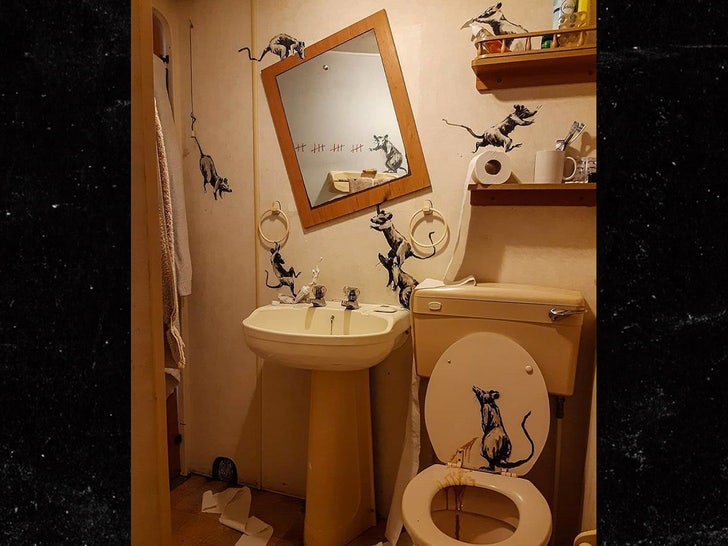
 In the 3-D work, the rodents have run roughshod over their own habitat.
 Hoarded the essentials.
 Consumed the vital resources.
 Pissed all over the basin.