Category Archives: Muddled Musings

A Name, By Any Other Rose


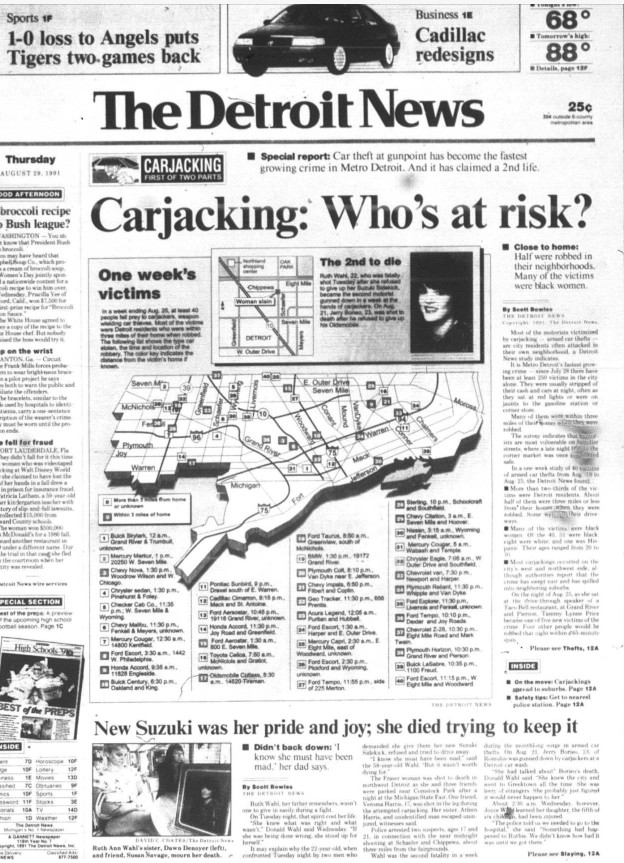
I had the honor last week of being interviewed by Detroit Public Radio for the 25th anniversary of the word “carjacking,” which we coined at the Detroit News in 1991.

The request stunned me. As did news that Wayne State University even had this copy in a file somewhere (and that WDET found it). Thank you to both.

For more than a decade, I’ve worked as a film critic. And have plenty of useless TMZ-like celebrity anecdotes with which to bore strangers. But to this day, few outside the family believe that the story above was the first time the word “carjacking” had ever been printed, or that I who wrote it. The interviewer, though, did her homework. Her questions were sharp, and raised urban myths I didn’t even know existed, like that the word was a riff of New Jack City, the movie that came out the same year.

I admitted I’ve still never seen the movie, though I know it was a hit. In truth, the word was just  a riff of hijacking; We needed something catchy, as the Detroit Police Department referred to the crime only as R.A./U.D.A.A. (Robbery Armed/Unauthorized Driving Away of an Automobile). The editors said I was free to do the project — as long as we had something better than R.A./U.D.A.A. It’s a mouthful  to type, let alone say or read read.

IMG_0871

But during the interview, I realized that the catch-phrase not only made my career; it helped helped me leave it.

Before we wrote the story, Detroit was already seeing a spike in the new crime. I mapped FORTY in one week. Then a kid, 21-year old Jerry Borieo, became the crime’s first official homicide victim. Six days later, a 22-year-old woman, Ruth Wahl was murdered for her Suzuki. We scrambled to turn the story. Slapped a copyright symbol on the article, splashed it on the front page, and skipped our way to catch-phrase infamy, network TV interviews,  even a Pulitzer Prize nomination.

And I was beginning my skip away, period. I realized, as we spoke in the radio interview, that the story marked my first step away from crime. How much of my life had been spent preying on the grieving: mothers of dead kids; witnesses to to the merciless; atrocities embodied? The greater their grief, the greater my story.

So as the Detroit News gained gravitas for recognizing  — and nicknaming — another city-borne plague, I was craving  the intentionally trivial: entertainment. I used the story’s cache to join People magazine as a freelancer to cover movies, a business that measures disaster in box office and claims as art Pauly Shore and Electric Boogaloo 2.

But it was the antidote to the palpable…sadness. And remains so. I’ll take the inane over the insane, any day. It’s a lot easier, I’ve discovered, to ask a studio exec why his movies suck than to ask a grieving mother how she’s feeling

Wrapping up the interview, the producer asked if I missed the city, nonetheless. I told her terribly: I keep spare Detroit Tigers bumper stickers as tribal symbols and emergency adhesive. tigersI miss the Renaissance Center (from Windsor, it looks like Detroit flipping Canada the bird)rencen; Greektown (which has very few actual Greeks); even the financial black hole that remains the People Mover (it only moves you in a small downtown circle).

But I especially miss the people who deal with real life, everyday. Like my oldest friend and his boy, who live there still.

There was an elderly woman I once interviewed at the News, known in the neighborhood simply as Ms. Hattie, who owned the last standing home on a crime-decimated block. I asked her why she refused to leave. She told me her mother gave birth to her there. That her love of that home was a helluva lot more powerful than her fear of thugs.

That’s Detroit. No matter what catch-phrase you give it.


Not.


You are not your age,
Nor the size of clothes you wear,
You are not a weight,
Or the colour of your hair.
You are not your name,
Or the dimples in your cheeks,
You are all the books you read,
And all the words you speak,
You are your croaky morning voice,
And the smiles you try to hide,
You’re the sweetness in your laughter,
And every tear you’ve cried,
You’re the songs you sing so loudly,
When you know you’re all alone,
You’re the places that you’ve been to,
And the one that you call home,
You’re the things that you believe in,
And the people that you love,
You’re the photos in your bedroom,
And the future you dream of,
You’re made of so much beauty,
But it seems that you forgot,
When you decided that you were defined,
By all the things you’re not.

e. hemingway

The Maturing — and Inevitable Breaking Bad Arc — of Better Call Saul


Pity poor James McGill.

He’s got a brilliant, condescending older brother who undermines his career dreams. He’s got such a penchant for scoundrels  he becomes known as ‘Slippin’ Jimmy’ in the neighborhood for his staged injuries. He has the Albuquerque branch of the Mexican drug cartel miffed.

And now he has to carry on the legacy of one of the greatest television shows of all-time, Breaking Bad.

Better Call Saul, which launched its second season this month, stands as a marked improvement over its smart-but-sporadic freshman year. Two episodes in, the series already has recovered some of the dark humor and violent tension that defined Vince Gilligan’s landmark preceding show.

Saul Goodman (Jimmy changed his name to match his motto: ‘S’all good, man.’) now has a love interest. A company  car and his own digs. He’s even smoothing out the relationship with soon-to-be hired gun Mike Ehrmantraut. mike n saul

Of course, that puts Saul — and creators Gilligan and co-creator Peter Gould — in something of a pickle. As the chronological predecessor to Breaking Bad, Better Call Saul must, eventually, return its hero to the place we first saw him: In Breaking Bad climes, as a pretty sleazy Yellow Pages injury attorney.

Consider how Saul was first described by Jesse Pinkman in Season 2, Episode 8 of Breaking Bad: When you’re up against the wall, “you don’t want a criminal lawyer. You want a criminal lawyer.”

And while he was great comic relief, Saul also was, in truth, a racist  and chauvinist. He openly propositioned his secretary Francesca (“You’re killing me with that booty”) and confided in Walter the reason he changed his name: “My real name’s McGill. The Jew thing I just do for the homeboys. They all want a pipe-hitting member of the tribe, so to speak.”

The Breaking Bad Saul even sassed the feds. In the same episode, he trades barbs with DEA macho man Hank Schrader, who offered an unsolicited review of Saul’s daytime TV commercials. “I’ve seen better acting in an epileptic whorehouse,” Hank taunted.

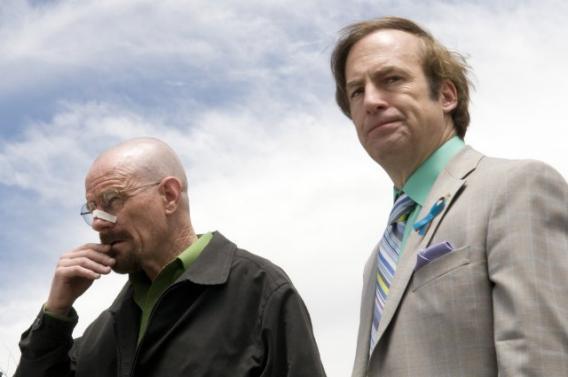
hank n saul

“Is that the one your mom works at?” Saul snapped back. “She still offering the two-for-one discount?” Saul is decidedly gentler in his own series, and Gilligan and Gould  would appear to have wedged themselves into a creative corner.

But Gilligan takes to pickles like a kosher dill. He is the first to admit he likes to write his characters into near-inescapable peril — then have them pull Houdini-esque escapes. Gilligan said he knew, for instance, that he wanted to end Season 2 of Breaking Bad with a plane crash, even though the series had been as landlocked as a dehydrated scorpion. So he wrote the season finale first, then retrofitted the story arc to include an airline disaster.

Shades of those darker grays are surfacing in Saul. Just as Walt slowly circled the drain into villainy in Breaking Bad, Saul appears headed for a fate that will change his law-office nickname from Charlie Hustle to Charlie Hustler. Just how dark a fate? In Gilligan’s hands, you’re almost scared to ask.

Still, Saul deserves credit for understatedly fixing what Hollywood movie studios still can’t: creating tension in a prequel. There’s a certain lack of suspense in an opening chapter: After all, your hero has to survive an origins story if chapter two is already written (and a hit). Gilligan and Gould circumvented that by making Better Caul Saul both flashback and prequel, leaving us to fret over his ultimate fate.

Of course, Saul the man still has a ways to go before he becomes a lovable lowlife, just as Saul the show faces its own challenges turning sinister: Mike continues to look older than he did in the “sequel” show, and capturing any of Breaking Bad‘s bleak lightning in a bottle would seem an impossible appeal.

But in the courtroom of television drama, even a shadow of Breaking Bad is a convincing argument. And in Gilligan’s and Gould’s hands, s’all good.