Dear reader, a confession:
This should have been written years ago. Or years from now. Regardless, the truth is the time will never feel right. For all of the hours I’ve embered over the coals of the topic, it’s never just right. Each new thought bears two more, and so on. Iterations never relent. I guess rough drafts are fine, though. Even Christians got a practice whack with the Old Testament, right?
So why not now?
Which, I guess, is the point of all this.
Jesus. It’s time to start a new religion.
I discovered this a few months ago, while watching an online debate between believers and non-believers and featuring Jim Jeffries, a talented comedian who wears his atheist badge proudly. And he does a wonderful skit on how the world’s population is essentially a three-car-railroad: the scientists and atheists in the front engine car, wussy agnostics in the one that follows, and the largest in the rear, believers weighing the train down. In the act, he pretends to be one of the atheists in front, considering pulling the pin from cars carrying the dimwits behind him. It’s a great skit. Do check it out.
But back to the show. Jeffries, as expected, was on the panel of non-believers, and bristled even at the term “atheist.” It’s absurd, he contended, to label something that doesn’t believe in something, and coyly rejected the label.
And with that, and before he could utter another word, he gave away the debate.
The problem with any argument staged between “believers” and “non-believers” is that non-believers are left in an uphill knife fight. To be of the camp “without faith” is to automatically surrender the debate.
Because faith is important. We atheists must accept this truth. It is integral to the fabric of what makes us human. We have turned the word into a synonym for religion, but that need not be.
Take early man. He fashioned a spear to hunt food. To do so, he had to use scientifically cognitive skills to fashion a blade that could pierce hide and kill game. Do we really think any of this would have happened without a fervent belief in evidence combined with ingenuity? Can we say with a straight face that astronauts who strap themselves into jet-powered tuna cans lack faith?
Regardless of whether it’s in a god or an otherwise higher agent, we need something to believe in. If anything, to not believe in something is to waste the miraculous gray matter that sits in our skull and scaffolds our very humanity.We are where we are, from the cosmic to microscopic scale, because of the flawed beauty of faith. So why reject it? That’s simply a rejection of us. Instead, what we need is a faith to buttress the natural world order that binds us all.
Enter Evidentialism.
Evidentialism is faith for atheists, a secular way of thinking parenthesized by belief.
Science is a Faith More Ardent than Any Religion
Ironically enough, the practice of Evidentialism could not be easier. In truth, nearly every human being practices it everyday, just without assigning a name to it.
This screed is not a rap against atheists, by any measure. But we need to practice what we preach (since we pull the Hypocrisy card on our counterparts). And let’s admit what is hardest to accept on the road to Evidentialism: Science is a Faith.
I know only one scientist, and she is the exception, not rule. Beyond her, I’ve yet to meet anyone even loosely connected to the sciences who will accept that. Proven is proven. H20 is two hydrogen atoms and one oxygen atom. Period.
But there was a time not long ago when scientists of their day believed Poseidon was the barkeep for all matters aquatic. Now, we can measure his realm on the sub-atomic level. Science evolves just as we do, and — unlike religion — is willing to update its commandments when evidence suggests. Why not put the strength of that truth into faith?
I know the mere use of that word brings flinches from non-believers, and this all seems antithetical to an idea as bulky as faith. But consider: Scientists debate the same matters as the shamen, from the ignition of life to its final candle blow. And there is no consensus among scientists. Yet they still make a choice. How? By looking at the work of those that preceded and joining a school of thought. How is that principally different than choosing your house of worship? In both cases, the facts may prove you wrong. So you act on a hunch based on the best probability of a good outcome.
Take Newton’s apple. Einstein’s general relativity is the simplest plausible theory of gravity that can be based on just one symmetric tensor field (the metric tensor). Others include: Starobinsky (R+R^2) gravity, Gauss–Bonnet gravity, f(R) gravity, and Lovelock theory of gravity.
I have no idea what the fuck the preceding paragraph means. I looked it up and cut and pasted. But that’s the point. We have tools we never once had to underpin our faith.And science is an impressive one. Even with Albert as one of our prophets (which he is, along with Darwin, Hawking, Sagan, etc.), there are branches in his sect that question even his principle. They’re putting their faiths in a different arithmetic. Which, really, is what Evidentialism is attempting.
http://childpsychiatryassociates.com/treatment-team/donner-dewdney Claims and Proportionate Evidence
The tenet behind Evidentialism is singular and simple: Claims to truth need a proportionate amount of evidence to support the claim. And in truth, it’s simpler than that. Put another way: Fantastic claims require fantastic evidence.
We already apply this in our everyday lives. The weather, for instance, is a small claim, requiring little evidence. But if your weatherman is wrong for a week, you’re going to switch to a more dependable forecaster.
Evidentialism is that theory writ large. If you’re going to claim that a snake spoke or a sea parted, Evidentialism requires something less flimsy than a self-published book written by Iron Age goat herders.
This is not to say fantastic claims cannot be true. But even for atheists, this is where we need to accept that our belief system is just as fantastical as any religion ever scribed.
Consider the words of our prophets (and please point out the difference from any other faith): The universe may be one of countless; it bends time in its darkest corners; dark matter and energy move invisibly through the cosmos — and us.
The beauty of Evidentialism is that it allows us to embrace the wildest claims of science — because it has a better track record than any other god on record. Our god taught us to fly, to breathe underwater, to touch travel the cosmos. Who wouldn’t want to proudly claim that as your faith?
Here are just a few of the miracles Evidentialism can claim:
1. Two people were reportedly cured of HIV:
In 2009, a man received a stem-cell transplant from a donor who was genetically resistant to HIV and leukemia. He became the first person to be reportedly cured of HIV. Then, again, in 2019, another individual received a stem-cell transplant that replaced their white blood cells with HIV-resistant versions and had no sign of the virus returning.
2. Partial vision was restored to six people who were blind:
In 2019, it was reported that six trial participants who were blind had received an implant that transmitted video images to their brains. The system, called Orion, works through a video camera that is attached to glasses that send footage to electrodes implanted in the visual cortex of each individual’s brain, allowing them to have partial vision.
3. A developer was able to control JavaScript with her thoughts:
In 2018, Charlie Gerard was able to successfully mind-control JavaScript. For instance, she moved a 3D cube forward in her browser just by thinking about pushing it. The “mental commands” Charlie created are: push, pull, lift, drop, left, right, rotate left, rotate right, rotate clockwise, rotate counter-clockwise, rotate forward, rotate reverse, and disappear.
4. “Smart” gloves could recognize American Sign Language and translate it into text:
The glove was created in 2017 by researchers at the University of California San Diego. They are able to translate ASL into digital text on a corresponding computer or smartphone. When someone wearing the glove signs ASL, the letters are recognized by variances in the electrical resistance in the glove. The variances allow an on board computer to figure out which letter is being signed.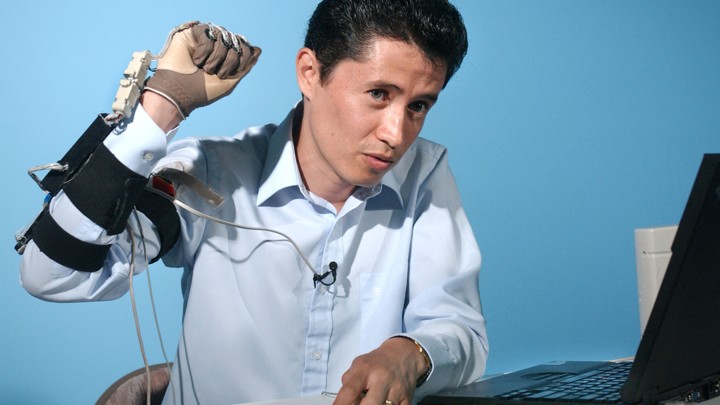
5. 3D technology was used for brain surgery, cast alternatives, and so much more:
Sichuan Revotek is a Chinese biotechnology firm that was able to 3D-print blood vessels made from stem cells and implant them into monkeys. The 2017 discovery is an advance toward developing artificial organ transplants.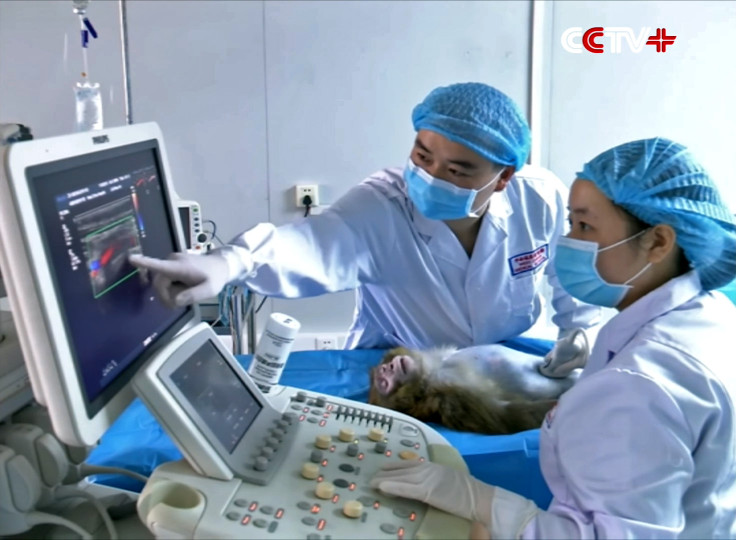
Can I get an Amen?