You know you’ve been in quarantine too long when your pets need a break from you.


Robert Button, journalism mentor and teacher:
“Perhaps the greatest reward a teacher can have is watching students grow into themselves and their potential. Their successes are our successes. And the memories of the time they spent together ensures they live on for a lifetime.
“Kevin Roberts was one of those students; he brought fun and joy – and an enviable talent and commitment – to the classroom and to long hours after school producing a weekly student newspaper. Even though it has been more than 20 years since I have seen or talked to him, he has lived with me every day. And in spite of the fact that an aggressive cancer took his life this morning, he will live in me forever. My heart and sympathy to his father Art, his brother Jon and to his wide circle of caring friends.”

When great trees fall,
rocks on distant hills shudder,
lions hunker down
in tall grasses,
and even elephants
lumber after safety.When great trees fall
in forests,
small things recoil into silence,
their senses
eroded beyond fear.When great souls die,
the air around us becomes
light, rare, sterile.
We breathe, briefly.
Our eyes, briefly,
see with
a hurtful clarity.
Our memory, suddenly sharpened,
examines,
gnaws on kind words
unsaid,
promised walks
never taken.Great souls die and
our reality, bound to
them, takes leave of us.
Our souls,
dependent upon their
nurture,
now shrink, wizened.
Our minds, formed
and informed by their
radiance,
fall away.
We are not so much maddened
as reduced to the unutterable ignorance
of dark, cold
caves.And when great souls die,
after a period peace blooms,
slowly and always
irregularly. Spaces fill
with a kind of
soothing electric vibration.
Our senses, restored, never
to be the same, whisper to us.
They existed. They existed.
We can be. Be and be
better. For they existed.— Maya Angelou
Safest passage, northern Traveler. Today all Towers face South.

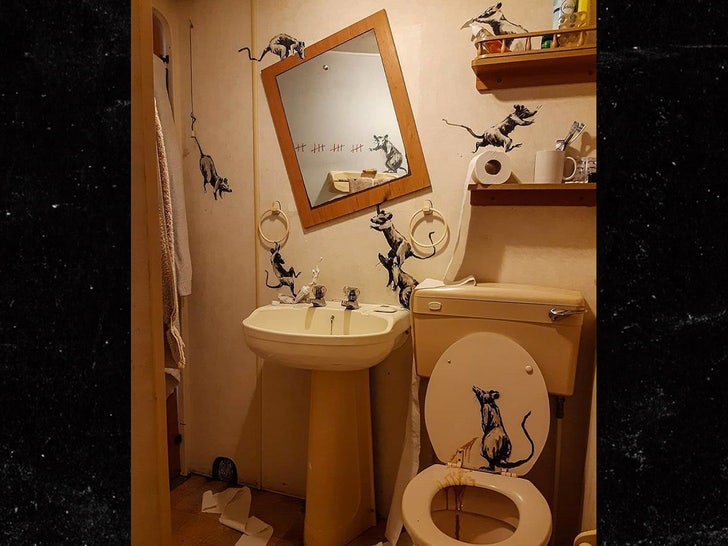
Leave it to Banksy to not only demonstrate that art doesn’t stop just because life does, but to take a skewering jab at our base selves while doing it.
The world’s greatest tagger unveiled his latest work — on Twitter, of all places — earlier this week. Consider it a coronavirus consolation prize; normally his work is painted over by city employees or shredding itself at Sothey’s.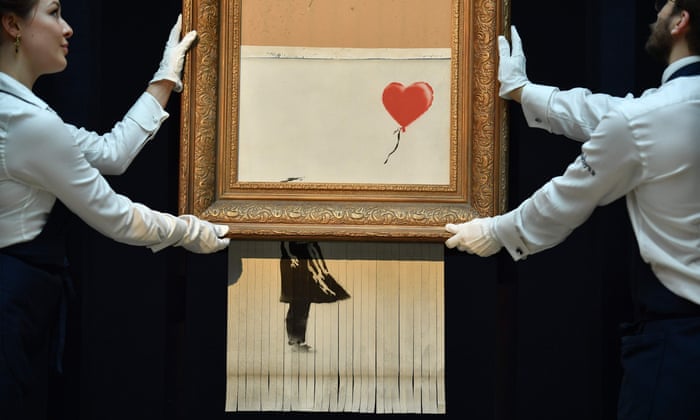
In the very finite reaches of cyberspace, however, Banksy’s work can be freeze-framed in a fashion that must tickle the artist. His latest, captioned My wife hates it when I work from home, even includes several closeups of the piece, as if he wants you to pay particular attention to some corners of the canvas.
People have certainly paid attention. It became a viral sensation, broke Twitter and even warranted coverage by the venerable institution TMZ. It and other outlets raved that the street-Warhol was telling fans that we are all in this together, that all of us are struggling to cope with the Everyday under the new world order.
I’m not so sure. Banksy has always been subversive in his expressions, and you can make an argument that he’s not casting us as victims of the virus. But that we are virus itself.
Consider: He could have used any animal running rampant through the house. Dogs. Cats. Roaches. Mice. Instead, he chose rats, the symbol of the bacteria bank that financed The Black Plague. In the 3-D work, the rodents have run roughshod over their own habitat.
 Hoarded the essentials.
 Consumed the vital resources.
 Pissed all over the basin.
Sounds like a cautionary environmental message scratching about to me.
It’s hard to imagine Banksy not taking an alternate view of the pandemic. Considering he made his name throwing Molotov Cocktail bouquets into the middle of the modern-art landscape, could he be arguing that COVID-19 is not a virus, but an antibody?