And it starts sometime around midnight Or at least that’s when you lose yourself for a minute or two As you stand under the bar lights And the band plays some song About forgetting yourself for a while And the piano’s this melancholy soundcheck to her smile And that white dress she’s wearing You haven’t seen her for a while
But you know that she’s watching She’s laughing, she’s turning She’s holding her tonic like a crux The room’s suddenly spinning She walks up and asks how you are So you can smell her perfume You can see her lying naked in your arms
And so there’s a change in your emotions And all of these memories come rushing Like feral waves to your mind Of the curl of your bodies Like two perfect circles entwined And you feel hopeless, and homeless And lost in the haze of the wine
Then she leaves with someone you don’t know But she makes sure you saw her She looks right at you and bolts As she walks out the door Your blood boiling, your stomach in ropes Oh, and your friends say, “What is it? You look like you’ve seen a ghost”
Then you walk under the streetlights And you’re too drunk to notice That everyone is staring at you You just don’t care what you look like The world is falling ’round you
You just have to see her You just have to see her You just have to see her You just have to see her You just have to see her
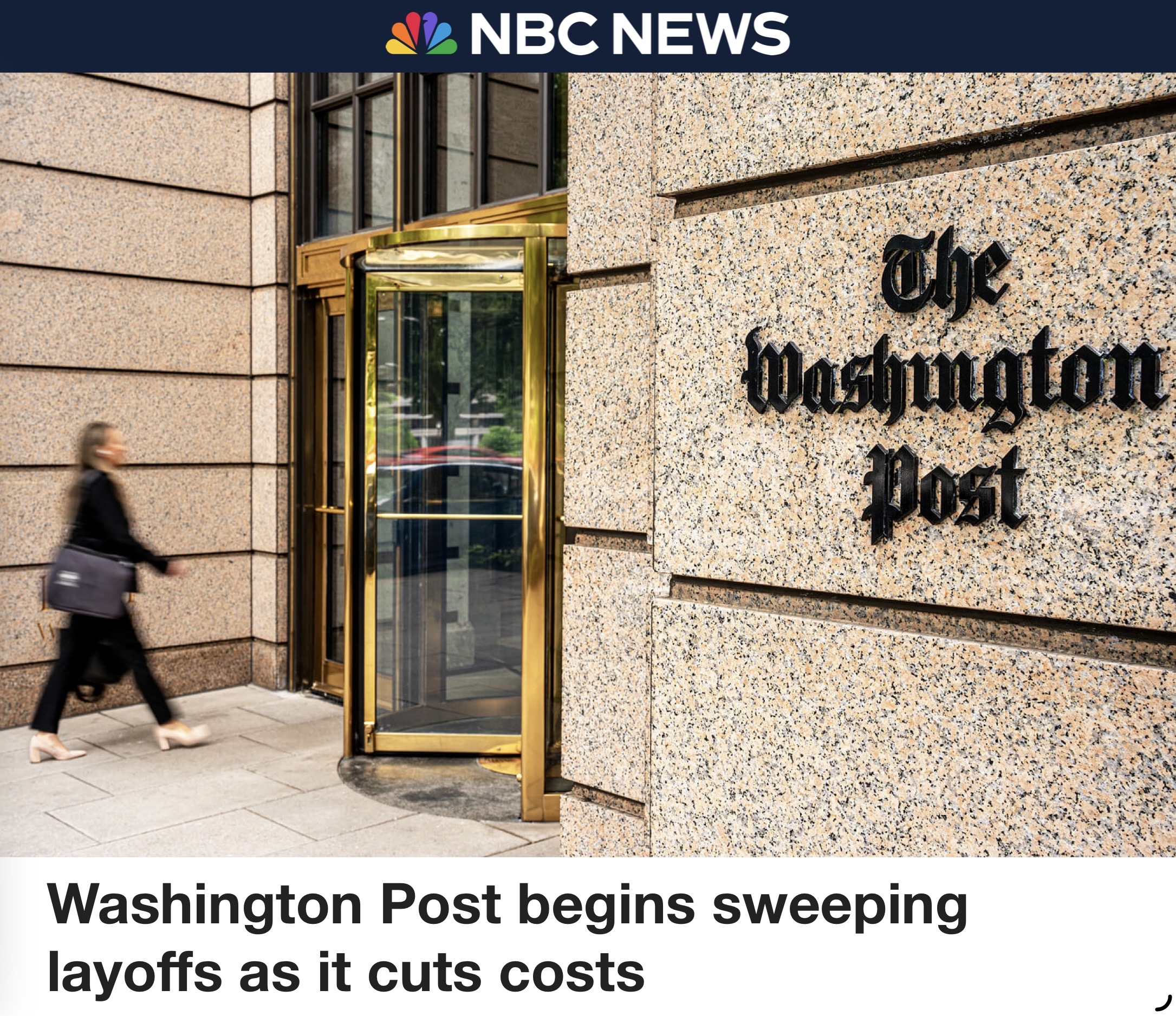
Jeff Bezos buys The Washington Post. Patrick Soon-Shiong acquires The Los Angeles Times. John Henry takes over The Boston Globe. We call them white knights rescuing struggling institutions.
But we’re confusing a tourniquet for a cure.
The crisis in American journalism is the inevitable collision between two incompatible goals: capitalism demands profit maximization, while journalism demands truth-telling regardless of cost.
These goals stand fundamentally opposed. Capitalism succeeds by accumulating wealth and protecting the systems that enable that accumulation. Journalism succeeds by exposing how power operates, including the mechanisms of wealth accumulation. One builds walls, the other tears them down.
For decades, we pretended this contradiction could be managed. Newspapers were profitable enough that owners could extract returns while mostly leaving the newsroom alone. That arrangement was always imperfect (plenty of stories died to protect advertisers and powerful friends) but it was sustainable.
Then the internet destroyed the economics. The money that had allowed the contradiction to persist disappeared, and we saw capitalism’s true priority. Newsrooms were gutted. Investigative units vanished. The choice became clear: maximize shareholder value or expose power structures.
We know which won.
Enter the billionaires, presented as the solution. But billionaire ownership perfects the contradiction rather than resolving it. At least old publishers had to pretend to care about journalism to maintain the business. Today’s oligarch owners are the business.
When Jeff Bezos owns your newspaper, covering Amazon’s labor practices, its tax avoidance, its monopolistic behavior becomes impossible to do fearlessly. The conflicts are total.
The self-censorship requires no direct orders. Journalists learn what stories will be met with enthusiasm and which with budget scrutiny. They learn to anticipate friction and adjust accordingly. The system selects for compliance without ever demanding it explicitly.
The problem runs deeper than individual billionaires interfering with individual stories. Capitalism tells us everything must generate returns. Journalism tells us some truths are worth pursuing regardless of profit. Capitalism concentrates power. Journalism distributes it.
These are contradictions to be resolved, and we cannot resolve them by shuffling ownership between different flavors of capital. It might require the notion of operating at a loss simply on principle.
We keep asking the wrong question. We debate nonprofit models, community ownership, public funding. All valuable, but all still operating within capitalism’s logic.
The real question is whether truth-telling can ever be truly independent while it depends on the very power structures it’s meant to challenge.
The answer may be that journalism will always exist in this compromised space between its ideals and its economic reality. But we should at least be honest about the contradiction we’re living with.
When we accept that billionaires must save journalism, we accept that journalism exists at capital’s pleasure. We accept that truth is a luxury afforded when it’s profitable or amusing.
This is capitalism, doing exactly what it was designed to do: protect itself.