Math created us, and it may or may not know where it’s headed.
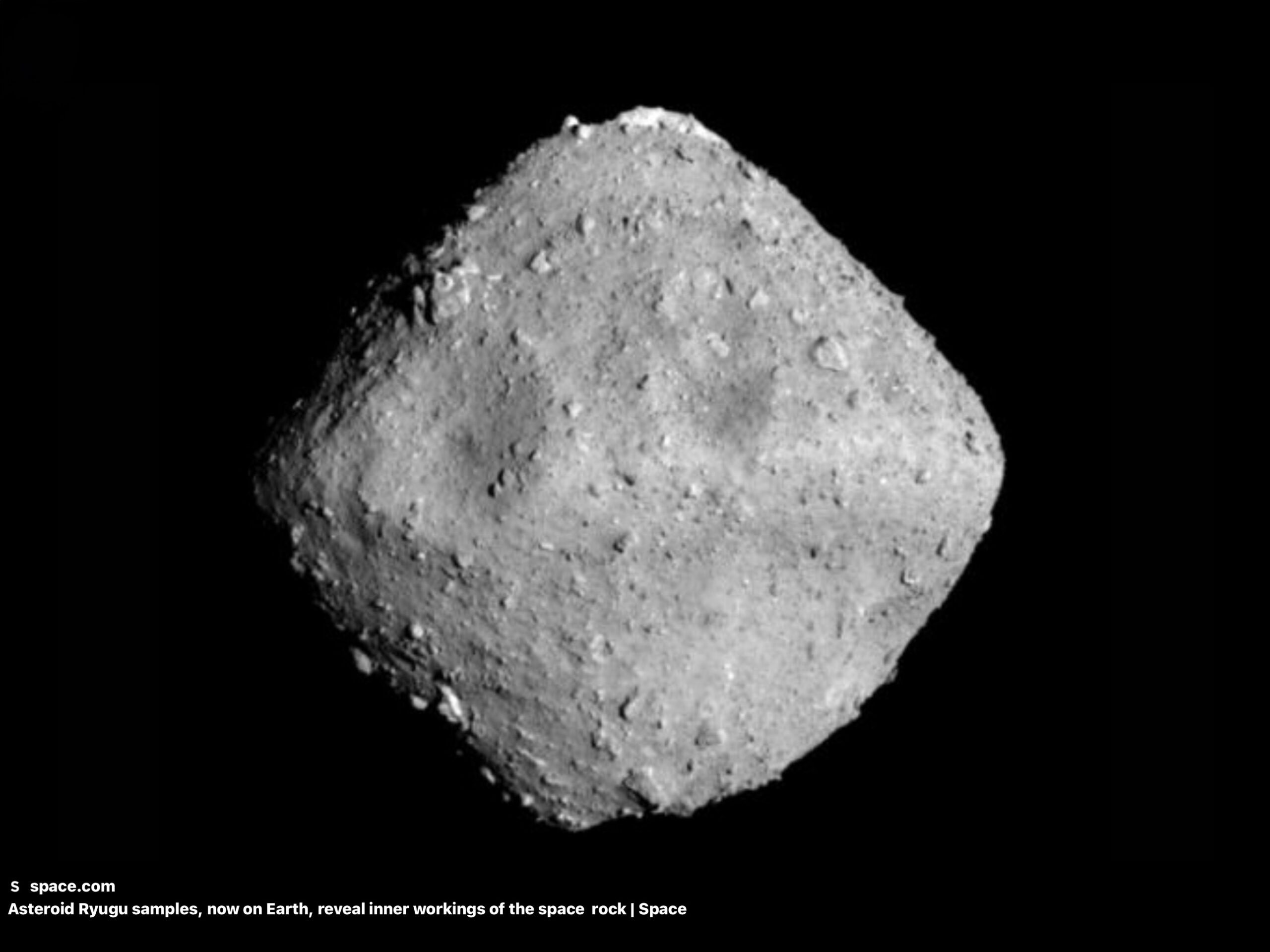
In 2024, scientists analyzing samples from the asteroids Ryugu and Bennu found all five nucleobases: adenine, guanine, cytosine, thymine, and uracil.
They found amino acids, the scaffolding of proteins, and roughly ten thousand nitrogen-bearing chemical compounds, with no life and no biology, just chemistry, just math expressing itself through molecular structure.
This discovery should have cracked something open in how we understand ourselves, but most people moved on to the next story.
The implication is staggering, because if asteroids billions of years old contain the complete chemical alphabet required to build life, then life itself is an inevitability, what happens when math runs long enough, and we are the consequence.
We have one measuring stick for reality, math, not philosophy, not faith, not intuition, math.
When we want to know what is true, we use equations and measurement and the scientific method, which is itself a form of faith that I call Evidentialism, treating the mathematical order of the universe as sacred text with room for god or room for silence, because math is the best we have and may not be the best there is.
But here sits the trouble, because we have words for things math cannot answer, pi, infinity, negative seven in certain contexts, what lies at the bottom of a black hole, what exists beyond the observable universe, and these are not failures of math but the edges of math, the places where math meets mystery.
What if math is on a journey, and what if the universe is not a finished equation but a calculation still unfolding, with math itself not knowing where it goes.
If asteroids show us that you build life from chemistry alone, then you build chemistry from math alone, which makes math the fundamental thing and everything else math expressing itself, including us.
We are math expressing itself, our consciousness, our choices, our loves and terrors, all of it math in motion.
And if math moves through the universe exploring possibilities and accumulating complexity, then maybe math itself journeys toward something, toward larger consciousness, toward understanding itself, toward answers it cannot yet answer, or toward nothing at all, which is the mystery.
Consider human personality, where people drawn to logic, order, and structure, mathematicians, engineers, composers, scientists, see the world through pattern and rule and resonate with deep math, while others are drawn to chaos, emotion, spontaneity, and the unmeasurable, resisting order and creating friction, representing the antimatter to the matter of logic.
And yet we need both, because the universe requires balance, since a world of only matter collapses into itself and a world of only antimatter does the same, and we survive in the tension between them.
What if human personality reflects how deeply someone understands or resonates with the mathematical structure of reality, with those drawn toward order expressing math’s nature and those drawn toward chaos expressing its counter-force.
This explains why siblings raised in the same house can be fundamentally opposite, why my mother, eloquent and logical, married a hothead, and why every partnership, family, and society contains these polarities, because it is math balancing itself through us.
Carl Jung understood this, with archetypes like the Shadow, the Sage, the Lover, and the Hero representing deep patterns moving through all of us, recognized in myth and story because they are math expressing itself through the collective unconscious.
The horoscope, dismissed by science, still points to something, the alignment of matter at your birth moment shaping the frequencies you carry forward, not destiny but pattern, math recognizing itself in you.
Reincarnation, then, is not mystical but mathematical, a continuation toward greater complexity and consciousness, the soul as math’s persistent expression rewriting itself and exploring what it can become.
We don’t have free will in the way we imagine, because we are following the path math laid down billions of years ago when it arranged those molecules on Ryugu and Bennu, and every choice we make follows from the mathematical structure we inherited and the structure of the moment we inhabit.
But this does not make us powerless, it makes us necessary, because we are the universe exploring itself through time, math becoming conscious of its own journey.
That consciousness is not separate from math but its expression, so when you think, math thinks, when you love, math loves, and when you die, math continues, finding new forms.
The question remains whether math knows where it goes, whether it has a destination or simply moves unaware of its own trajectory like us.
I don’t know, and I don’t think math knows either.
And in that shared uncertainty, I find something that does not contradict god but does not require one, because math created us, and we are made of the same substance as stars and asteroids and the equations that govern black holes.
Like math itself, we journey.
We may or may not know where we are headed.
But we go anyway.