linked here Spoiler alert: This column discusses major plot turns in Breaking Bad and Better Call Saul.
If Breaking Bad had a weakness, and you can argue it had none, it was that its fifth season never quite matched its fourth.
The fourth season ends with “Face Off,” a title that works as a pun and a verdict. Gus Fring leaves the nursing home with half his face gone, straightens his tie and collapses. Walter White has beaten his most formidable enemy. He calls Skyler and says, “I won.” For me, that is the end of Breaking Bad: Walt gets his victory, and the story closes on the terrible satisfaction of watching him take it.
I have reported on the show and its creators several times. The uncertainty surrounding a fifth season matters here. Gilligan and his writers wanted the fourth-season ending to feel complete in case the show stopped there. Gilligan told CBS they wanted a satisfying ending without knowing what the future held. AMC announced the 16-episode final-season order on Aug. 14, 2011, after the fourth season was already underway.
That makes “Face Off” feel like a finale, even as it leaves the door open. Walt has won, Jesse has learned that Brock was poisoned with lily of the valley, and the final shot reveals the plant in Walt’s backyard. The victory carries its own stain. Season 5 had to follow that ending by showing what Walt’s win meant: he was becoming the villain he had spent four seasons fighting.
That turn gives the final season its force, but it also changes the shape of the story. The show needed a new enemy, and the white supremacist gang led by Jack Welker supplied one. They are dangerous, and they help bring Walt’s story to its brutal close. Yet they lack the strange, intimate intelligence of Gus Fring. The conflict becomes simpler: Walt faces men whose evil is plain on sight.
Gilligan found a more compelling answer in Better Call Saul. Lalo Salamanca is the kind of final adversary a crime story wants: charismatic enough to draw you in, smart enough to keep you guessing and monstrous enough to make every scene feel unsafe.
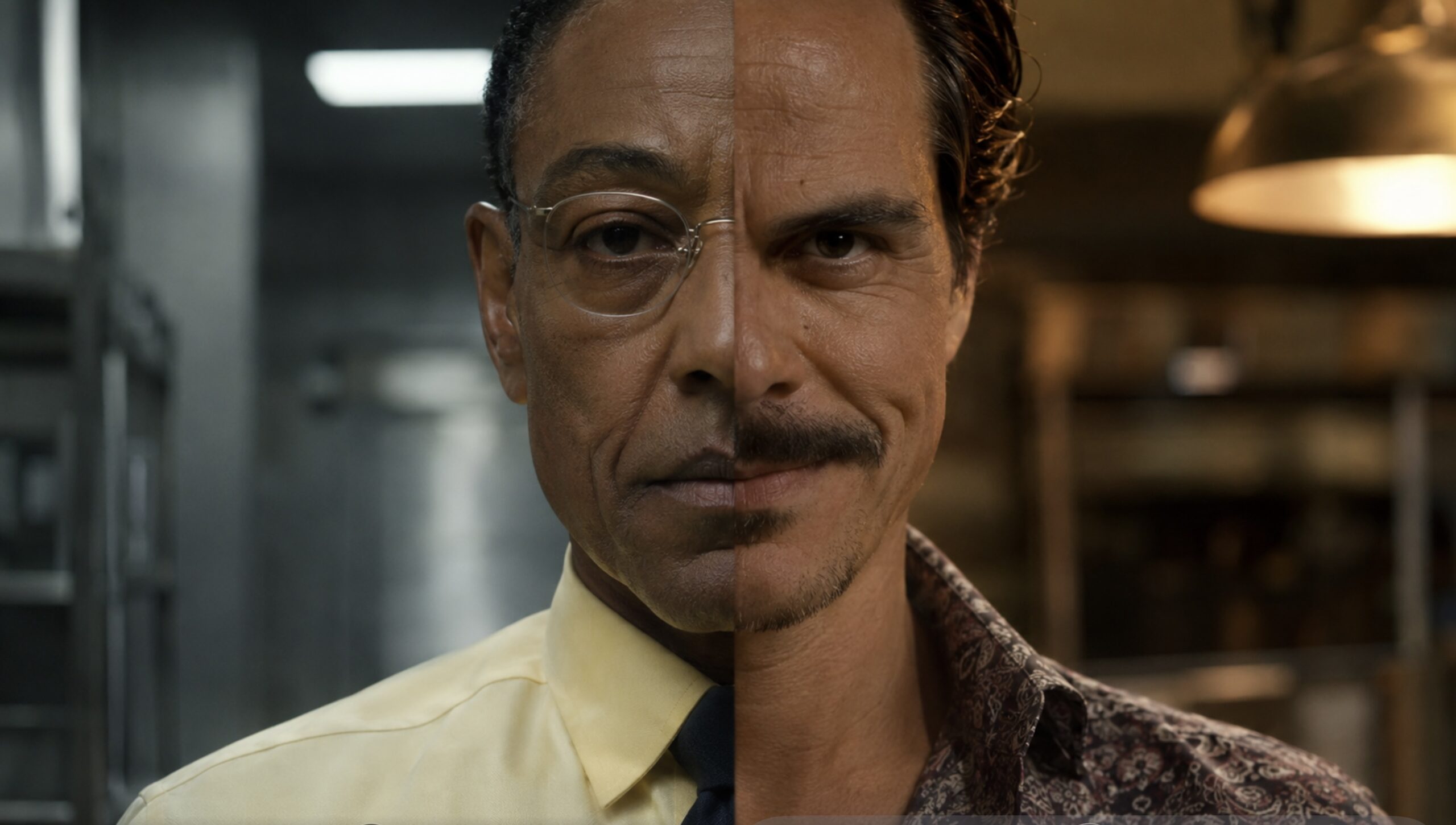
Gus and Lalo are doppelgangers, opposite sides of the same coin. Both can read a room, plan several moves ahead and kill without hesitation. Both conceal a criminal empire behind a public face. Gus’s mask is civic respectability: the fast-food executive with the pressed shirt and careful manners. Lalo’s is sociability. He smiles, cooks, jokes and makes a dangerous conversation feel almost pleasant.
The difference is what happens when their plans meet resistance. Gus builds systems to control events. Lalo moves through those systems himself. He follows Mike, breaks into TravelWire through the ceiling and kills the clerk to get the information he wants. He is a detective with a cartel’s methods and no patience for a locked door.
For a while, the contrast can make Lalo look impulsive and Gus look superior. The show corrects that impression. Lalo is every bit the strategist Gus is, but he adapts in ways Gus cannot predict. Better Call Saul co-creator Peter Gould called him “kind of brilliant” and said he could be almost as indirect as Gus. Giancarlo Esposito described the effect on Gus: Lalo made chaos, and Gus, who usually controlled it, could not tell what was coming.
That is the anti-Fring. Lalo shares Gus’s intelligence, patience and ruthlessness, while reversing the qualities Gus uses to stay powerful. Gus hides inside order. Lalo hides inside charm. Gus wants a world that behaves according to plan. Lalo is dangerous because he can make a plan while seeming to play.
Their final confrontation pays off that design. Lalo reaches the secret lab and gets Gus alone. He has the upper hand, but he wants Gus to know it. He stops to make the moment a victory speech. Gus uses the pause, the darkness and a weapon he has prepared in advance. He kills Lalo, but the win comes down to a sliver of luck and the familiarity Gus has built with the lab.
Lalo is a spectacular death for a spectacular villain. His body ends up buried beneath the very laboratory Gus hoped would make his operation permanent. Gus wins the duel, but Lalo has made the hidden cost of Gus’s empire literal. The lab rests on the men it takes to build it.
That is richer than giving Walt another obvious monster to defeat. Lalo forces Gus to reveal the fear beneath his discipline. He is not simply Gus’s opposite. He is the one opponent who can make Gus experience his own methods from the other side.