Butwāl By 10:30 Saturday morning, the kitchen had already defeated her twice.
The first defeat was cereal.
Not the cereal itself. The cereal was harmless. Cheerios had no agenda. It was the box, open on the island, the plastic sleeve rolled down but not closed, a scatter of pale rings around the bowl like evidence left by an especially lazy burglar.
Beside it sat a spoon in a puddle of milk.
She stopped in the doorway.
“Really?”
No one answered.
The house had entered that peculiar weekend silence that meant everyone was home but no one was available.
A bedroom door closed upstairs.
Something thumped.
A burst of laughter came through the ceiling and disappeared.
Her husband, Mark, had left forty minutes earlier for Home Depot, which meant he would either return with the two lightbulbs he needed or with six hundred dollars’ worth of shelving, brackets, rechargeable tools and some new theory about the garage.
She looked again at the cereal.
There was a bowl three feet from the dishwasher.
Three feet.
She picked it up.
The dishwasher was empty.
She opened it.
Placed the bowl inside.
Opened the silverware drawer.
Stopped.
Closed the silverware drawer.
Opened the dishwasher again and put the spoon beside the bowl.
“Jesus Christ.”
She said it quietly.
Not because anyone would care.
Because she didn’t.
The second defeat was the glass.
It sat on the very edge of the kitchen table.
Half full.
One inch farther and gravity would take over.
She stared at it long enough that she could almost see the future: the elbow catching it, the glass tipping, the little instant of suspension before it fell, someone shouting, the crash, the water running beneath the table, everyone lifting their feet.
Then her.
Towels.
Broom.
Dustpan.
Bare hands checking for slivers.
She crossed the room and moved the glass six inches toward the center of the table.
And heard herself say it.
Not now.
Years ago.
“Push your glass back, honey. You’re going to knock it over.”
A smaller table.
A smaller kitchen.
A smaller boy.
Maybe eight.
No, younger.
Six.
Ryan had still had that cowlick then, the one that stood straight up no matter how much water she put on it before school.
“Move your glass back.”
He had looked at her without moving it.
“What?”
“Your glass.”
“Oh.”
Then he had moved it.
Half an inch.
She had laughed.
She remembered laughing.
Now she stood in the kitchen with her hand still around the glass.
Ryan was eighteen.
He had stopped having the cowlick years ago.
He was upstairs now, probably asleep again despite having come down twenty minutes earlier, eaten cereal and apparently experienced a sudden medical emergency that prevented him from moving the bowl three feet.
She looked toward the ceiling.
“Put the glass in the middle of the table.”
The sentence came back again, another year.
This time Emma.
Maybe nine.
“Why?”
“So you don’t knock it over.”
“I won’t.”
“You will.”
“I won’t.”
She had.
Orange juice.
A whole glass.
Onto homework.
There had been crying.
Not because of the juice.
Because Emma had spent an hour drawing a map of California and the ink ran south into Mexico.
She smiled despite herself.
Then she stopped smiling.
The kitchen was still dirty.
She carried the glass to the sink.
There were four more glasses there.
Of course there were.
She put on music.
That was how she did it.
Some people cleaned in silence, which struck her as evidence of either great inner peace or severe psychological disturbance.
She needed volume.
Not loud enough to irritate the neighbors.
Loud enough to establish jurisdiction.
She opened the playlist on her phone and hit shuffle.
A song she didn’t want came on.
Skip.
Another.
Skip.
She stood with one hand on her hip, waiting.
Then the opening of “Gideon” filled the kitchen.
“There we go.”
She turned it up.
The first guitar hit and something in her unclenched.
Not relaxed.
Released.
There was a difference.
She tied her hair back.
Opened the cabinet beneath the sink.
Pulled out the spray cleaner, stainless-steel polish, glass cleaner, disinfectant wipes, floor concentrate.
Set them in a row on the counter.
For a moment she looked like a pharmacist preparing a difficult procedure.
Then she began.
The island first.
Always.
Everything came off.
Mail.
Keys.
A charging cable.
Three pens, none of which worked.
A school permission form that apparently needed to have been signed yesterday.
A roll of athletic tape.
One AirPod.
A fork.
A receipt from Chipotle.
A rubber band.
A blue plastic cap whose corresponding container had either vanished or had never existed.
And a tall aluminum can, empty, near the fruit bowl.
She picked it up.
Red and silver.
Ryan’s.
Again.
She shook it.
Nothing.
“Recycling.”
She said it louder than necessary.
No answer.
“Ryan?”
Nothing.
She walked to the far cabinet and waved her foot beneath the sensor.
The lid of the recycling bin rose with a soft electric whir.
She dropped the can inside.
It struck another can below with a hollow aluminum knock.
The lid waited.
Then descended.
Whirr.
Clunk.
She turned back to the island.
The song moved through the room.
She sprayed.
Wiped.
Sprayed again.
There were moments when she loved this part.
Not cleaning.
Never cleaning.
The transformation.
That she liked.
The surface becoming itself again.
The gray smear disappearing from the stainless steel.
The fingerprints vanishing from the refrigerator.
The crumbs swept into one hand.
The disorder reduced.
She could stand in the middle of the kitchen afterward and see nothing that demanded anything from her.
Nothing unfinished.
Nothing asking.
Nothing saying Mom.
She wiped the island in long, even strokes.
The kitchen brightened incrementally.
She put away the mail.
Threw away the receipt.
Plugged in the charging cable.
Put the fork in the dishwasher.
Left the AirPod where it was because she had learned that moving an AirPod, even from the middle of a kitchen island, constituted an act of war.
The rubber band went in the junk drawer.
The blue plastic cap went in the junk drawer.
Everything whose purpose had been forgotten went in the junk drawer.
The junk drawer was the witness protection program of the American household.
She smiled.
A little.
The music climbed.
She moved faster.
Counters.
Sink.
Stovetop.
The coffee maker with the dried brown crescent beneath the carafe.
She wiped it.
There it was again.
A memory.
“Guys, if coffee spills, just wipe it up.”
Mark this time.
Not one of the kids.
He had nodded.
“Absolutely.”
That had been last Sunday.
The coffee crescent had dried by Monday.
She scraped it with her thumbnail.
“Absolutely.”
She laughed once through her nose.
Then wiped harder.
The kitchen had been hers before it belonged to everyone.
Not literally.
They had bought the house together.
But she had chosen the cabinet pulls.
The counters.
The pale tile.
She had argued for the island to be six inches wider than the plans called for.
Mark had said six inches couldn’t possibly matter.
She had said every woman in America knew otherwise.
The contractor had laughed.
Mark had laughed.
She had laughed.
They had made it wider.
She had been right.
Six inches mattered enormously.
That had been fourteen years ago.
Back when Emma was a baby.
Ryan had been four.
Sophie hadn’t existed.
She stopped wiping.
Sophie.
Where was Sophie?
She listened.
Movement upstairs.
A drawer.
Someone laughed.
Right.
Home.
All of them home.
Sophie had volleyball later.
Mark would take her when he got back.
She looked at the clock.
10:47.
Fine.
Plenty of time.
She resumed.
There had once been another clock.
A cheap black one on the wall of her dorm room.
She saw it without wanting to.
Three in the morning.
Books open.
Highlighter uncapped.
Her roommate asleep.
She could not remember the roommate’s last name.
Melissa something.
No.
Michelle?
She could remember the clock.
She could remember a yellow legal pad.
She could remember writing across the top of it:
THESIS PROPOSAL.
She stopped.
The sponge remained pressed against the backsplash.
What had the thesis been?
She knew the subject.
Of course she knew the subject.
She had studied political science.
No.
Not exactly.
She had started political science.
Then communications.
Then back to political science.
She had wanted law school.
For a while.
Or public policy.
Maybe journalism.
Something with words.
Something where people listened when she spoke.
That seemed melodramatic now.
She rinsed the sponge.
The sink water ran cold across her fingers.
She turned it off.
“God.”
She hated when cleaning made her nostalgic.
It was one of the reasons she played music.
Memory needed silence.
Noise kept it civilized.
She turned “Gideon” louder.
The dishes came next.
A cereal bowl.
Four glasses.
Two plates.
A pan someone had left soaking long enough for the water to become a separate ecosystem.
And beneath one of the glasses, partly hidden by a dish towel, the mug.
Maize block M on blue.
University of Michigan.
Hers.
She lifted it.
A brown ring had dried around the inside.
Chocolate milk.
She stared into it.
“Seriously?”
Nobody in the house was supposed to use that mug.
Not because it was valuable.
It wasn’t.
The glaze had a hairline crack near the handle and the blue had faded after years in the dishwasher.
But it was hers.
She had bought it in Ann Arbor.
She could remember the store.
Could almost remember the day.
Cold outside.
Her backpack too heavy.
A yellow legal pad inside it.
THESIS PROPOSAL.
She ran hot water into the mug.
The dried chocolate loosened reluctantly.
She scrubbed.
For one moment the kitchen disappeared.
A cheap black clock.
Three in the morning.
Books open.
Someone she had been certain she was becoming.
Then the mug slipped slightly in her wet hand.
She caught it.
“Jesus.”
She held it tighter.
Rinsed it.
Dried it carefully.
Then opened the cupboard above the counter.
She had arranged the shelves years ago.
Three on the left.
Three on the right.
White ceramic bowls to the left.
Black ceramic bowls to the right.
Each one facing its opposite across the center of the cupboard.
Mark had once asked why the colors couldn’t be mixed.
“Because then they wouldn’t match.”
“They’re different colors.”
“They match each other.”
He had looked at her.
She had looked at him.
Eventually he had learned that this was one of those conversations in which understanding was unnecessary.
White on the left.
Black on the right.
Three and three.
Between them, the mugs.
She placed the Michigan mug among them, handle turned outward.
No.
She adjusted it.
The block M faced the room.
There.
She stood looking at the cupboard.
White.
Black.
Left.
Right.
Everything answering something else.
She could no longer remember whether there had ever been a reason for arranging it that way.
She closed both doors.
“Everything in its place.”
Her mother used to say that.
A place for everything and everything in its place.
Her mother had loved sayings.
Waste not, want not.
A stitch in time saves nine.
Pretty is as pretty does.
As though human existence were a series of minor household emergencies that could be solved with rhyme.
The song drove forward.
She attacked the stovetop.
The burners.
The microwave.
The cabinet fronts.
She opened the pantry.
Chips unclipped.
Crackers open.
A cereal box empty except for crumbs.
She held it up.
“Why?”
Nobody answered.
“Why put the empty box back?”
Nothing.
She stared into it as though perhaps a tiny person lived at the bottom and could explain.
Then she crushed the box.
Recycling.
Foot beneath sensor.
Whirr.
Drop.
Clunk.
Lid closes.
Whirr.
Clunk.
The rhythm pleased her.
She went back.
One shelf at a time.
Everything forward.
Labels visible.
Cans together.
Boxes together.
Snacks together.
She found three open bags of tortilla chips.
She combined them.
Three.
Why did no one else combine them?
Why did no one else see three bags and think three bags could become one bag?
She clipped the single bag shut.
Then wondered when she had become someone who felt victorious about consolidating tortilla chips.
She put the bag on the shelf.
For half a second she saw herself from above.
A woman in leggings and an old Michigan T-shirt organizing chips on a Saturday morning while a song she had loved when she was younger played loud enough to make the cabinets vibrate.
The thought came without invitation.
Is this it?
She shut the pantry.
Harder than necessary.
No.
Don’t.
She knew better than to ask questions like that while cleaning.
Questions were how afternoons disappeared.
The answer was obvious anyway.
No.
This was not it.
There was lunch.
There was Sophie’s volleyball.
There was Emma’s thing at three.
There was dinner.
Mark had said maybe they should grill.
Ryan would probably be gone.
Ryan was always gone now.
He was eighteen.
That was what eighteen was for.
Soon he would leave for college.
She had spent years waiting for him to become independent.
Now every act of independence felt faintly like betrayal.
She wiped the table.
Moved the glass again.
Six inches farther inward.
She heard herself.
“Put your glass in the middle.”
Ryan at six.
Emma at nine.
Sophie at seven.
Mark last month.
How many times could a person say the same sentence before the sentence became the person?
She stopped.
The thought irritated her.
Too dramatic.
She sprayed the table.
Wiped it clean.
Chairs pushed in.
Placemats straight.
Fruit bowl centered.
She looked around.
Better.
Much better.
The song was nearing its end.
She knew it by feel.
She had listened to it hundreds of times.
Her body knew what remained before the song did.
She swept.
Crumbs moved into a neat line.
A fragment of popcorn.
Dog hair.
Something sticky she did not investigate.
She swept it all into the dustpan.
Trash.
Whirr.
Drop.
Clunk.
She mopped.
The final stage.
The floor changed color behind her.
Dull to clean.
Clouded to bright.
She backed toward the hallway, careful not to step where she had already been.
There was something satisfying about leaving no footprints.
She stood at the threshold and surveyed the room.
The transformation was complete.
The counters were bare.
The sink was empty.
The stainless steel shone.
The cupboard doors were closed.
Behind them:
White on the left.
Black on the right.
Michigan in the middle.
For a few seconds she felt it.
The reward.
Quiet.
Not actual quiet.
Music still played.
A lawn mower started somewhere outside.
Something thumped upstairs.
A child’s voice rose, then disappeared behind a closed door.
But visual quiet.
Nothing required correction.
Nothing leaned.
Nothing spilled.
Nothing waited to be put away.
She breathed.
“See?”
She wasn’t sure who she was talking to.
Maybe herself.
Maybe the house.
She walked back in carefully, avoiding the damp floor, and gathered the cleaning products from the counter.
Glass cleaner.
Polish.
Disinfectant.
Floor concentrate.
One by one she carried them to the cabinet beneath the sink.
The song ended.
Silence entered before the next track began.
Just one second.
Maybe less.
In that second she could hear the refrigerator motor.
The air-conditioning vent.
A footstep overhead.
Her own breath.
Then the next song started.
A drumbeat.
Steady.
Measured.
She knew it immediately.
Sinead O’Connor.
“I Am Stretched on Your Grave.”
She almost skipped it.
Not because she disliked it.
Because it belonged to a different mood.
A nighttime song.
A driving-alone song.
A song for weather.
Not a clean kitchen at eleven in the morning.
Her hand moved toward the phone.
Then stopped.
Leave it.
She crouched.
Opened the cabinet beneath the sink.
Placed the floor cleaner behind the disinfectant.
Moved the glass cleaner to the left.
No.
It belonged on the right.
She moved it back.
There.
Everything in its place.
She closed the cabinet.
Stood.
And saw the can.
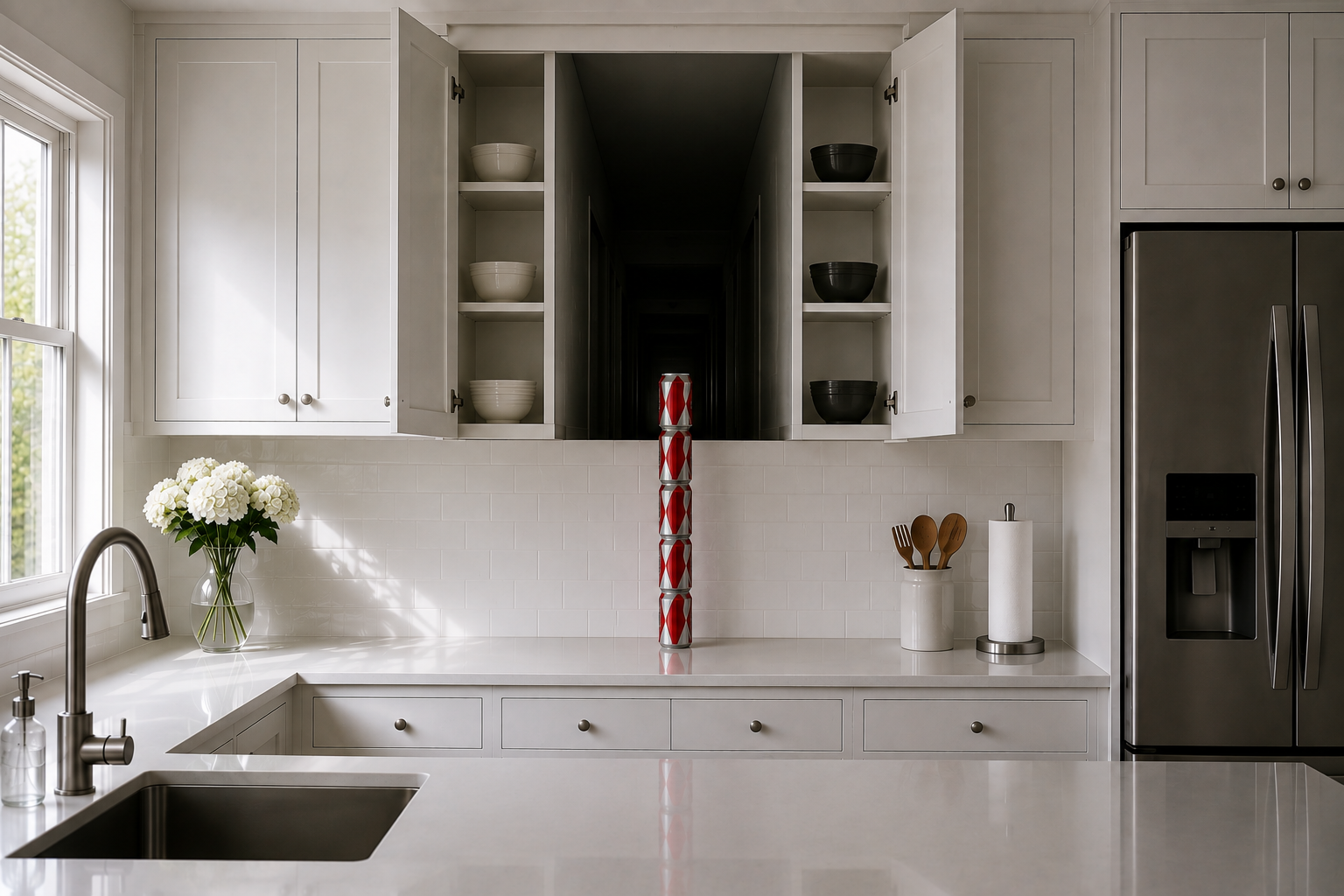
Red and silver.
Empty.
Standing upright on the counter beneath the cupboard.
For several seconds she simply looked at it.
Then she closed her eyes.
“Ryan.”
She opened them.
The can was still there.
She stared toward the ceiling.
“You have got to be fucking kidding me.”
She waited.
Nothing.
“Ryan?”
The music answered.
She looked at the ceiling.
“Ryan!”
A floorboard creaked above her.
Then footsteps.
Fast, heavy, crossing from one room to another.
She waited for an answer.
None came.
“Emma?”
Something thumped upstairs.
A burst of laughter followed.
A door closed.
“Emma!”
Nothing.
“Sophie?”
More movement overhead.
They were there.
All of them.
Twenty feet away.
“Sophie!”
No answer.
She looked at the can.
Red and silver.
Same brand.
Same size.
Of course it was the same brand.
Ryan drank them constantly.
She picked it up.
Empty.
A small dent near the bottom.
Had the other one been dented?
She couldn’t remember.
Why would she remember?
People did not catalog the distinguishing characteristics of garbage.
“Ryan, if you can hear me, I just cleaned this kitchen.”
Nothing.
She carried the can to the recycling bin.
Stopped.
Looked back at the counter.
Clean.
Perfect.
She waved her foot beneath the sensor.
Whirr.
The lid rose.
She dropped the can.
It struck the others.
A metallic tumble.
She watched it settle.
There.
She moved her foot away.
The lid descended.
Whirr.
Clunk.
She turned.
Two cans stood on the counter.
One atop the other.
She stopped.
The bottom can stood exactly where the first had been.
The second balanced on it.
Red.
Silver.
Red.
Silver.
She stared.
“No.”
She walked toward them.
Slowly.
She looked upstairs.
“Ryan?”
Nothing.
She reached out and touched the top can.
It shifted beneath her finger.
Real.
She caught it before it fell.
The bottom can remained upright.
She picked it up too.
Both empty.
Room temperature.
She looked toward the hallway.
Someone upstairs laughed.
She recognized Sophie.
Or Emma.
She wasn’t sure.
“Very funny.”
Nothing.
She carried both cans to recycling.
Foot beneath sensor.
Whirr.
She dropped the first.
Clatter.
Then the second.
Clatter.
She watched them land.
She waited until the lid closed.
Whirr.
Clunk.
She turned.
Three.
Stacked.
She screamed.
A short sound.
More surprise than terror.
Then immediately covered her mouth.
The three cans stood vertically beneath the cupboard.
One.
Two.
Three.
She backed away.
“No.”
The music continued.
Steady.
Measured.
She looked toward the ceiling.
“Ryan!”
Nothing.
“Emma!”
Nothing.
“Can somebody come down here?”
A muffled voice upstairs.
Not words she could make out.
Then laughter.
Not at her.
Something else.
Something in another room.
“Sophie!”
No answer.
She looked at the cans.
Three.
She wanted someone else to see them.
That desire became suddenly enormous.
Not help.
A witness.
Someone to walk into the kitchen and say:
What the fuck?
She listened.
Nobody came.
The three cans remained stacked.
She approached them.
Touched the top.
Then the middle.
Then the bottom.
She separated them.
Set all three on the counter.
One beside another.
She looked at them.
Three ordinary cans.
That was better.
Three cans were garbage.
A tower was something else.
She gathered them.
Walked to recycling.
Opened the lid.
Whirr.
She dropped them individually.
One.
Clatter.
Two.
Clatter.
Three.
Clatter.
She leaned over the opening.
Saw all three.
One on its side.
One against cardboard.
One nearly upright.
She counted them again.
One.
Two.
Three.
She stepped back.
The lid descended.
Whirr.
Clunk.
She did not turn.
Not yet.
She looked at the closed lid.
Then at her reflection in the stainless steel beside it.
Distorted.
Long.
She almost laughed at herself.
She turned.
Four cans.
Stacked.
Her hand went to her mouth.
Four.
The tower was higher now.
Still beneath the cupboard.
She looked at the cupboard.
Then away.
Coincidence.
A stupid word.
A useless word.
She looked back.
Four.
She walked toward them.
Stopped.
“Who’s doing this?”
Nothing.
“Ryan?”
Nothing.
“Emma?”
Nothing.
“Sophie?”
Nothing.
The children moved above her.
The house was full of them.
She could hear a drawer.
Footsteps.
Music from somewhere.
A laugh.
Twenty feet.
Maybe less.
She stood alone in the kitchen.
She picked up the four cans.
This time she did not separate them gently.
She grabbed them.
The tower collapsed against her arms.
She carried all four toward recycling.
She kept looking back at the counter.
Empty.
Good.
She reached the bin.
Waved her foot.
Whirr.
She looked at the counter.
Empty.
She reached behind herself with one can.
Dropped it.
CLANG.
It missed.
She flinched.
Kept looking at the counter.
Reached back with another.
CLATTER.
Rim.
Floor.
“Fuck.”
She refused to turn.
The third can slipped from beneath her arm.
Hit tile.
Rolled.
She heard it circling behind her.
The lid began to close.
Whirr.
“No.”
She kicked backward for the sensor.
Whirr.
Open again.
The counter remained empty.
She crouched without turning.
Reached blindly behind herself.
Her fingers found aluminum.
She grabbed it.
Another can rolled beneath the table.
She stretched.
Couldn’t reach.
“Goddamn it.”
She looked down.
One second.
Less.
She found the can.
Picked it up.
Then looked back.
Five.
She did not move.
Five cans.
Stacked.
One above another.
A narrow red-and-silver column rising from the counter.
The top can reached the level of the cupboard handles.
She remained crouched beside the recycling bin.
The song played.
She stared at the stack.
Then at the cupboard.
Then back at the stack.
Five.
She stood.
Slowly.
The four cans she had been trying to dispose of lay around her.
She looked at them.
Then at the five.
She did not count nine.
She had stopped counting that way.
The five were different.
They were the ones that mattered.
She gathered the four from the floor.
This time she looked away from the stack.
She put them into recycling.
One.
Two.
Three.
Four.
Clatter.
She stepped back.
Whirr.
Clunk.
She turned.
Five.
Still there.
Good.
The thought startled her.
Good?
She stared at the tower.
It had stopped.
Five.
The top can aligned almost perfectly with the cupboard handles.
She followed the line upward.
Can.
Can.
Can.
Can.
Can.
Handles.
She looked away.
“No.”
She waited.
Nothing happened.
The music continued.
She looked back.
Five.
She approached.
The tower seemed taller up close.
Of course it did.
Everything did.
She stood directly in front of it.
Her face nearly level with the top can.
Behind it, the cupboard.
She knew what was inside.
White on the left.
Black on the right.
Three and three.
Her Michigan mug between them.
She had opened it herself.
She had looked inside.
She had closed it.
She stared at the handles.
Then at the cans.
“No.”
Nothing.
She laughed once.
There was no humor in it.
“You want me to open that?”
The question embarrassed her the moment she heard it.
She was talking to soda cans.
She looked toward the ceiling.
“Guys?”
Nothing.
Not even a name this time.
Just:
“Guys?”
Footsteps overhead.
Someone was there.
Nobody came.
She looked at the five cans.
The top one seemed to look back.
That was ridiculous.
It was aluminum.
Printed metal.
A thing.
She had spent the morning putting things where they belonged.
The glass.
The bowl.
The spoon.
The AirPod she had wisely left alone.
The Michigan mug.
The cans.
Especially the cans.
Recycling.
That was where they belonged.
Not here.
Not stacked.
Not beneath her cupboard.
She felt anger return.
Clean.
Simple anger.
Better than fear.
She had cleaned this kitchen.
She had finished.
She was done.
“Fuck this.”
She swept one hand across the stack.
The cans flew.
CLATTER.
Five separate sounds becoming one.
One can struck the backsplash.
Another bounced against the sink.
Two fell to the floor.
The fifth rolled across the counter.
She watched it.
Red.
Silver.
Turning.
Slowing.
It reached the edge.
For a fraction of a second it seemed to balance there.
Then disappeared.
CLANG.
She did not look down.
She grabbed both cupboard handles.
Pulled the doors open.
And looked inside.
For one instant, everything was exactly as it should be.
Three white bowls on the left.
Three black bowls on the right.
Each facing its opposite.
Perfectly aligned.
Perfectly still.
And between them—
Nothing.
Not an empty shelf.
Nothing.
There was no back wall.
Just a space that went on, receding past the dimensions of the cupboard, past the kitchen, past the house.
A corridor.
White shelves ran along one side.
Black shelves along the other.
Plates.
Bowls.
Mugs.
White.
Black.
White.
Black.
Repeating into a distance too regular to be real.
Her hands released the cupboard handles.
Her face emptied first.
Then tightened.
Her eyes widened.
Her mouth opened.
She took one step backward.
Whatever she saw remained before her.
She shook her head.
Once.
Very small.
“No.”
She stepped back again.
Her hand found the island behind her.
There was nowhere else to go.
At the far end of the corridor stood a woman.
Herself.
But not.
The same eyes.
The same mouth.
The same line between the eyebrows.
But composed differently.
Sharper.
Unapologetic.
Dressed in something that might have been a suit or might have been armor.
Under one arm she carried a yellow legal pad.
She knew what was written across the top before she could possibly have read it.
THESIS PROPOSAL.
The woman began walking toward her.
Not quickly.
There was no need.
With each step the corridor seemed to offer another version of something that had never happened.
A courtroom.
A newsroom.
A podium.
A desk beneath a window in a city she had never lived in.
A byline.
A microphone.
A room full of people waiting for her to speak.
Then plates again.
Bowls.
Mugs.
White.
Black.
White.
Black.
The woman stopped.
Close enough now that there could be no mistake.
It was her.
Not younger.
That would have been easier.
Not prettier.
Not untouched by time.
She was the same age.
She had simply arrived somewhere else.
The woman looked at her.
For one terrible second, neither of them moved.
Then the woman smiled.
Not kindly.
Not cruelly.
Triumphantly.
As if she had been waiting.
As if she had known this moment would come.
As if, all these years, one of them had continued and one of them had stopped.
She stared at that smile.
Her own smile.
She knew exactly how it felt on her face.
Knew the muscles that made it.
Knew the tiny crease it put beside the left eye.
But she could not remember the last time she had worn it like that.
Certain.
Hungry.
Unapologetic.
The woman’s smile widened.
Behind her, something moved.
A small metallic sound.
She looked down.
One of the red-and-silver cans lay in the corridor.
Then another appeared behind it.
And another.
Five.
Not stacked now.
Lying on their sides in a perfect row.
Equally spaced.
Their circular ends faced her.
The woman looked down at them.
Then back at her.
Still smiling.
The first can began to roll.
Slowly.
She stopped breathing.
The can rolled down the impossible corridor toward the open cupboard.
Red.
Silver.
Red.
Silver.
Turning.
The second began to move.
Then the third.
Then the fourth.
Then the fifth.
A perfect procession.
She backed into the island.
“No.”
The woman did not move.
She only watched.
Smiling.
The first can crossed the place where the back wall of the cupboard should have been.
It did not fall.
It rolled onto the shelf.
Then out of the cupboard.
Onto the counter.
She stared at it.
“No.”
The other four followed.
One after another.
Each making the same small sound as it crossed from impossible space into the kitchen.
Tick.
Tick.
Tick.
Tick.
The first can rolled across the counter toward her.
She moved sideways.
It changed direction.
She stopped.
The can stopped.
Her eyes widened.
“No.”
She moved the other way.
The can turned.
Behind it, the others arranged themselves in a straight line.
Five red-and-silver cans.
Perfectly spaced.
All pointing toward her.
She looked into the cupboard.
The woman was still there.
Still holding the yellow legal pad.
Still smiling.
Her smile was the last thing in the cupboard that looked human.
Then the first can moved again.
Faster now.
Straight toward her terrified face.
She threw up one hand.
The can stopped at the edge of the counter.
She froze.
It rocked once.
Back.
Forward.
Then rolled over the edge.
But it did not fall.
It continued through the air.
Slowly.
Deliberately.
Toward her.
She could not move.
Could not look away.
Behind it came the woman’s smile.
That impossible, victorious version of her own.
The can touched her lower lip.
Cold.
Smooth.
Perfectly circular.
She felt the aluminum.
Smelled old sugar.
Her mouth opened.
Not because something forced it.
Because something in her recognized what was being offered.
The woman nodded.
Once.
Approval.
Or completion.
The can slid past her lips.
She did not gag.
She did not breathe.
Her eyes stayed open.
The kitchen brightened incrementally.
The counters were bare.
The sink was empty.
The stainless steel shone.
Inside the cupboard:
White on the left.
Black on the right.
Everything perfectly matched.
The woman turned.
Walked away.
Into the corridor.
Into the thesis.
Into the law school.
Into the journalism.
Into the words.
Into the voice that people listened to.
Into everything she had been certain she was becoming.
The darkness closed behind her.
The can moved deeper.
She followed.
Not her body.
Something else.
Something that had been waiting in the kitchen for fourteen years.
Something that had been cleaning.
And cleaning.
And cleaning.
The recycling bin closed with a soft mechanical sound.
Clunk.
Darkness.
Silence.
And somewhere above her, a child laughed.
Then called down:
“Mom?”
No answer.
The kitchen was perfect.
Everything in its place.