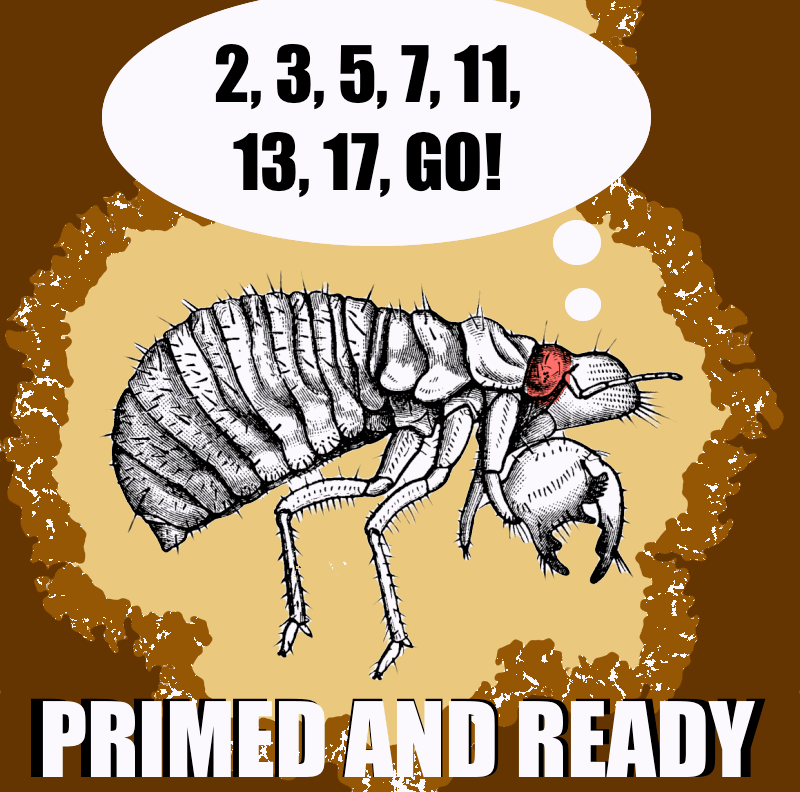
cicadas don’t know about prime numbers.
Thung Song That’s the thing. Brood X emerges every 17 years, not 16, not 18, and tunnels up through the soil in numbers that darken the sky over the eastern United States. A separate brood runs on a 13-year cycle. Both 13 and 17 are prime.
Biologists will tell you it’s evolutionary strategy. Prime-numbered cycles make it harder for predators with shorter cycles to sync up and feast.
Fine. But that explanation assumes the cicada solved a math problem it has no brain to solve.
Something solved it for them.
Primes are the integers divisible only by one and themselves: 2, 3, 5, 7, 11, 13, 17. They feel simple until you try to predict them.
Mathematicians have spent centuries hunting their pattern and come up empty. The primes scatter across the number line with what looks like randomness.
Until you zoom out and see the order beneath. They thin as numbers grow larger, following a distribution so precise it earned its own theorem. The Prime Number Theorem.
We found it. We did not invent it.
Every time you buy something online, primes guard the transaction. The encryption standard protecting your credit card number multiplies two enormous primes together, then dares anyone to factor the result.
The largest computers on earth cannot crack it in a useful timeframe. A number nobody invented, applied to a problem nobody anticipated when Euclid first wrote about primes around 300 BC, now stands between your bank account and the people who want it.
The same signature fires through nature with no financial stake in the outcome. Sunflower seeds pack into their heads in spiral counts of 34 and 55, both Fibonacci numbers, a sequence that bleeds into the golden ratio, which bleeds into primes. The chambered nautilus builds its shell to the same proportion. Romanesco broccoli spirals outward in fractals that follow the same math. A broccoli and a bank running on the same underlying code, one of them on purpose, one of them with no purpose at all.
Quantum mechanics leans on prime distributions to describe how energy levels in heavy atoms space themselves. Researchers at AT&T Bell Labs discovered in the 1970s that the zeros of the Riemann zeta function, the deepest unsolved problem in mathematics, follow the same statistical pattern as energy levels in quantum systems. A pure math problem and a physics problem, worked by different people in different centuries, governed by the same structure.
This is what Evidentialism asks you to sit with. No burning bush. No virgin birth. Just the stubborn fact that the universe runs on mathematics it preceded, and that the mathematics keep appearing in places with no reason to coordinate. A cicada and a cryptographer solve the same problem, on different timescales, with different tools, and arrive at the same prime.
Atheism calls this a lucky accident. Organized religion says God made it and to tithe.
Evidentialism says: look at the fingerprints. Somebody was here. Whether they stay, whether they care, whether they want anything at all, that question sits above my pay grade. But fingerprints tell the truth.
Here’s what I know. The primes worked before we found them. They’ll work after we go. Whatever pressed them into the fabric of things required no audience.
Neither did the cicada.