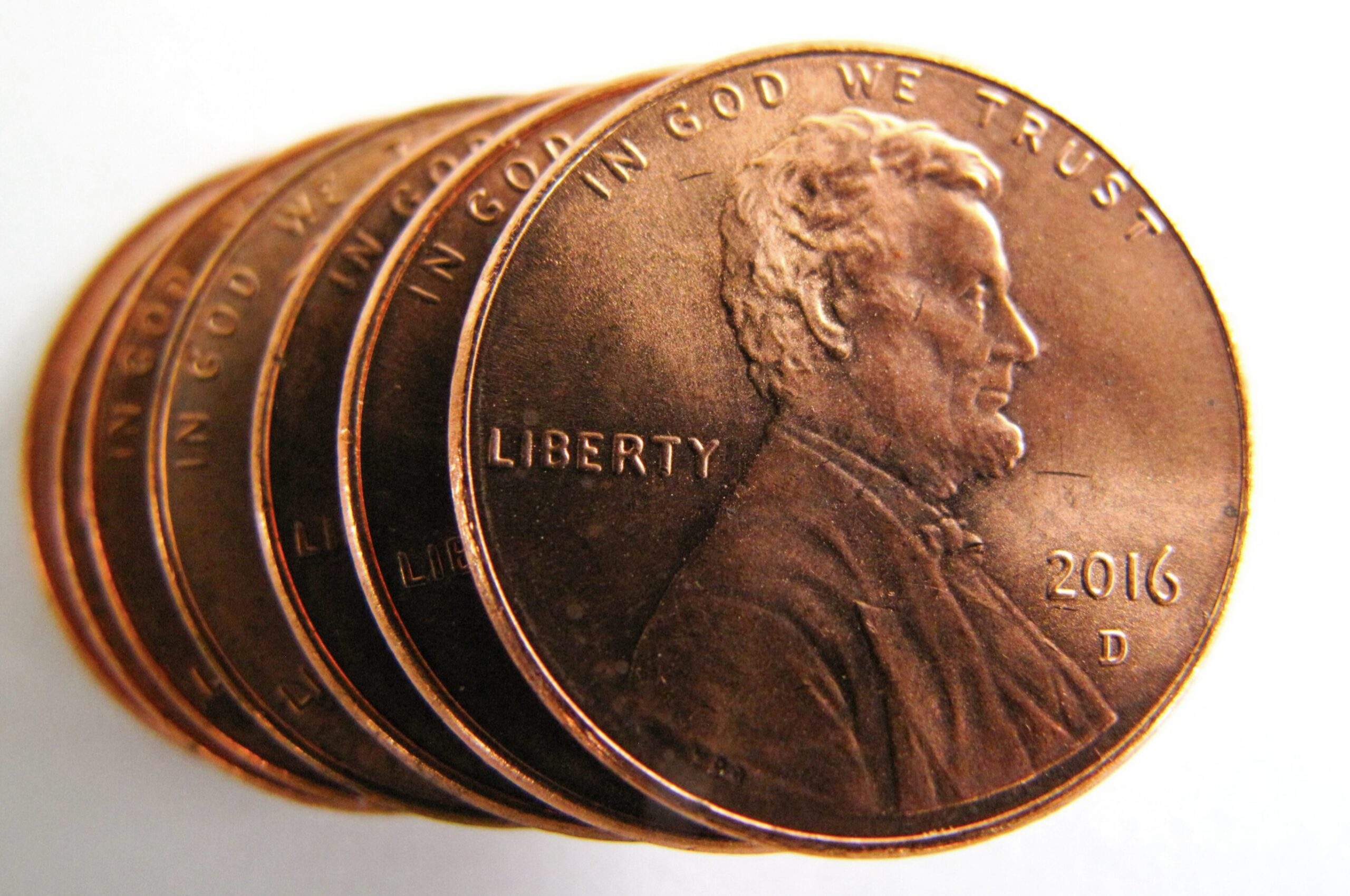
Now it’s leaving. The U.S. Mint will end production of the one-cent coin.
Each penny costs 3.69 cents to make, and last year the Treasury lost about $85 million trying to keep it alive. It’s time, they say, to let Lincoln rest.
Still, the news lands heavy. The penny was my first lesson in money, math, and patience. My father and I collected wheat pennies—those old bronze beauties minted between 1909 and 1958, with two curved wheat stalks framing “ONE CENT” on the back.
We would spread a pile of change across the table, faces down, searching for the twin sheaves that meant treasure. Some were dark and worn smooth; others still gleamed like they remembered the day Roosevelt took office.
That love of copper never left. I started rolling coins myself, counting and stacking like it was a small business. I’d pour handfuls of change, mostly pennies, some silver for variety, into a big glass jug that once held water or cider.
When it filled, I’d carry it to the automated counter and cash it in. The jug would thud onto the counter, and the machine would hum and click until the total popped up: two hundred dollars or more, built one coin at a time.
The penny taught value through ritual. You could feel the lesson in your hands: that something small, repeated often enough, turns into something lasting.
Now the penny’s cost outweighs its worth. Debit cards and apps handle what jars and rolls once did. The country will round its prices, shrug, and move on.
But something tangible disappears in that efficiency. The penny is proof that money once had texture. It clinked, rolled, and shone.
When I hold a wheat penny now, I think of my dad, sorting with me through dull copper and shining history. I think of the jug, the weight of coinage, the smell of metal and time. The penny was never about gain; it was about connection, between generations, between touch and value.
And it could once buy a bubblegum ball.
So yes, retire it. Let the Mint save its money.
But you can keep one, somewhere. Keep it for luck. Keep it for memory.
Every coin tells a story, and the penny’s is ours.
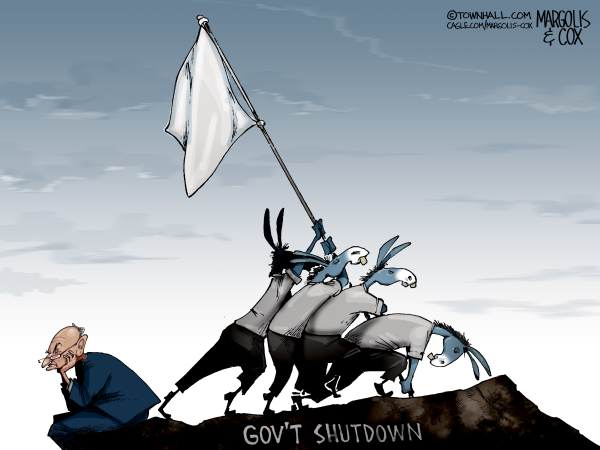
I salute the moderate Democrats. It takes guts to snatch defeat from the saber-sharp jaws of victory like that..
Their party had swept elections. Donald Trump’s approval sank. Polls showed the public blaming Republicans for the shutdown. It was a rare moment of leverage.
And eight senators decided to hand it back.
Their deal was to reopen the government, pay furloughed workers, restore food aid, and clear crowded airports. Those are real gains for everyday Americans.
But the prize Democrats claimed—a future vote on Affordable Care Act subsidies—exists only as a promise. Not law, not funding, only a handshake from Mitch McConnell that something might happen in December.
That handshake raises the real question: if Democrats planned to settle for a promise, why let the shutdown drag on for a month? Why furlough workers, stall food programs, and jam airports just to end up trusting the same people who caused the mess?
If the goal was symbolic, they succeeded. If it was practical, they wasted a month proving their own weakness.
The senators say they acted to protect federal employees and keep programs alive. That part worked. The government runs again. Paychecks resume, SNAP benefits return, and air travel steadies.
Yet the Affordable Care Act credits that lower premiums for millions remain suspended in uncertainty. The Senate will “consider” them later, which helps no one who needs coverage now.
Let’s name the coalition of cowards: Jeanne Shaheen and Maggie Hassan of New Hampshire, Catherine Cortez Masto and Jacky Rosen of Nevada, Dick Durbin of Illinois, Tim Kaine of Virginia, John Fetterman of Pennsylvania, and Angus King of Maine. They crossed the aisle for a 60–40 vote that let Trump and McConnell claim victory while Democrats carried the burden.
This came on Chuck Schumer’s watch. He calls every retreat a reset.
Gotta go. His leadership has softened the party’s will to fight. The Senate needs a leader who refuses to trade principle for peace. AOC, primary this clown.
Moderates call this governing. They believe in handshake politics, in quiet talk, in the grace of restraint. They trust that patience wins and civility carries weight.
Politics, however, rewards strength. The other side pressed forward, and these eight stepped aside.
Democrat: “All right, but how about a little less in the nuts?”
Republican: “No.”
Democrat: “Understood. Just wanted to make sure we were communicating.”
The party’s humanitarian argument collapsed under its own weight. Democrats spent a month warning that the shutdown hurt real families, then handed victory to the people who caused the pain. You can’t claim moral ground while surrendering practical ground. A promise from Mitch McConnell will not pay a rent bill or fill a prescription.
Still, they remain consistent. They prefer order to heat. When the battle tightens, they search for civility.
Applause for the eight who reopened doors, paid clerks, and polished silver while the fire still smoked. Their service matters.
But their judgment saps strength. They stepped in when the tide turned and gave the current back to the seat.
History will mark this as the day Democrats held the high ground and chose comfort over courage. The nation runs again, though its resolve limps.
The moderates stand tall, proud of restraint, sure that a promise will someday turn into policy. Because if the GOP is known for anything, it’s keeping promises.
The moderates are also shopping for bargain prices on the Brooklyn Bridge.