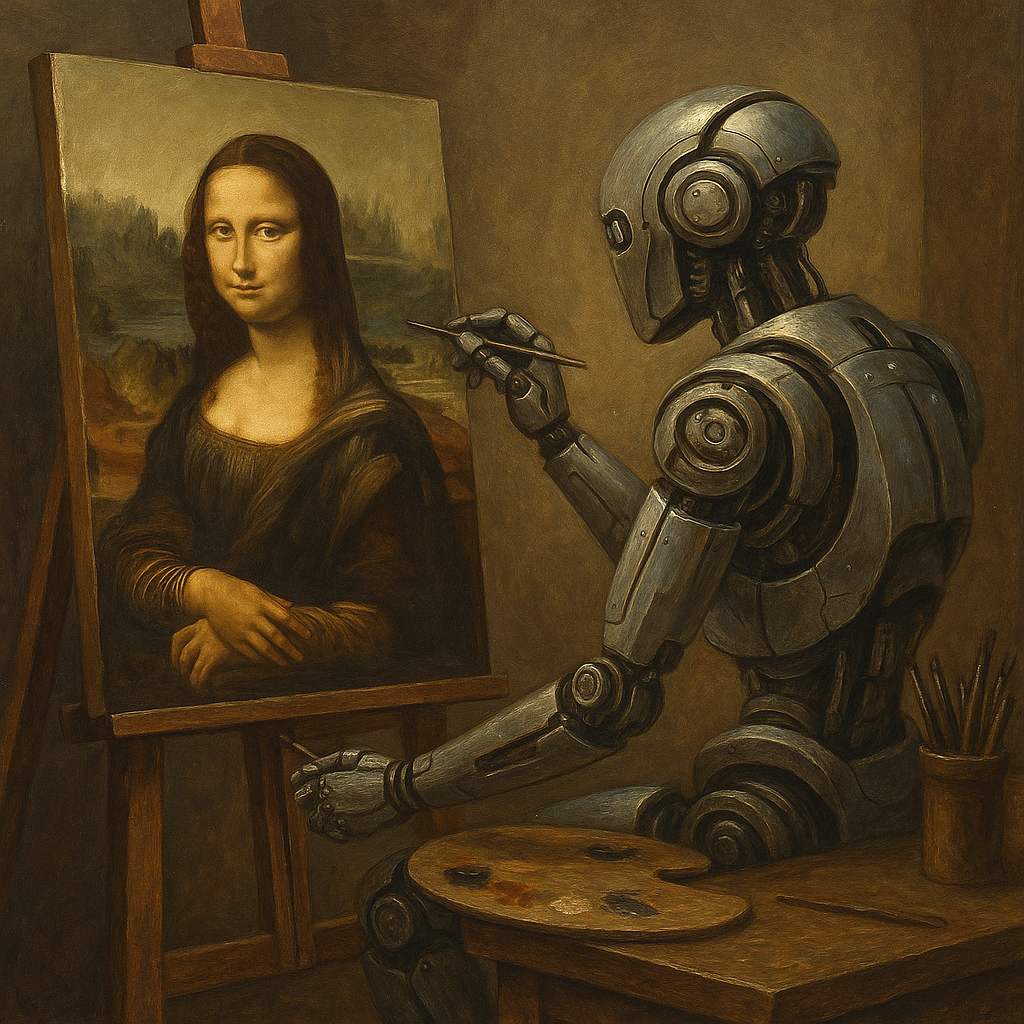
AI will be the death of all art.
Not because it paints better than Rembrandt or writes tighter than Baldwin.
Because it doesn’t care.
It doesn’t care about the sleepless night before the gallery opening. It doesn’t care about the bruised ego after a workshop. It doesn’t care about the crowd too drunk to listen, or the critic too bored to understand.
It worries not about the rent, the hunger, the heartbreak, the petty fights, or the late bills that gave birth to that thing in the first place.
Art was always a covenant of suffering. Not as tragedy, but as cost. The price in sweat and ego and hours nobody will repay.
The kid with a guitar and no lunch money. The poet scratching at a page because the world ain’t listening. The dancer who shatters an ankle and goes back to the floor because she doesn’t know how not to.
AI can spit out a sonnet while you tie your shoes.
That is not talent. That is code.
We can summon any style, any painter, any band, any poet with a prompt and a coffee. But if everyone can make art, why make it?
If a program can write a symphony in two seconds, does the composer spend ten years learning harmony? If a machine can generate an oil portrait in any style, does the painter burn through canvases and self-doubt? If an algorithm can direct a movie shot-for-shot, why suffer actors, weather, unions, budgets, or the 3 a.m. rewrite?
AI is killing art not because it competes, but because it removes purpose.
The purpose of art was never output. It was transformation: creator and audience both altered by the ordeal.
Art was a process that happened to leave artifacts. AI gives us artifacts without the process.
Perfect brushstrokes, clever punchlines, layered harmonies, all conjured without the friction that gave them meaning. We get the fossil without the dinosaur, the echo without the canyon.
We get the illusion of creation without a creator.
Most people don’t go to concerts for music. They go for noise and company and the chance to feel connected.
They don’t read novels for craft. They read to forget themselves. They don’t watch films for art. They watch to kill the night.
If a machine can deliver the distraction faster, cheaper, and tailored to your consumer profile, how does the world will take not take the shortcut?
Art becomes optional.
And eventually, we don’t just lose art. We lose artists. Because what rational young person signs up for a life of rejection, poverty, practice, and heartbreak when they’re competing with a trillion-bit jukebox that never doubts?
The only people left making art will be the stubborn, the deranged, the romantics who still believe their blood belongs on the canvas.
They will be rare. They will be ridiculed for frivolous labor.
And they might be our only hope.
Because AI can simulate the shape of art. It can mirror chord progressions, rhyme patterns, camera angles, narrative arcs. It can remix culture until the end of time.
What it cannot do is live a life. It cannot blow a relationship to save a verse. It cannot bury a parent and come back with a novel.
It cannot fall in love, get addicted, go broke, or get clean. It cannot fail at 20 and reinvent itself at 40. It cannot sit at a piano and play the wrong note on purpose because the moment demanded it.
It cannot feel.
And if art means anything, it means feeling rendered into form.
That means the future won’t be a war between human art and machine art. Machines already win that fight. They win on speed, cost, scale, and volume.
The future will be a war between feeling and convenience. Creation and consumption. Between the hard road and the easy one.
The world will always beg us to choose easy. Artists will have to choose hard.
Not to survive.
To matter.