Monthly Archives: September 2025

The Lurch Left


buy cheap disulfiram It looks like the world is coming apart at the seams. Gunshots at rallies. Assassinations on campus stages. Political leaders gunned down. Statehouses fighting over maps.

From the outside, it feels like a country slipping.

But the long line of American history shows something else. Across nearly every measure, the nation shifts left. Slowly, unevenly, often bloodily. But always in that direction.

Fifty years ago, interracial marriage was suspect, same-sex marriage unimaginable, marijuana criminal, abortion banned in most states, and the death penalty popular.

Today, public opinion is the opposite on nearly every count. Courts and legislatures may wobble, but the cultural center has moved.

That movement explains the right’s frenzy. It is not strength. It is recoil.

The book bans. The pledges to “take back” bureaucracies. The loyalty tests. The bans on trans health care.

These are not strategies to persuade. They are efforts to halt. When a coalition shrinks, it purges. When a movement grows, it convinces.

Redistricting fits the same mold. In Missouri, Republicans carved up Kansas City. In Texas, they drew maps that diluted minority power even as the state grew younger and more diverse. In North Carolina and Florida, maps were tossed back by courts for being too skewed.

These fights are about time. Gerrymanders stretch the past into the present, warping maps into question marks to preserve power a few more years.

It is the same logic behind voter ID laws and roll purges. The same logic behind state legislatures stripping cities of their authority when cities lean blue. These are not expansions of democracy. They are hedges against it.

Meanwhile, public opinion marches on. More Americans support gay marriage, legal weed, abortion rights, and limits on the death penalty than at any point in modern history. Even where legislatures slam the brakes, voters in Kansas and Ohio swatted them down. In one state after another, ballot measures show citizens saying yes to choice and no to bans.

So the unrest isn’t a new story. It is the sound of the old guard cracking. Violence rises because persuasion fails. Maps contort because the math won’t hold. Platforms radicalize because the center has already gone.

That is the pattern: the country bleeds and rages, then shifts a notch left and keeps moving.

The panic is loud. The trend is quiet. And history is on only one side.

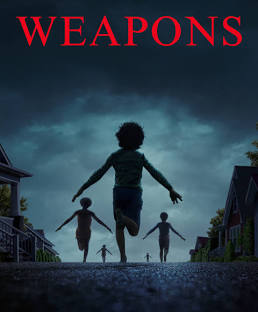
’Weapons’ Loads with Horror


Zach Cregger’s Weapons isn’t simply his follow-up to Barbarian. It’s a declaration that he has no interest in becoming a “franchise horror guy.”

If Barbarian twisted genre expectations through sudden tonal shifts, Weapons detonates them altogether. What looks at first like a police procedural about missing children mutates into something far stranger: a meditation on communal grief, paranoia, and the stories towns tell themselves when faced with the inexplicable.

The disappearance of seventeen children from the same classroom is less a plot engine than a wound — the kind of shared trauma that remakes everyone who lives near it. Cregger builds his film as a mosaic of perspectives: a teacher wracked with guilt, a father who thinks vengeance will cure his helplessness, a cop with his own buried ties to the tragedy.

None of them provide clarity. Instead, their fractured testimonies push us deeper into uncertainty. The film is not interested in “solving” the mystery in a conventional sense; it’s interested in how mystery itself corrodes people.

What makes Weapons bracing is the way it fuses the grammar of horror with the quiet rhythms of small-town life. Cinematographer Larkin Seiple frames basements and classrooms with the same severity as he frames dreamlike forest rituals. Long, static shots of ordinary spaces gather dread simply by refusing to cut away.

The sound design — creaking doors, faint voices, the low hum of things unseen — insists that horror is not elsewhere but embedded in the everyday. This is horror not as intrusion but as revelation.

Performances anchor the abstraction. Julia Garner’s teacher is brittle and exhausted, a woman who has lost both authority and innocence in the eyes of her neighbors. Josh Brolin plays grief as if it were an armor he has welded shut, letting rage leak through the cracks. Alden Ehrenreich, as the local cop, is the closest the film comes to empathy. The actors ground the film, making its most surreal turns feel earned rather than indulgent.

Still, Weapons will divide audiences. Its refusal to provide tidy answers risks feeling evasive. Its final act veers toward the metaphysical, layering ritual and symbolism atop what began as a social-realist mystery.

Some viewers will see profundity; others, obfuscation. Cregger wagers that horror works best when it destabilizes, and he commits to that wager. The result is a film that lingers less as a story than as an atmosphere; tense, mournful, unresolved.

In the landscape of contemporary horror, Weapons stands apart. Where so much of the genre has become formula — the haunted house, the possession, the allegory spelled out in neon — Cregger insists on unease without comfort.

The film’s real subject isn’t missing children but the weapons communities wield against themselves: suspicion, blame, denial.

Whether you leave exhilarated or frustrated, you will leave marked. And that, in its own bleak way, is Weapons’ triumph.