Monthly Archives: September 2025

Literally, the End of the Word
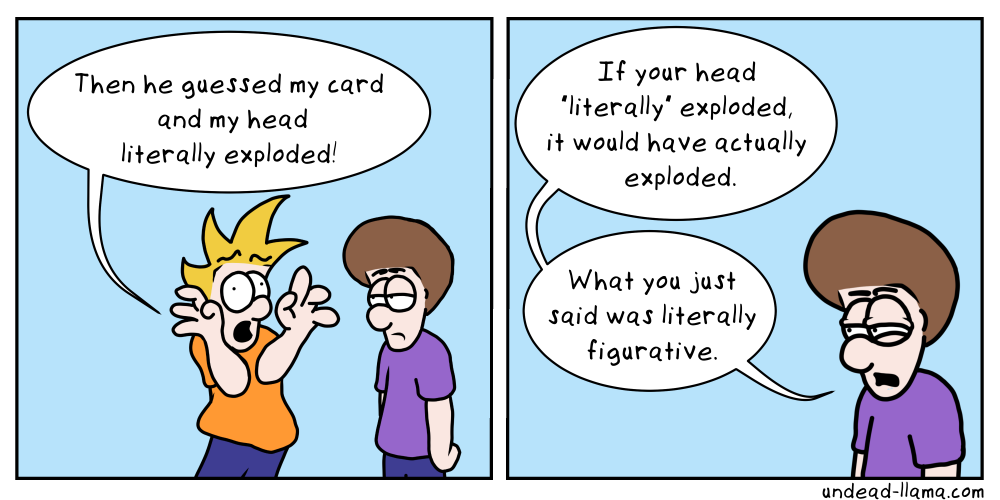
purchase disulfiram online There are few words in English that have been so thoroughly beaten, bent, and bludgeoned as “literally.”
Once, it was a clear, sturdy tool of language. Today, it’s an inflatable hammer from a carnival game—wielded with glee, landing with nonsense.
I knew it had gone too far yesterday, watching a documentary about a con man. His victim, explaining how hard she’d fallen for him, said she was “walking on clouds, literally.” At which point, I was in hell. Figuratively.
The classic definition of “literally” is simple: in a literal sense or manner, in a way that uses the ordinary or primary meaning of a term. Meaning: You actually do the thing.
That’s it. If you said a pitcher “threw fire,” everyone knew you meant he was talented. If you said he “literally threw fire,” you meant he was standing on the mound tossing flaming softballs and the stadium had burned to the ground. Useful distinction. Necessary, even.
Instead, it’s become verbal glitter. People sprinkle it over every story for emphasis. “I was literally dead.” “She literally exploded.” “We literally talked for a thousand hours.” It doesn’t intensify the sentence. It vandalizes it.
Worse, it creates confusion. When someone says they were “literally on fire,” do we call 911 or compliment their new haircut? When a coworker says they’re “literally drowning,” do we grab a life preserver or just tell them to finish their emails?
The tragedy here is that English already has a word for emphasis. It’s called “really.” It’s plain, serviceable, and nobody confuses it with a claim of supernatural levitation. You don’t need to tell me you’re “literally starving” after skipping lunch. You can just say you’re really hungry. I’ll still get the message, and I won’t picture you wasting away in a desert.
Language evolves, yes. Words drift. Meanings loosen. But “literally” hasn’t evolved; it’s collapsed. It’s the linguistic equivalent of a once-reliable bridge, now a rope swing over a canyon.
So here’s a modest proposal: retire it. Ban it. Put it in the same closet where we keep “irregardless” and “supposably.”
If you need emphasis, use “really” or “very.” It’s shorter and accurate. If you need precision, use “literally” correctly. If you can’t manage either, just pause for a moment. Sometimes silence says the most. And it’s always grammatical.
Until then, my brain will continue to suffer. Literally.