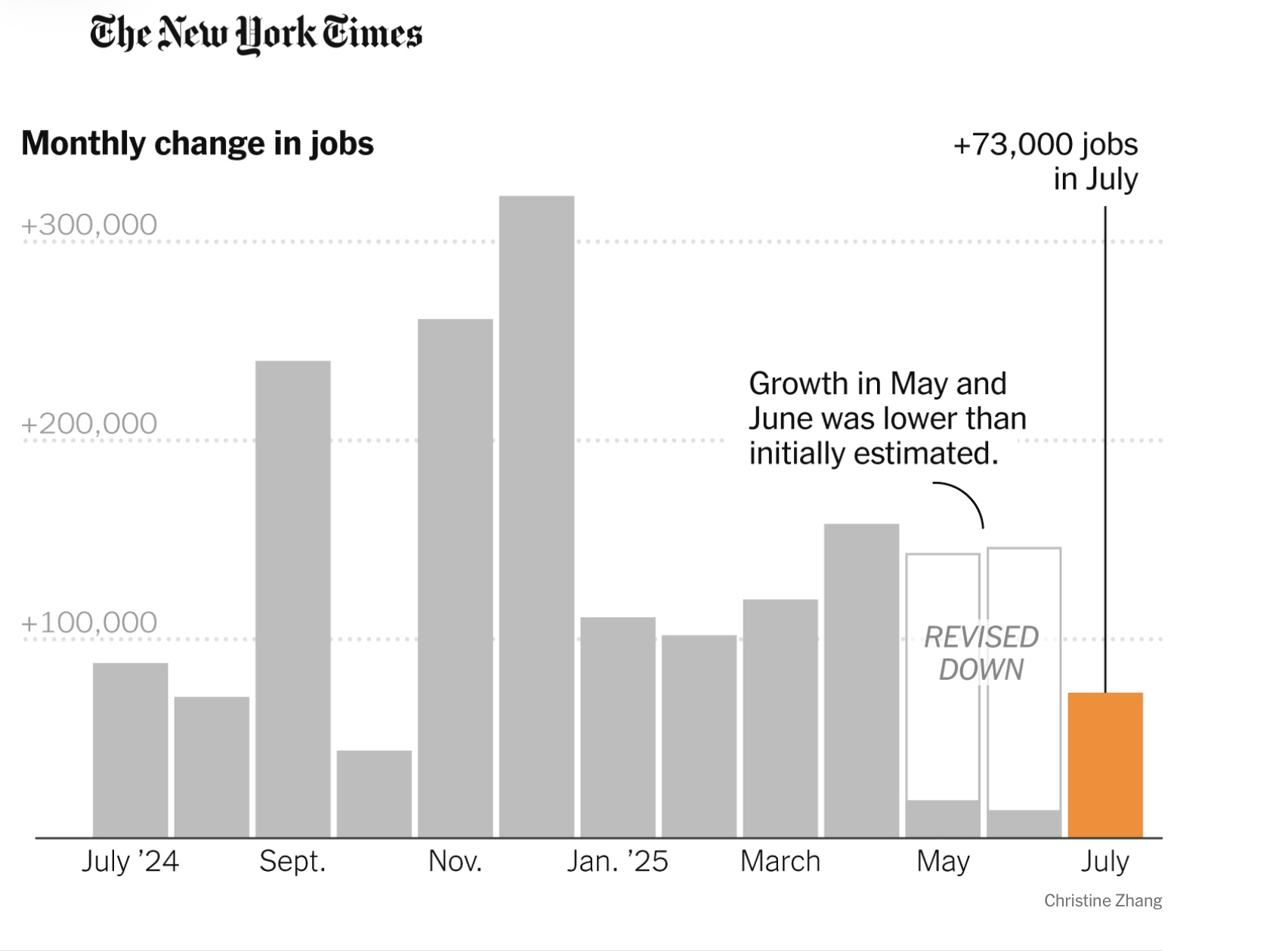
The Bureau of Labor Statistics reported sluggish job growth this morning. So President Trump fired the person who told us.
That’s not a metaphor. It’s not some bureaucratic shakeup. It’s a red-line moment: a sitting U.S. president just removed the nation’s top labor statistician—Erika McEntarfer—for releasing government data that contradicted his economic narrative.
The July jobs report showed a net gain of just 73,000 positions and steep downward revisions for the two months prior. In Trump’s view, the numbers weren’t just disappointing—they were treasonous.
By midday, McEntarfer was out, and Trump’s loyalists were already pushing conspiracies about “deep state saboteurs” in the Labor Department. Her sin? Reporting reality.
This is banana republic stuff.
The Bureau of Labor Statistics isn’t partisan. It doesn’t run opinion polls or issue talking points. It counts. It gathers and analyzes. Its work is relied upon by the Fed, economists, corporations, journalists, and the public.
To fire its head over bad numbers—especially with no evidence of wrongdoing—is to declare war on objective measurement. Trump didn’t dispute the methodology. He didn’t point to any irregularities. He just didn’t like the outcome.
And so, he fired the truth.
This is a warning shot across the bow of economic reporting. It’s a cannonball through the waterline of institutional credibility.
If the President can turf out career professionals for producing inconvenient facts, who’s next? Census Bureau officials? Climate scientists? Intelligence analysts?
This is what autocracies do: They eliminate the scoreboard. They swap referees for cheerleaders. They don’t want to win the game—they want to rewrite the rules.
And it comes at a fragile time. The economy is teetering. Consumer confidence is slipping. Trump has layered in a new batch of erratic tariffs, kneecapping U.S. supply chains in the name of national pride.
Analysts are already warning that today’s weak jobs numbers could mark the start of a downturn. The last thing this economy needs is doctored data and blind policymaking.
But that’s what we’re getting. With McEntarfer gone, Trump has installed a “temporary” acting commissioner. That might sound innocuous.
But the Trump era is built on acting officials—unconfirmed loyalists who serve at his pleasure and fear his fury. And the message is clear: produce the right numbers, or you’re next.
What’s worse, this is how democracy dies in 2025—not with a riot or a coup, but with a quiet edit to the Excel spreadsheet. A revision here, a firing there. An erosion of truth, slow enough that we might not notice until we no longer recognize the country we’re trying to measure.
This isn’t about a jobs report. This is about whether America still believes in facts. Or whether we now believe only in the people who claim them.
The threat isn’t that the president fired a statistician. The threat is that he’ll fire the next truth, too.
How do you make a war film that is antiwar, an epic that undermines its own grandeur, a masterpiece that never stops bleeding?
You make Apocalypse Now. And then you watch it unravel you.
Francis Ford Coppola’s 1979 fever dream is one of the most ambitious acts of cinematic self-destruction ever filmed. It begins as a mission and ends as a meditation, not just on Vietnam, but on the disease of power, the moral rot of empire, and the strange poetry of collapse. It is not a war film. It is a film about war’s hallucinatory pull—the way it bends light and logic and turns men into myths.
It opens not with guns, but with The Doors. Jungle palms drift across the screen as helicopters and napalm melt through the soundtrack. A man lies in a Saigon hotel room, sweating, shaking, spinning toward madness. That man is Captain Willard, but he is also Coppola, and also us. He is the tether to the river, the escort into hell.
There are a hundred reasons Apocalypse Now should have failed.
The budget ballooned.
The star (Martin Sheen) had a heart attack.
The weather destroyed sets.
Marlon Brando showed up overweight, unread, and unwilling.
And yet, the chaos made the film. The madness wasn’t around the movie—it was the movie. Coppola knew it, too. At Cannes, he famously said, “My film is not about Vietnam. It is Vietnam.” That wasn’t just bravado. That was confession.
Because this isn’t a story about winning or losing. It’s a story about knowing.
About how far down the river you’ll go to find the truth.
About how far into yourself you’re willing to stare.
The film adapts Joseph Conrad’s Heart of Darkness, but it doesn’t transpose so much as transfigure. Vietnam replaces the Congo. A classified mission replaces colonial trade.
But the descent—the moral erosion—is still the story. As Willard rides deeper into the jungle, the war gets stranger, louder, more unhinged: Robert Duvall’s surfing colonel dropping napalm because the waves are good; Playboy bunnies helicoptered in for a show and then airlifted out like contraband; a French plantation scene (often cut) where the ghosts of colonialism smoke opium and pretend history can be negotiated.
Each stop on the river is a station of the cross. Each scene asks a question the next one refuses to answer.
And then there’s Kurtz.
Brando’s shadow, mumbling from the temple of despair. He’s barely a man anymore. He’s a whisper in the jungle, a god gone to seed. That he showed up to the shoot grossly overweight only adds to the mythos; here he represents the excesses of American military.
Kurtz recites Eliot. He murders with ceremony. He’s become the thing America pretends doesn’t exist: a soldier who understood the war, and kept going.
Kurtz isn’t the villain. The war is. The horror is.
And it is beautiful.
Vittorio Storaro’s cinematography doesn’t just capture the jungle—it devours it in gold and smoke. Walter Murch’s sound design builds a nightmare from whirring blades and broken hymns. Every frame is deliberate delirium.
This isn’t a film you watch. It’s one you survive.
Coppola didn’t just chronicle a descent into madness. He brought a camera with him. And the miracle is: he brought something back.
Some films entertain. Some inform. A few transform.
Apocalypse Now leaves you haunted—and grateful for the wounds.