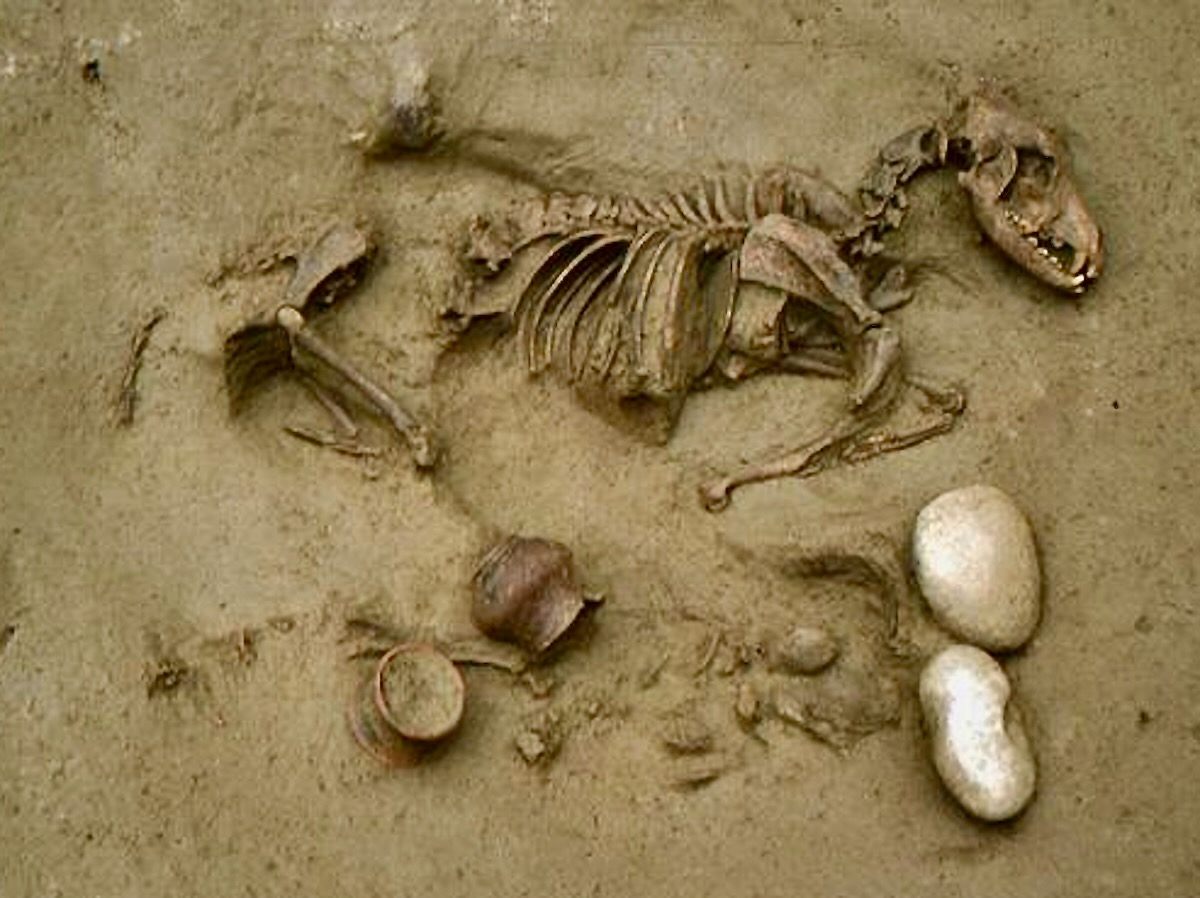
Roughly 14,000 years ago, in what is now Germany, a puppy died. Its people laid the pup to rest beside a man and a woman.
The burial was deliberate. The puppy had been cared for through sickness. Someone had kept it alive for weeks despite distemper, a fatal and miserable disease, spoon-feeding it, nursing it, holding on.
That animal, now known as the Bonn-Oberkassel dog, offers the earliest known archaeological evidence of dogs being loved. Not owned. Not fed for utility. Loved.
The true beginning lies further back, hidden in the fog of the Ice Age, when our ancestors weren’t farmers or city dwellers but nomadic hunter-gatherers scraping survival from harsh landscapes.
Somewhere between 20,000 and 40,000 years ago, wolves started hanging around human campsites. They scavenged our scraps. The tamer ones got closer. We didn’t kill them. We probably threw them bones. Eventually, we let them stay.
From that evolutionary dance emerged something new: the proto-dog.
Unlike wolves, these early canines weren’t just tolerated—they were selected. For gentleness, for alertness, for their ability to read our moods. Over thousands of years, natural selection gave way to cultural selection. Wolves became dogs.
By 15,000 years ago, the relationship had begun to crystallize. Dogs helped hunt. They barked at threats. They traveled alongside humans across continents.
But if the measure of friendship is emotion—bond, grief, memory—the Bonn-Oberkassel burial is the first time archaeology speaks not just of dogs being used, but missed.
Because that puppy wasn’t buried like trash. It wasn’t tossed into a pit. It was laid in a grave with humans, likely its companions, and sealed with care.
It had no functional purpose in death. The only possible explanation is emotional: mourning, maybe even love.
This shift is what makes dogs unique. No other domesticated animal shares this layered role of worker, companion, protector, and confidant.
Cats, despite their charm, were late to the scene—domesticated only about 9,500 years ago in the Fertile Crescent. Horses were harnessed for transport and war. But dogs were there before we settled down, before cities, before wheat.
By the time agriculture took hold around 10,000 years ago, dogs were already a fixture. Ancient DNA studies suggest distinct dog lineages had already formed around 11,000 years ago, with populations spread across Eurasia. They migrated with us. They endured with us.
So when did dogs become our best friends?
If the question is about domestication, the answer is 15,000–30,000 years ago, when our ancestors first began cohabitating with wolves.
But if it’s about emotional attachment, the Bonn-Oberkassel burial at 14,200 years ago is the landmark moment. That’s when we stopped simply feeding dogs and started feeling for them.
The truth is, dogs didn’t just become our best friends. We became theirs. And they’ve been waiting at the door ever since.