


Of course Superman is an immigrant story — he’s America’s greatest flying love letter to the outsider.
James Gunn, the director of the upcoming Superman film, kicked off a firestorm this July 4 when he described the Man of Steel as “an immigrant story,” emphasizing that his new take would focus on “basic human kindness.”
Gunn’s brother, Sean Gunn, took it even further, saying if you don’t understand Superman as an immigrant, “you’re not American.”
The backlash was swift and loud.
Dean Cain, the former Lois & Clark star and a longtime cultural commentator, argued that Gunn was making Superman “woke,” calling it a mistake that would alienate audiences and hurt ticket sales. On Fox News, Jesse Watters mocked the idea outright, quipping that Superman’s cape might as well read “MS-13,” invoking an immigrant gang to undermine the point. Laura Ingraham framed Gunn’s comments as yet another example of “Hollywood’s endless politicization” and declared she would skip the film. Conservative sports radio host Clay Travis took to social media, calling Gunn “an absolute moron” and suggesting the film would bomb.
These critics see Gunn’s immigrant framing as a new, politicized twist on a beloved American icon. But they’re missing the most crucial point: Superman has always been an immigrant story. In fact, he’s one of our best.
Created in 1938 by Jerry Siegel and Joe Shuster, both sons of Jewish immigrants, Superman was envisioned as a refugee hero from the start.
Kal-El didn’t stroll into Kansas with a visa and a voter registration card. He arrived alone, as a baby in a spaceship, fleeing a dying world and landing in the heartland. He was taken in by the Kents, taught American values, and ultimately chose to dedicate his life to defending the very country that adopted him.
Here’s the truth that often gets lost in the culture war crossfire:
The idea that Superman is “just a farm boy from Kansas” isn’t wrong — it’s incomplete. His story is about reinvention and choice, two hallmarks of the immigrant journey. Superman doesn’t simply assimilate; he enhances. He lifts America to its best imagined self.
Some pundits argue that pointing out these truths is “politicizing” a character who should be above it all.
But Superman has always been political in the truest, deepest sense. He fought Nazis in the comics long before America officially entered World War II. He stood up for workers, immigrants, and the powerless in his earliest issues. He’s never just been a muscle-bound symbol of strength; he’s a moral compass, designed to show us who we could be at our best.
Gunn’s timing, right before the film’s release and during a patriotic holiday, is no accident. As America lights up fireworks and waves flags, Superman stands as a reminder that the American story is the immigrant story — not just a series of star-spangled slogans but an ongoing experiment in welcoming, uplifting, and transforming.
A 2023 Pew survey showed that nearly 70% of Americans believe immigrants strengthen the nation through their hard work and talents. Superman embodies that faith more powerfully than any statistic or stump speech.
Gunn isn’t injecting a new ideology into Superman. He’s recovering the original. Superman isn’t just strong; he’s compassionate. He doesn’t just protect; he believes. He arrived from the stars, adopted our values, and chose to fight for us, even when we fail to live up to those ideals ourselves.
If we can’t see Superman as an immigrant, we risk losing sight of the most aspirational part of our own story.
He didn’t just arrive on Earth; he chose America. Like all immigrants.
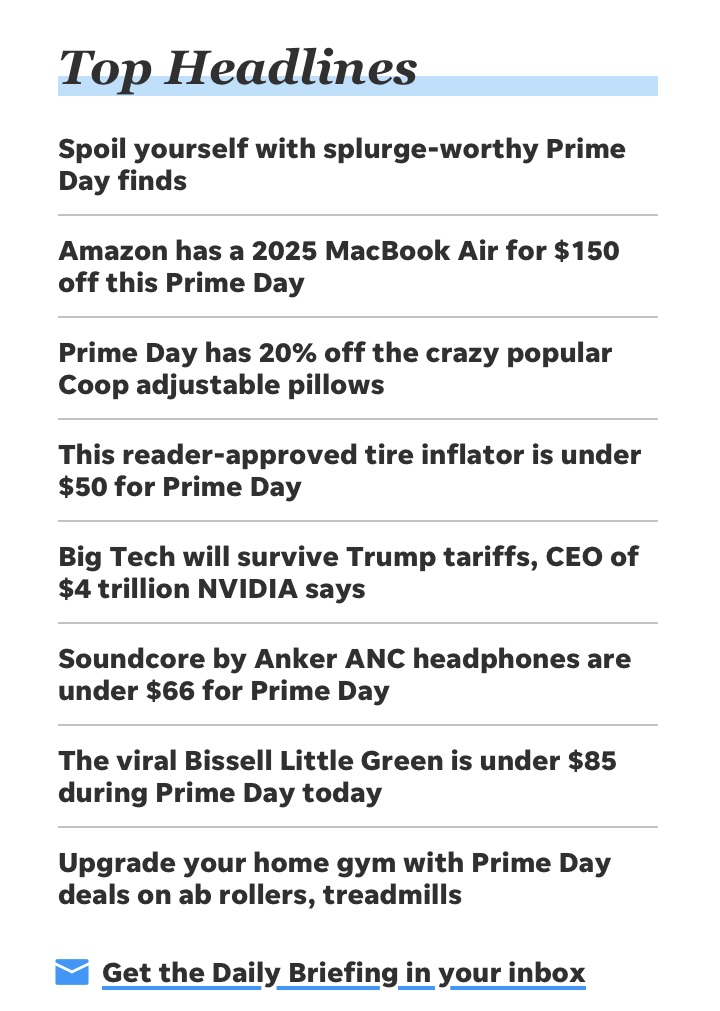
This is what the death of journalism looks like.
I used to work at USA Today. Seventeen years in that building, watching reporters hustle for scoops, editors argue over a single word in a headline, and the pride that came with a byline printed on real paper, waiting in hotel lobbies and airports across the country. We cared then. We really did.
Now, it’s all Prime Day.
Scroll through those headlines — “Spoil yourself with splurge-worthy Prime Day finds,” “Amazon has a 2025 MacBook Air for $150 off this Prime Day,” “Prime Day has 20% off Coop adjustable pillows.” It’s not a newspaper anymore. It’s an affiliate link in human form. An SEO sacrifice at the altar of cheap consumer dopamine.
Forget democracy. Forget watchdog journalism. Forget reporting that holds power accountable. Today, the only power USA Today holds to account is whether your mattress is properly supported by a Coop pillow and if your dog’s carpet cleaner is on sale for $85.
I don’t mean to sound nostalgic for the “good old days.” Plenty was broken back then, too. But there was a baseline respect for news. There was a belief that journalism meant accountability, not peddling the latest Anker headphones.
It’s easy to blame social media. Or Amazon. Or our collective inability to resist a deal. But the real villain is the willingness to trade credibility for a few extra affiliate dollars.
I’m not against commerce. Journalists need to be paid. Newsrooms need to stay afloat.
But when every headline reads like a walking infomercial, you can’t call it journalism anymore. You can’t even call it service journalism. It’s just service — to Amazon, to advertisers, to anyone waving a check.
The lone “real” story on that page — “Big Tech will survive Trump tariffs” — is a billionaire CEO reassuring us that his trillion-dollar company will be just fine. That’s the journalism we get when the newsroom becomes a marketing department. Power flattering power, no hard questions, no uncomfortable truths.
We used to call ourselves the “Nation’s Newspaper.” You’d see USA Today tucked into hotel doors across the country, a snapshot of America in bright, crisp colors.
It wasn’t perfect, but it tried. It tried to be more than a shopping catalog.
That spirit is gone. In its place stands a hollow shell, hawking deals like a carnival barker. You can almost hear the shout: “Step right up! Don’t miss your chance to splurge on a Prime Day pillow! Limited time only!”
If we want to understand why trust in media is in freefall, we don’t have to look far. It’s right there, in bold headlines and lazy copy, reminding us that for some publications, the only truth left is the checkout total.
I don’t know what’s sadder — that this is happening, or that it’s working. Could a suit ask for better “headlines?”
When the front page is for sale, I guess the soul goes cheap.