The Cost of Love

http://childpsychiatryassociates.com/treatment-team/kerrie-hill/  

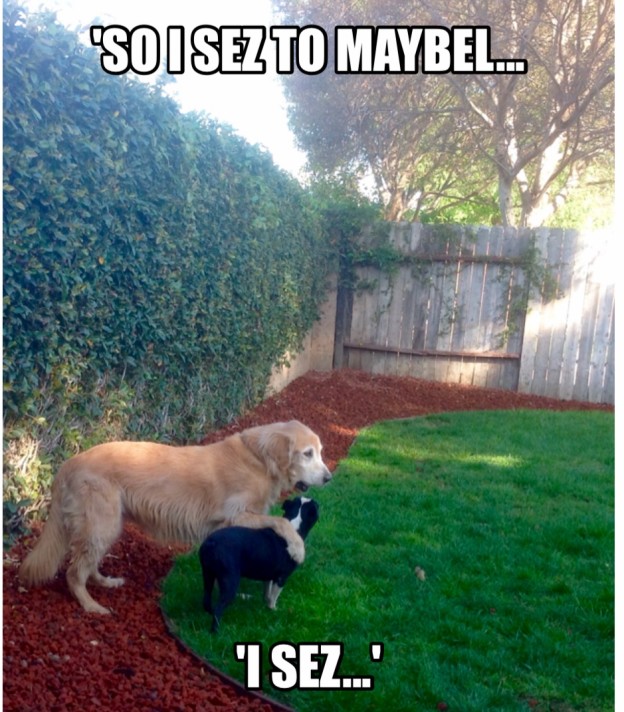
Kitchener Teddy, I swear to god, sometimes that dog…

whyyoulittle_c

So he’s always eaten weird things at the house. He once took two TV remote controls while I was out of town, chewed on them a bit, and left them under a sprinkler for two days (somehow, they still work).

Another time, when he learned he could use his height to his fiendish advantage, he ate an entire chocolate brownie, requiring a late-night scramble to the emergency room of my vet.

teddyatcounter

But cotton. Teddy always cottoned to cotton.

Paper. Underwear. Sweatpants. Bath robes.

Then he took a hankering for, of all things, money. And, apparently, the bigger the bill, the better. When I left a $5 and $1 bill on the foyer table, he ate the $5, in half as precisely as a frog dissection. The $1 was left untouched.

This week, Teddy went for the big score.

I got up about 9 a.m., padded toward the living room. As I opened the bedroom door, I discovered my floor tiled in plastic: credit cards, driver’s license, insurance card. It had been three days since he’d been home, thanks to a quick trip to Atlanta.

And I realized: He ate my wallet. Must have smelled the billfold (perhaps a bouquet of  ass and leather?), decided it was a premium rawhide, and ate my wallet. At least he left me my driver’s license, but it was a lot of cash: $164 from the trip. Seven $20 bills, a $10, two $5 bills and four $1 bills (my obsessive compulsive urges demand I order my bills, largest to smallest, and I remembered ordering the stack before the flight).

Then, a break in the case: The ID cards led me on a bread-crumb trail to my wallet, tucked in the cushions of my black leather couch (how he has not passed that through his bowels remains a mystery).

Or what remained of my wallet. Teddy went to town on it.

But when I opened the wallet, the biggest surprise: He left me the four $1 bills.

Mom suggested I check Teddy’s poop for the money, and couldn’t help but crack I could still try to spend it (just lay a turd on the counter at 7-11 and ask for change for a $20).

Yet, I can never hold a grudge against the guy, who simply wants to taste the world.

at pool

After a few choice words for him, Teddy took a timeout in the backyard.

Normally, this would not be punishment for him, so thick his coat. He’ll often nap outside to enjoy the winter air, a stark difference from the boiler room Esme and I tend create inside the house.

esmecold


But if he sees me — anywhere — he wants to be there, too. I’ve seen him sit in the rain when I’m in the backyard. My house is a sauna, but he pants his way through without complain. He leaps into any car I’m driving with unwarranted confidence, unrestricted trust.

dogs in car

And now, he is at the back patio door, awaiting forgiveness and re-entry. He must know me inside out: I could never stay mad at Ted. Not even for $160 cash. I still melt when I think of what that boy has brought to my life.

Teddy, I swear to god, sometimes that dog…

teddy mug


In God We Trusted (an Act in Two Bits)


I’ve always been something of a coin nerd.

It began when dad got me into collecting wheat pennies, the early coins minted from 1909 to 1955.wheat-penny-large I’m not sure why dad liked them, but I hunted them like Ahab on a bender. We tallied 147 of them. They may still lay congregated  somewhere, in an unused beer stein at the house (dad, unlike Ahab, wasn’t much of a drinker).

As I got older and into magic, I extended my geekreach to larger coins: half-dollars, silver dollars. I still pester friends traveling overseas to collect the coinage of the land. I have several arcade tokens I’ve kept simply because of their heft and shine.

Recently, cleaning out a drawer, I came upon a quarter that saved itself from the change jar. That’s where all coins typically go, to be amassed and then wasted on something like a magic trick or battery-operated toy or some such equivalent of beanstalk seed.

But this quarter caught my eye. It was dingy, beaten up, clearly around the block a few times. Still, its year — 1953  — shone like a new mom. I’m still not sure why I kept it. 1953 isn’t a memorable year for me, nor an important number.

But the more I thought about the coin, the more valuable it became.

It must have sparkled like Waterford when it was minted, either in Philly, Denver or San Francisco.

Who was the first owner? How many has it seen? Where has it been traveling for the past 62 years? Did it once jingle in a president’s pocket? Help Bob Dylan buy a pack of smokes? Sit in a kid’s first piggybank?

I began to research the year. Gas was 22 cents a gallon. Bread was 16 cents a loaf. The average annual income was $4,011 a year.

Then, another surprise: My quarter, probably handed to me in a handful of change at Yummy Donuts, was actually worth $2.55. Apparently, the U.S. Treasury put more silver in coins back then, when we paid our debts. One website said that, if it were struck at a certain mint, it could be worth as much as $6.

But this coin’s not for sale.

I know that when I’m gone, the coin will re-enter America’s economical orbit. Maybe it will wind up in a parking meter (for the hover cars we’ll all be riding, right?). Or Yummy Donuts. Or Bob Dylan’s great-great-granddaughter’s first piggybank.

For now, though, it remains safe here, in the admiring hands of a nerd in Van Nuys who took a shine to its shine. For we all have one, don’t we? We all are one, aren’t we? Looking to catch the light at the right angle, to rest among the treasured, to announce to the world: Kilroy was here.

Unknown

It’s funny how priceless a thing becomes with just a little attention.


Please Allow Me to Introduce Myself

(Warning: spoilers abound)

Much ink and many megabytes have been spent in praise of the season 2 finale of Fargo, all of it earned.

But in breaking down the cleverness of the final episode, perhaps we, as Lou Solverson would say, are missing the bigger picture there, yeah.

For all the brilliant Coen references, time jumps and links back to season 1, Fargo’s second season is really a retelling of the story of Job — with Hanzee as the devil, a well-dressed-but-indifferent stranger as God and Lou as Job.

The show foretold that in episode 1, when judge Mundt tells Rye Gerhardt the parable: That one day, the Devil challenged God that he could get a righteous man to denounce his faith. He plagued Job with loss, pain and suffering. But Job remained unwavering, and was returned his health and fortune for taking the righteous path.

In the same way, Lou was set upon by modern plagues. He is sent to serve in Vietnam — twice. He’s watched “his boys” die senselessly. His young wife and mother of his 6-year-old has cancer. He is threatened to surrender his faith by the Gerhardt clan, which owns local law enforcement, and by Mike Milligan, who has corporate backing to lure him with cash.

But Lou rejects the crooked for the enlightened path, literally following a pool of blood toward the the glow of the crime scene in creator Noah Hawley’s profound Palindrome in Fargo’s second season finale.

Hawley managed to do with season two what the Coen Brothers did in 2007 with the film adaptation of Cormac McCarthy’s epic No Country for Old Men. The brothers took a bloody Western epic and turned it into a Biblical tale of Satan-angel rivalry. For who is Anton Chigurh if not Death, unstoppable and random as a coin flip, friend-o? And Tommy Lee Jones, as Sheriff Ed Tom Bell, is more: a wizened angel who sees the pointless of engaging with madness, particularly after a simple man (Josh Brolin as Llewelyn Moss) loses his life and soul to greed.

antone hanzee at store tommylee

The canny interpretation would win the Coens a raft of Academy Awards, including Best Picture.

Similarly, Hanzee is Death incarnate. Throughout season 2, he was present as a silent instigator: Between Dodd and his family, between the Gerhardts and the Kansas City mob, perhaps even between the white man and Indian in the West’s Manifest Destiny (Hanzee takes a long, unreadable look at the site of Indian hangings at Sioux Falls). His demonization is made visually official when he is cast in flames as Peggy imagines him outside, smoking her out of the cooler.

But the defining scene comes 52 minutes into the episode, when a scarred, bandaged and vanquished Hanzee awaits the stranger with his new identification. Mr. Numbers and Mr. Wrenches, both children and both staples of season 1, toss a softball in a park. The stranger talks of Hanzee’s insistence of joining empires whose vanity assures their destruction. He issues Hanzee a new Social Security number and new name, Moses Trinity.

Fans have gone nuts over the name, as it’s a reference to a crime boss from season 1. moses

But, measured as a story unto itself, isn’t it God allowing the Devil to continue to wreak futile chaos — which Satan promises to do (“Head in a bag. That’s the message.”)? As a furious Hanzee storms off the field and brushes past the now-fighting brothers, you could nearly hear Sympathy for the Devil playing in the background. Hope you guess my name.

Meanwhile, the devil’s lieutenants are sent to their corresponding hells: The Gerhardt’s lose their entire family, Peggy becomes a literal prisoner of her pride, Ed left a slab of refrigerated meat for ignorance, and Michael made an emperor-turned-drone in a corporate hellscape for greed.

The faithful Solversons, meanwhile, retire to their version of heaven — and even gets a brief sermon from patriarch Ted Danson (Moses?) who dreams of a world with one language, not of tongues divvied like the Tower of Babel.

Which would also explain the alien visitors from above. Sometimes all people need is faith to make the following a true story.

The devilish question for the F/X network, which has green-lit a third season of Fargo, is how do you top it?

https://www.youtube.com/watch?v=EiIH5PewAzs