All the News That Fits, We Print


I have been a police reporter for 15 years, and a film reporter for another decade.

So I feel comfortable committing the following double heresy:

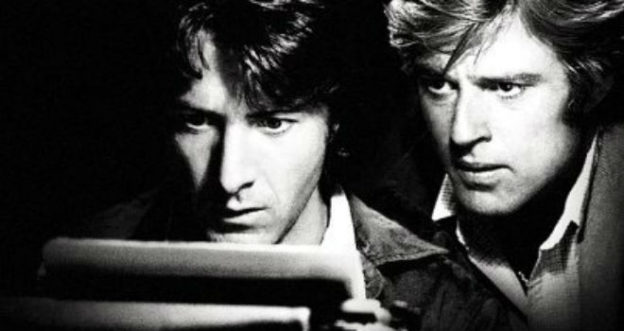
All the President’s Men is a lousy movie.

As a book, it’s poetry. As a story, it’s the gold standard for every aspiring reporter.

But, strictly from an entertainment perspective, the 1976 Oscar winner for Best Picture — and five other Academy Awards —  cinematically sucks.

I realized this last month, when HBO — perhaps in a plea for substantial political journalism — made it one of their feature films for the week spanning Election Day.

At least a dozen times, the movie has unspooled before me. I know the story, the characters and the circumstances inside out. I even recognized the lobby, newsroom and parking lot, as The Washington Post was my old employer, Bob Woodward my Sunday editor.

So on my most recent viewing, I decided to watch again. This time with intensified focus. Even played it with closed captioning, to absorb the nuance of the script.

No matter. It still blows.

For one, there are simply too many characters to follow. Just try keeping up with the names of more than three dozen actors with screen credits, from political wonks to Post editors. Unless you’re a journalism major in college, you likely don’t know the name Harry Rosenfeld (He was the Post’s city editor an a key figure in the scandal.). By the second hour, you need a score card and flow chart to keep track of the characters.

Second: we never meet the mysterious character behind the film, Deep Throat. The real life character, Robert Felt, was only identified posthumously.

Now imagine trying this strategy in any other film. Consider the pitch:
Producer: “So we’ve got this shadowy figure, who only meets Robert Redford in darkened garages after secretly signaling him he has found new evidence.”
http://childpsychiatryassociates.com/treatment-team/sheila-pottebaum/ Exec: “I love it. Who does it turn out to be?
Producer: “We don’t know, so we never reveal.”
Exec: “The door is that way.”

Or another scene, in which Carl Bernstein confirms his story with a source over the phone.
Producer: “It’s even got a 10-second countdown. Or count-up — the reporter is counting to ten.”
Exec: “Beautiful. What happens at 10?”
Producer: “Nothing. He confirms the story by not hanging up.”
Click

One thing it does get right: the acrobatics required to handle a telephone while trying to write down what people say. How many collective hours, I wonder, were wasted in old films of characters dialing a rotary phone?

phones

It’s easy to see why APM was an unmitigated success. For the public, it was a reminder of what a healthy press looks like in action. And they could drool over Redford.

For critics, Alan Paluka’s drama took painstaking measures to get the details right, and it did (however stultifying those details were). Good films raise the art of its subject matter.

And who in the mainstream press was going to knock it? Sure, the meetings between Deep Throat and Woodward were pure fiction. But when’s the last time reporters were portrayed by acting icons? Hollywood characterizations of reporters is typically  negative when the journalist is a minor character. But positive when they are central characters.

Finally (spoiler alert): the finale. APM concludes with no arrest, no showdown of powers. Simply a teletype, clacking the news that Richard Nixon resigned from office. Roll credits.

It was a wholly appropriate finale, one that perhaps was as spot-on as any based-on-a-true-story premise.

But ending a narrative with a few lines of text rarely makes for compelling drama.

See?
Spring Forward, Fall Back, and Do the Hokey Pokey

To miss a train or business deal,
Because our clocks are without keel
Can cause a nation loss of gold
E’en worse than all the misers hold.

— 1942 letter to Time magazine urging a national daylight savings time


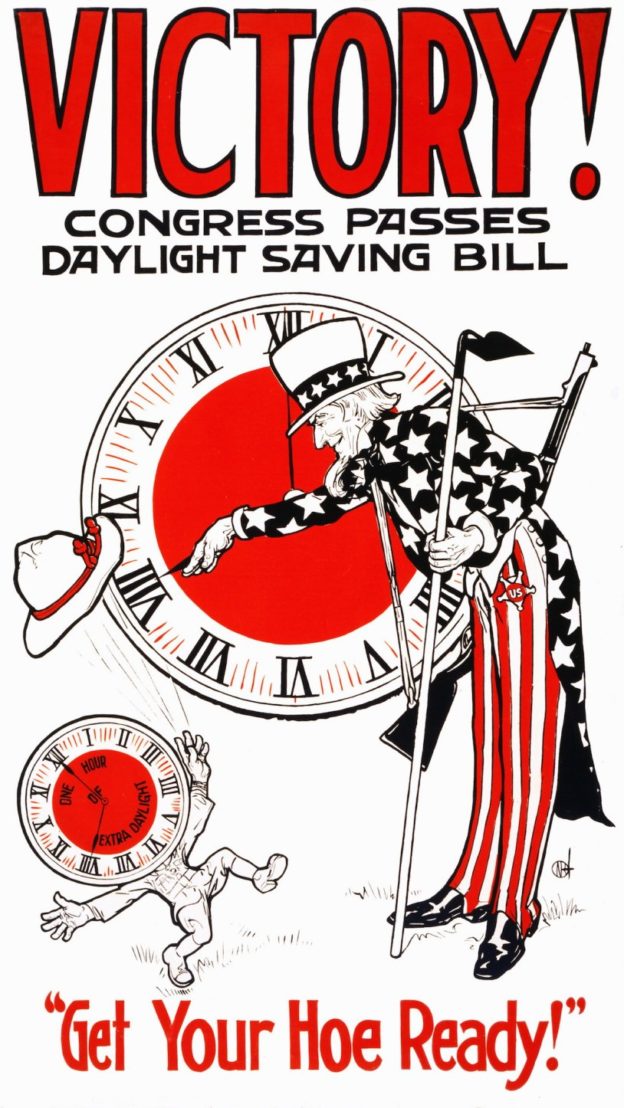
One of the few undeniable benefits of living in the digital era is not having to walk through your home, manually turning back or twisting forward by an hour all of your clocks and watches. Smartphones, computers and even DVRs automatically align with society’s circadian rhythm , as dictated by the nation’s Daylight Savings Time law.

Yes, it’s a law, signed in 1964 by Lyndon Johnson.

But we’ve been screwing with clocks long before then. Sunday morning will mark exactly the 100th time the U.S. has either sprung forward or fallen back. Indeed, we’ve been doing it for so long we’ve forgotten why we did it in the first place — or why we continue to do it.

Daylight savings was initially a wartime maneuver. Germany was the first country to implement it, calculating that the Weimer Republic would save thousands in electricity costs by maximizing daylight hours. Turns out, despite schoolyard legend, that it wasn’t because of stupid farmers.

In fact, farmers hated the change. It meant that, for half a year, they had to get up earlier to bring milk and harvested crops to market. Hollywood hated it, too, reasoning that people were less likely to go into a darkened theater while the sun was shining.

But Uncle Sam would have none of it. If Germany could figure out a military advantage using only a pocket watch, surely we could too. And it didn’t hurt that some institutions — like Major League Baseball, which had not yet invented stadium lighting — tacitly lobbied Congress to institute the shift.

Never mind the grim statistics that come as surely as a beach tide during daylight savings. The National Highway Traffic Safety Administration says that accidents spike fractionally twice a year — the weekend and first week of daylight savings — due to fatigue and drowsy driving.

clock

And there’s no evidence supporting an energy savings. When Indiana adopted the law (you can opt out as a state, though only Arizona and Hawaii have done so), electricity use actually rose 1%. Small, but with a population of 6.5 million, significant.

Still, don’t expect anything resembling change. After all, this is a Congress that still supports an electoral college, though I challenge a single lawmaker to explain why it still exists.

So for now, we’ll just have to get used to it. And, as a public service, remember to adjust your clocks at 2 a.m. Sunday. Remember, it’s the law.

Speaking of which, how about at least an amendment to the bill? Instead of messing with the time-space continuum at 2 a.m. on a Sunday, why not have spring’s leap forward at 4 p.m. Friday? And its  fall backward at 9 a.m. Monday? You know, so we can at least spend a couple hours less in a cubicle.

That would at least keep us clearer-headed on Tuesday’s election day.

Speaking of which (encore); ever wonder why our presidential elections are held on a Tuesday? Congress chose the day because voting booths were once rare and separated by hundreds of miles. Many voters had to spend Monday simply traveling to make it to the polls in time. And we’ve never modernized.

Stupid farmers.

'Daylight Savings Time claims another victim.'

‘Daylight Savings Time claims another victim.’


Send out the Clowns


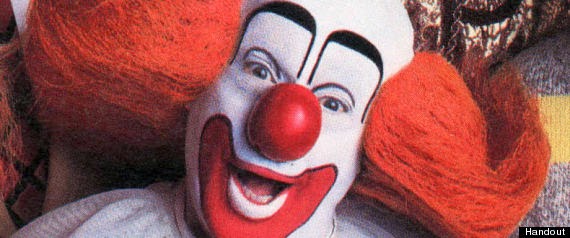
I’ve never really had an issue with clowns.

Krusty is one of my favorite Simpsons characters.

The Joker is my favorite villain from the realm of superheroes (I even have a Halloween mask from The Dark Knight). knight-clown

As a boy, I was one of Bozo‘s faithful TV servants (along with Bozo’s magician sidekick, Marshall Brodien, whose products I would consume like a meth addict). I once wrote the show requesting tickets, only to be told there was a two-year waiting list.

marshall

I couldn’t wait two years. I had to go to college.

But I knew clown aversion was real. My ex brother-in-law was so creeped out by them he would visibly shiver if you brought up the issue.

Still, I had no idea how pervasive it was until I began reading about the “creepy clown” craze sweeping the nation. Apparently, dressing up like a clown and trying to freak out children (and the childlike) has become a thing.

According to the New York Times, more than a dozen people have been arrested for clowning. Children in Ohio and Texas have been charged with making clown-related threats to school classmates. A New York City teen told police a clown threatened him with a knife in the subway. In Wisconsin, a couple was arrested after police discovered they’d left their 4-year-old child home alone while they went clowning. A Seattle-area high school was shut down after  some students reported seeing costumed figures in the woods.

But the prize goes to Mississippi, which reacted as if evolution were being taught in its classrooms. Supervisors in Kemper County passed a bill that bans people from wearing any clown costume, mask or makeup in public. The local law carries a $150 penalty, and it will be lifted Nov. 1.

You know, after Satan’s favorite holiday.

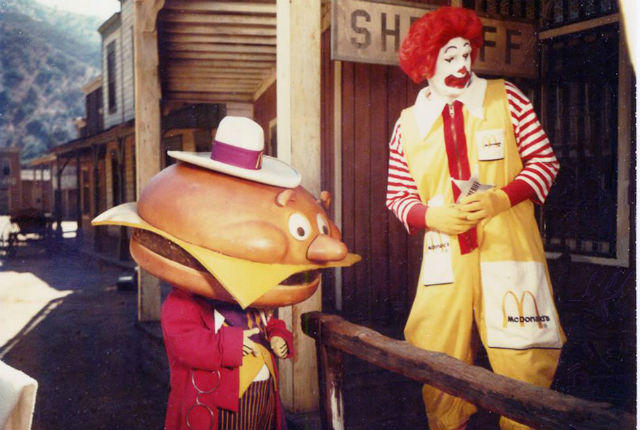
Which raises a few questions. What is the criminal charge for circus wear? Do they have to wear said getup in a police lineup? Does Ronald McDonald have to turn himself in to Mayor McCheese?ronald-and-mayor

If you fear being a victim of clownism, there’s reason for hope. Halloween is just around the corner, and the shelf life of fads in the social media time-space continuum can be measured with a stopwatch, not a calendar.

Unless, of course, we find lurking in our woods the most frightening of the orange-haired menaces.

trump-clown