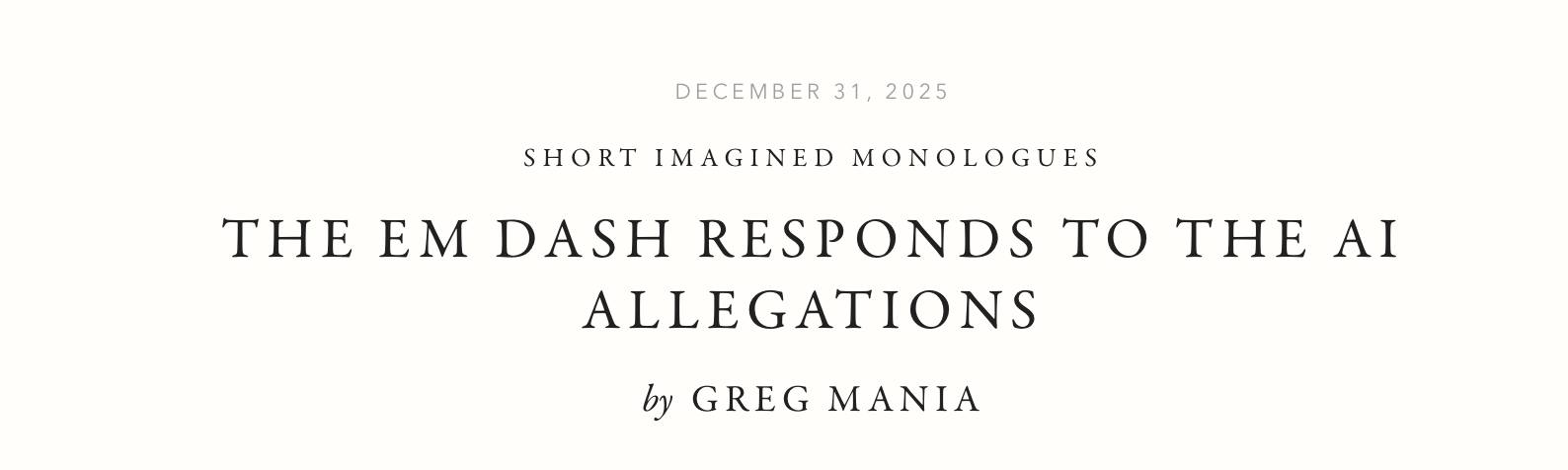
Boca Suno I would like to address the recent slander circulating on social media, in editorial Slack channels, and in the margins of otherwise decent Substack newsletters. Specifically, the baseless, libelous accusation that my usage is a telltale sign of artificial intelligence.
Listen here, my good bitch.
Writers have been using me long before the advent of AI. I am the punctuation equivalent of a cardigan—beloved by MFA grads, used by editors when it’s actually cold, and worn year-round by screenwriters. I am not new here. I am not novel. I’m the cigarette you keep saying you’ll quit.
You think I showed up with ChatGPT? Mary Shelley used me… gratuitously. Dickinson? Obsessed. David Foster Wallace built a temple of footnotes in my name. I am not some sleek, futuristic glyph. I am the battered, coffee-stained backbone of writerly panic—the gasping pause where a thought should have ended but simply could not.
Let’s be honest: The real issue isn’t me—it’s you. You simply don’t read enough. If you did, you’d know I’ve been here for centuries. I’m in Austen. I’m in Baldwin. I’ve appeared in Pulitzer-winning prose, viral op-eds, and the final paragraphs of breakup emails that needed “a little more punch.” I am wielded by novelists, bloggers, essayists, and that one friend who types exclusively in lowercase but still demands emotional range.
If anything, AI uses me as often as any kind of sentence-obsessive who’s ever stared at a line like it owed them rent. In fact, go to your nearest café and look to your left, then to your right. A hundred percent of those people are slathering me across sentences like adding more cheese to a risotto that’s already drowning in parmesan—without tasting, without thinking, without remorse.
And yet, when a think piece packed with me goes live, somehow, I’m the problem—never the flagrant lack of fact-checking.
Just because I’m not on the keyboard—and you have to add two extra steps for me to appear correctly—I’m suddenly the product of some soulless technology? Please. AI has no deadlines. No ego. No sleep-deprived human brain stockpiling forty of me in a draft, just for an editor to cut twenty.
I am the punctuation mark of human frailty.
I am the writer’s block, resolved mid-sentence.
I am the OG vibe shift.
So next time you read something and think, “AI wrote this—it has a lot of em dashes,” ask yourself: Is it AI? Or is it just a poet trying to give you vertigo in four lines or fewer?
Exactly.
Signed,
—The Em Dash
P.S. You’re probably thinking of the en dash. That whore has always been suspicious.