
where do i buy disulfiram
One reason that Fargo the TV series is not more popular is because people think that it’s the small-screen version of Fargo the movie.
The error is understandable. Television has made a cottage industry out of taking films and stretching them into longer (more profitable) home entertainment. Think Snowpiercer, Watchmen, Friday Night Lights. Movies, but with commercials.
Fargo is not a movie with commercials. Fargo is a Coen Brothers trivia game with commercials. No Country for Old Men, The Big Lebowski, Miller’s Crossing and just about every movie Joel and Ethan Coen ever made are referenced in the series, which has spanned four seasons (so far), a half-century of ”true” crime stories and one zealous Coen Bros. fanboy, show runner Noah Hawley. If you play a Coens-reference drinking game, you are hospital-drunk by the half hour mark of any episode.
Hawley pays homage to the Coens the way Paul Thomas Anderson kneels at the altar of Stanley Kubrick: with an awe, reverence and an attention to the master’s style that cannot help but mimic brilliance, thus producing its own.
And nowhere is that more evident than in the second season, in 2015, perhaps the greatest 10-part crime story ever told. Which makes sense, since it’s a sly take on the greatest one-part crime story ever told: The Book of Job.
The Coens (who serve as executive producers) and Hawley have never said as much, and the season’s symbolism — particularly the neon blue UFO that plays such a critical role — is debated even now.
But the Coen Brothers have made careers out of religious parables, and Hawley has likewise chocked the series with biblical references. And season two is Sunday school with action sequences.
Consider these divine parallels with the bible and Fargo’s 1979 ”true crime” story about a couple that stumbles into a massacre at a Minnesota diner (spoilers abound):
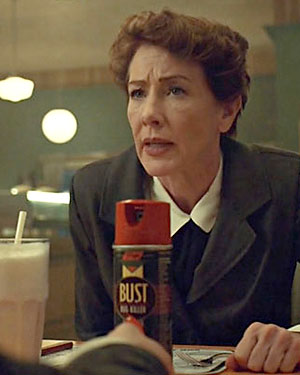
- The series begins when the target of the killing (Joan Cusack) tells a cautionary tale about Job’s plight to her murderer.
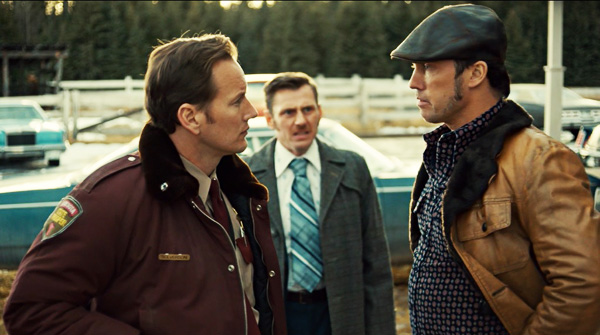
- The hero, Trooper Lou Solverson (Patrick Wilson) is a man of unwavering virtue seemingly cursed by evil. Criminals menace him, cowards undercut him, his wife has cancer and his entire family faces existential uncertainty.
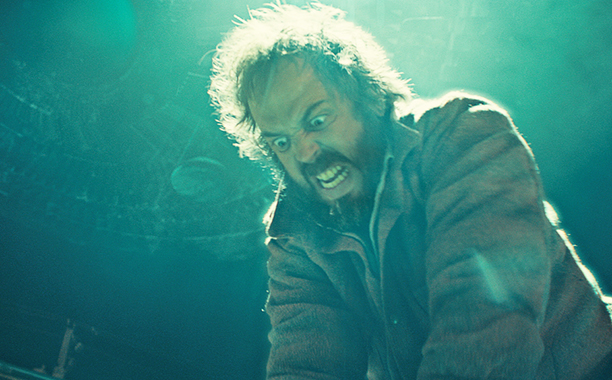
- The villain, O’Hanzee Dent (Zahn McClarnon), pursues our hapless couple with a devilish determination — with flames as his licking backdrop.

- The series ends with a cryptic conversation between the Devil (Hanzee) and an unnamed character known only as ”The Book.” The Book explains that the outcome of the ordeal was never in doubt. Is that you, God?

The story of Job seems tailor-made for the Coens, because no one has ever known quite what to make of Job.
The title character of the Book of Job is a confounding figure for Christians, Muslims, Jews, and those of any faith who have tried to incorporate the story over millennia. The tale goes like this: Job is a perfectly righteous and God-fearing man whose good deeds have brought him prosperity—children, an estate, good health. But then God enters a wager with Satan, who claims he can make even goodly Job curse the deity. Soon, Job’s servants are killed. His children are killed. He is afflicted with painful boil. His life is a waking nightmare. But he refuses to curse God for what has befallen him. When he is at death’s door, God mysteriously spares him.
Similarly, Solverson refuses to surrender his belief in the good of people or the rule of law. He, too, is brought to death’s door until a mysterious savior: the Close Encounters-style UFO. In a literal Deus Ex Machina, the orb distracts a killer, allowing the hero to shoot himself out of an impossible pickle.
Much has been made of the UFO, its message, and Fargo’s larger statement about humankind’s treatment of each other.

But, like Barton Fink, Blood Simple and No Country, bafflements may be the point. The Coens love bafflements. Apparently, so does Hawley.
And, for the record, this is not a true story. Just a timeless one.