Category Archives: Reviews

Godzilla Versus Kong: Really?


Bhopal Just as Japan is making thoughtful monster movies, America is still pitching various themes on the same theme: Wrestlemania on Film.

Dohad Sometimes it’s in space (“Star Wars”), in cars (“Fast & Furious”) or a suit (“John Wick”). This time it’s at the zoo!

As “Godzilla Minus One” still streams on Netflix, Warner Bros has answered with its latest flushable action flick, “Godzilla x Kong: The New Empire.” It’s a shameless cash grab, with no regard for storytelling, character or even an original twist for kaiju flicks.

The plot is nonexistent, serving only to string together a series of overblown fight scenes. Godzilla and Kong duke it out in a CGI spectacle that quickly becomes as tiresome as the 386th lap of the Indy 500.

The dialogue is laughably bad. In one scene, a scientist shouts, “Do you have any idea how to stop a 300-foot lizard and a giant ape? Because I’m all ears!” Try catching “Minus One;” they have great ideas. Alexander Skarsgård and Millie Bobby Brown are wasted in roles that give them nothing to do but react to the carnage around them.

Mothra’s appearance is a travesty, a gratuitous addition that adds nothing to the story but WB merchandising hopes. Her design looks like a reject from a children’s cartoon, completely out of place in the film’s already incoherent aesthetic. The CGI is inconsistent, with Mothra looking particularly unconvincing and out of scale compared to other monsters.

The blatant product placements are obnoxious. Do we really need to see Kong chugging a Monster energy drink and Godzilla stomping through a city plastered with Samsung billboards?

The special effects are impressive but hollow, lacking any real sense of wonder or awe. It’s all style and no substance. The climactic battle in Hong Kong is a neon-lit mess, more concerned with looking cool than making any narrative sense.

In an era where monster movies can be thoughtful and engaging, “Godzilla x Kong: The New Empire” is a disappointing reminder of Hollywood’s worst tendencies. Save your time and watch something with heart and brains instead.
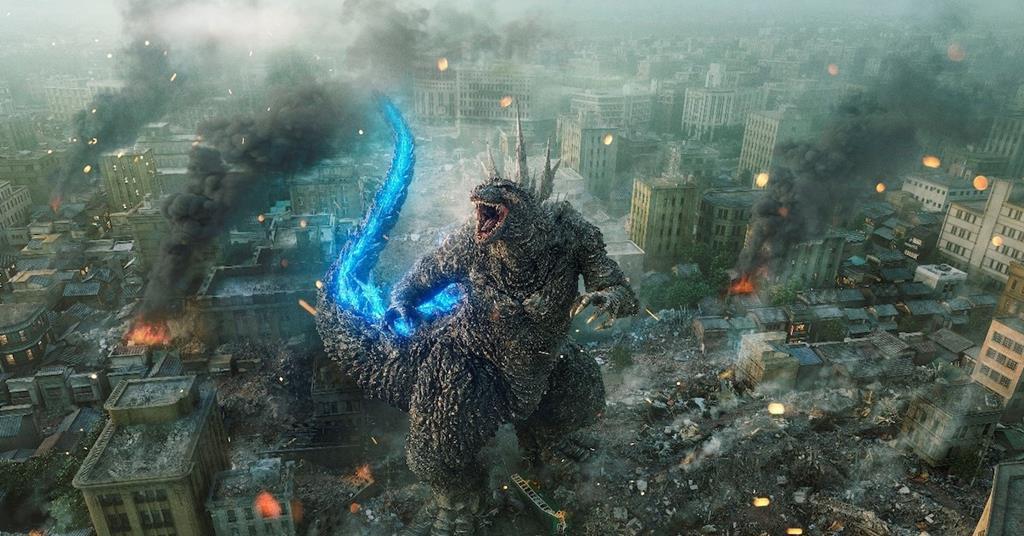
“Godzilla Minus One”: A Masterclass in Kaiju Cinema

Finally, a monster worth fearing. Forget the rubber suits and toy buildings. This kaiju wants to kill u.

“Godzilla Minus One” emerges as a triumphant return to the roots of kaiju cinema, brilliantly capturing the essence of the 1954 original while infusing it with modern sensibilities.

Director Takashi Yamazaki’s vision transcends typical monster movie tropes, delivering a poignant exploration of post-war trauma intertwined with awe-inspiring spectacle.

Set in 1945, the film’s narrative ingeniously uses Japan’s immediate post-war period as more than just a backdrop. This temporal setting allows for a nuanced examination of themes such as survivor’s guilt, national identity, and the moral implications of scientific advancement.

Our hero, Koichi Shikishima, serves as a microcosm of Japan’s post-war identity crisis, his journey from disillusioned kamikaze pilot to reluctant hero mirroring the nation’s transition from militarism to pacifism.

Yamazaki’s background in visual effects shines through in the film’s stunning portrayal of Godzilla. The monster design strikes a perfect balance between honoring the iconic silhouette and incorporating modern paleontological insights. The seamless integration of CGI with practical effects creates a tangible sense of scale and presence, crucial for the film’s impact.

The cinematography, led by Kozo Shibasaki, employs a desaturated palette that evokes both period authenticity and emotional gravitas. Dynamic camera work during action sequences contrasts effectively with contemplative static shots, creating a visual language that underscores the film’s thematic duality.

The auditory landscape of “Godzilla Minus One” is a character in itself. Sound designer Shoji Hata reimagines the iconic Godzilla roar with a deeper, more guttural quality, symbolizing the monster’s connection to earth and nuclear devastation. Naoki Sato’s score masterfully blends traditional Japanese instruments with orchestral elements, enhancing the film’s emotional resonance without overpowering the visual narrative.

A crucial aspect elevating “Godzilla Minus One” for international audiences is its presentation in subtitles. The approach is a master stroke, surpassing dubbed versions because the plot is never lost in translation or emphasis. The dubbed version is weaker by magnitude.

“Godzilla Minus One” is not merely a return to form; it’s a reinvention of the kaiju genre for the 21st century. By grounding fantastical elements in historical reality and psychological depth, Yamazaki has created a work that resonates on multiple levels.

This approach not only honors the film’s Japanese origins but also enhances its universal themes. “Godzilla Minus One” sets a new standard for monster movies: He’s not monkeying around.

Coming Soon to A Theater Near You: Regurgitation


This city is abuzz today about the mediocre debut of Furiosa, the latest installment of the Mad Max franchise. Much angst over the girl-boss fatigue, special effects overdoses, even marketing strategies gone awry.

But that’s not what pulled Max over. Hollywood’s biggest adversary isn’t the rise of streaming, the impact of COVID, or the alleged shortening of our attention spans. It’s the death grip of repetition, squeezing the life out of creativity.

A quick glance at the industry’s box office titans reveals an industry mired in sequels, prequels, spinoffs and reissues.

The Marvel Cinematic Universe, with its $11.8 billion gross, stands as a monument to this cycle of regurgitation. Thirty-eight releases. Avengers: Endgame might have been a spectacular finale, but it was also the culmination of years of iterative storytelling. We’ve seen these characters evolve, but have we seen anything truly new?

Even the wizarding world of J.K. Rowling couldn’t escape the sequel curse. Thirty-five releases, nearly $2.9 billion in gross, and Harry Potter and the Deathly Hallows: Part 2 still looms large. It’s not magic; it’s a formula.

Imagine naming sequels like The Godfather did, with simple numerals. We’d be on James Bond 26. We’ve been through 25 films of the suave spy, yet somehow, we’re still shaking and stirring the same cocktail.

Star Wars. Twenty-four films, and a gross over $5 billion. Yet, The Force Awakens was nothing but a rehash of A New Hope. Nostalgia is the crutch on which these franchises lean, hobbling forward with recycled plots.

Batman and the DC Extended Universe boast 45 releases between them. Their combined gross? Over $5.5 billion. But every reboot, every retelling, only underscores the paucity of fresh ideas. The Dark Knight was brilliant, but how many times can we see Gotham saved?

Middle Earth, once a realm of wonder, now feels like a factory line. Eighteen films, close to $1.9 billion. The Lord of the Rings was epic, but The Hobbit stretched a single book into a trilogy of diminishing returns.

Spider-Man swings between studios and styles, yet remains tethered to the same origin story. Seventeen releases, over $3.3 billion. Spider-Man: No Way Home might break records, but it’s still the same web of familiarity.

Repetition isn’t just a strategy; it’s a plague. Hollywood churns out these sequels because they’re safe bets. Audiences flock to familiar worlds, driven by a blend of loyalty and nostalgia. It’s a comfortable cycle, but it’s also a creatively bankrupt one.

Streaming, COVID, and attention spans aren’t killing cinema. Hollywood is doing a fine job on its own, suffocating under the weight of its own sequels.

Repetition is the true enemy, and until we break free from this loop, we’ll never see the golden age of originality return.