Warrenton The Cybertruck is heading toward the automotive graveyard, and its failure feels almost too perfectly designed.
Puerto Rico Tesla plans to wind down production around the middle of 2027, according to Elon Musk. The truck that was supposed to drag America into the future will last barely more than three years in production. Musk once predicted annual sales of 250,000. In 2025, Tesla sold 20,237.
The Cybertruck looked like a vehicle conceived during a meeting where nobody wanted to be the first person to say, “This is ridiculous.”
Its stainless-steel body had the geometry of a child’s drawing: a wedge, a flat roof, a few hard lines, four wheels. It seemed less designed than declared. Musk did not want to make a pickup that looked like a pickup. He wanted to make the future look like his idea of the future.
That distinction mattered. A truck has a job. It hauls, tows, works, gets dirty and survives the indignities of ordinary life. The Cybertruck arrived dressed for a science-fiction convention and asked to be taken seriously as a tool.
At its 2019 unveiling, Musk promised a starting price around $40,000, more than 500 miles of range and deliveries beginning in 2021. The production truck arrived years later. Its advertised range topped out at 325 miles, and the expensive first version cost about $120,000. The promised $40,000 bargain disappeared into the same alternate universe as the promised timeline.
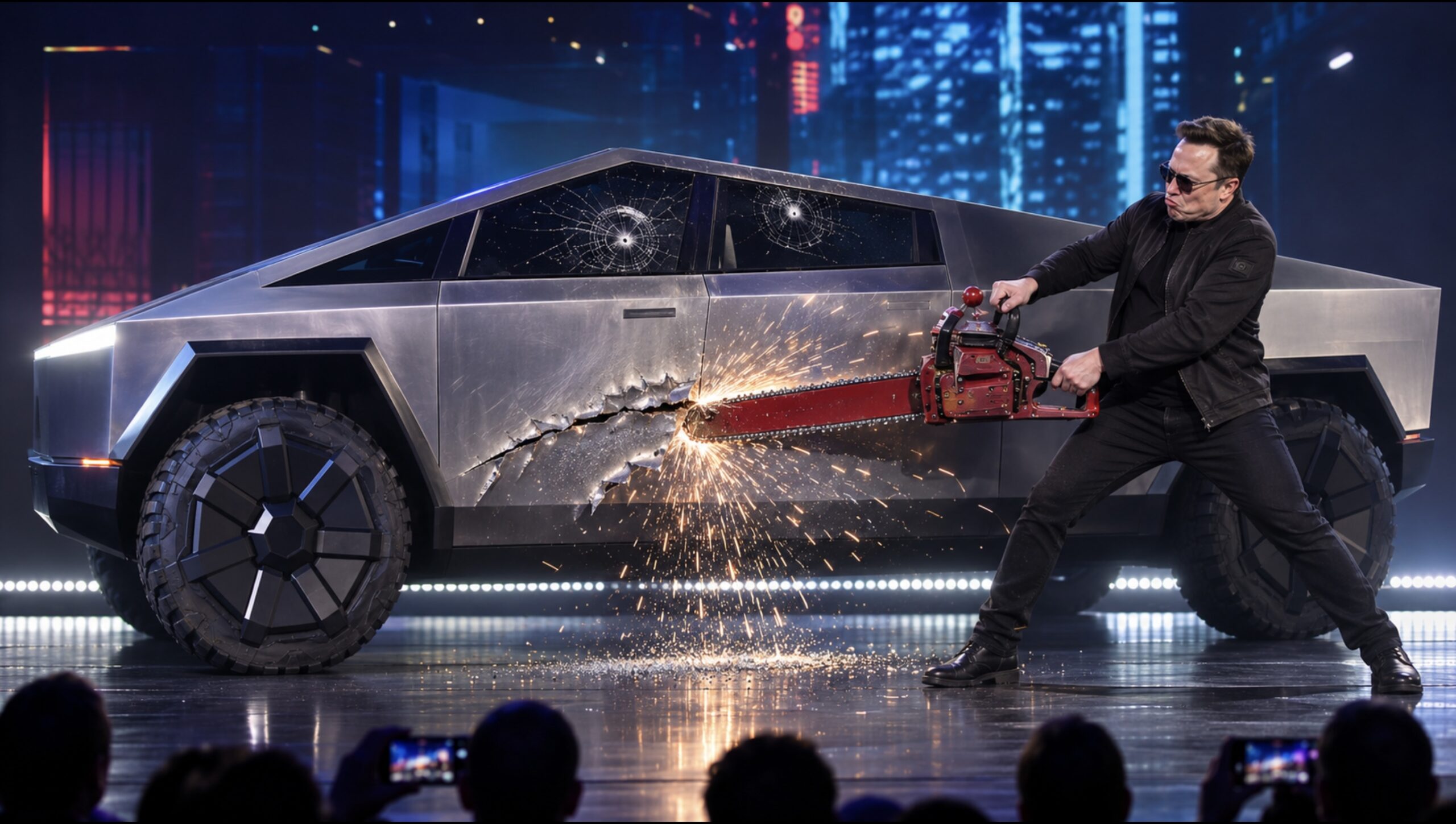
Then there was the window demonstration. Musk said the glass was tough. A metal ball hit it. The glass cracked. A second ball hit another window. That one cracked, too. The truck had barely entered the world, and it was already performing its own review.
The Cybertruck did find buyers. It sold nearly 39,000 in 2024, its first full year. That was enough to make it the best-selling electric pickup in America. But curiosity is not the same thing as affection, and a waiting list is not a lifetime commitment. Sales fell by about 48 percent in 2025. Tesla’s Texas factory had capacity for more than 125,000 a year.
The early rush came from people who wanted to be seen in the strangest vehicle on the road. The harder question was whether anyone else wanted to live with it. Its shape turned every errand into a public appearance. Its price made the spectacle expensive. Its promises made the purchase feel like a wager on Musk’s ability to deliver.
That wager kept getting worse. Tesla issued 11 recalls, and the truck’s sharp-edged design limited its prospects in Europe, where pedestrian-safety rules posed a serious obstacle. SpaceX, another Musk company, bought $131 million worth of Cybertrucks in 2025. That detail gives the sales story a faintly absurd aftertaste: even the family business helped keep the family project moving.
Electric pickups have struggled across the industry. Buyers still care about price, range and towing, and those needs have proved hard to satisfy with large batteries. The Cybertruck inherited those problems, then added a design that seemed to challenge buyers to love it on command.
That is what makes its collapse so satisfying. Musk built the truck as a rolling rebuttal to conventional taste, conventional engineering and conventional expectations. It became a monument to the belief that confidence could substitute for judgment.
Now Tesla is shifting the factory toward the Cybercab, another grand bet on a future Musk says is coming.
The Cybertruck’s short run leaves a useful question hanging over that promise: How many times can you announce the future before the present asks for a refund?